

Imagine walking into a large, bustling market in Douala or Yaoundé for the first time. Without any signs to guide you, finding the specific stall you are looking for would be confusing and frustrating. You might wander around for a bit, but chances are you would quickly give up and leave. Many Cameroonian business websites feel exactly like this to new visitors. They are full of great products and information, but they lack the clear signposts that help users find their way around. This is where breadcrumb navigation comes in.

Named after the fairytale of Hansel and Gretel, who left a trail of breadcrumbs to find their way home, breadcrumb navigation is a secondary navigation system that shows a user their current location on a website. It’s a simple text path, usually located at the top of a page, that looks something like this: Home > Services > Web Design. Each step in that path is clickable, allowing the user to easily go back to a previous section.
In a rapidly growing digital landscape like Cameroon’s, where more businesses are coming online every day, creating a seamless user experience is what will set you apart. You cannot afford to have potential customers get lost or frustrated on your site. This guide will explore the powerful, multifaceted benefits of implementing breadcrumb navigation, from making your visitors happier to making your website more visible on Google.
1. Drastically Improving the User Experience (UX)

The primary and most important benefit of breadcrumb navigation is that it makes your website significantly easier to use. A positive user experience (UX) is the foundation of a successful website. When visitors feel comfortable and in control, they are more likely to stay longer, explore more pages, and ultimately make a purchase or inquiry.
Providing Instant Orientation
Breadcrumbs act as an immediate “You Are Here” sign. The moment a user lands on a page, especially if they came directly from a Google search or a social media link, they can instantly understand where that page fits within the larger structure of your website. For a user landing on a product page for “Handmade Leather Sandals” on a Cameroonian craft e-commerce site, the breadcrumb trail Home > Women's Shoes > Sandals > Handmade Leather Sandals immediately provides context. They know they are in the sandals sub-category, which is part of the women’s shoes category. This orientation reduces confusion and makes users feel more confident navigating your site.
Encouraging Exploration and Reducing Clicks
Without breadcrumbs, a user’s primary way to go back a level is to use the browser’s “Back” button or to find the main navigation menu again. Breadcrumbs offer a much more elegant and efficient solution. In the example above, if the user decides the handmade sandals are not quite right, they can click on “Sandals” in the breadcrumb trail to see all the other sandal options, or on “Women’s Shoes” to browse different types of footwear.
This simple feature encourages users to explore your site further rather than leaving. It reduces the number of clicks required to move between related sections, which is a core principle of good UX design. By making it easy to move up the hierarchy, breadcrumb navigation keeps users engaged and helps them discover more of what you have to offer.
Reducing Bounce Rates
A “bounce” is when a user visits a single page on your site and then leaves without interacting further. High bounce rates can signal to Google that your page isn’t relevant to the user’s search, which can harm your rankings. Breadcrumbs are a powerful tool for lowering bounce rates.
When a user lands on a page that isn’t exactly what they were looking for, their first instinct is to leave. However, a breadcrumb trail provides them with immediate, relevant alternatives. Instead of bouncing back to Google, they are more likely to click on a parent category in the breadcrumb path to see if another page on your site can meet their needs. This simple click turns a potential bounce into a continued session, giving you another chance to win over that visitor.
2. A Significant Boost for Search Engine Optimization (SEO)
While breadcrumbs are designed for human users, they also provide immense value to search engine crawlers like Googlebot. Google’s primary goal is to understand your website’s structure and content so it can present the most relevant results to searchers. Breadcrumb navigation helps Google do this job much more effectively.
Helping Google Understand Your Site Structure
A well-structured website is easier for Google to crawl and index. Breadcrumbs create a clear, logical pathway that shows the relationship between your pages. They reinforce your site’s hierarchy, making it crystal clear to Googlebot how your content is organized. For example, the breadcrumb path Home > Blog > Marketing Tips > How to Use WhatsApp for Business signals to Google that “WhatsApp for Business” is a specific marketing tip, which falls under your main blog category.
This structural clarity helps Google build a better map of your site, ensuring that it can find and understand all your important pages. This is a foundational element of good technical SEO, and implementing breadcrumb navigation is a straightforward way to achieve it.
Enhancing Your Appearance in Search Results
One of the most visible SEO benefits of breadcrumbs is their ability to appear directly in Google’s search results pages (SERPs). When you have proper breadcrumb markup on your page (more on that later), Google often replaces the standard URL in the search result with your breadcrumb trail.
Instead of seeing:
www.yourbusiness.cm/cat/serv/web-design-packages
A user might see:
www.yourbusiness.cm > Services > Web Design
This provides a much cleaner, more user-friendly appearance. It gives searchers immediate context about where the page is located on your site before they even click. This can increase your click-through rate (CTR), as users are more likely to click on a result that looks well-structured and relevant. A higher CTR is a positive signal to Google, which can in turn improve your rankings.
Building a Strong Internal Linking Profile
Internal links (links from one page on your site to another) are crucial for SEO. They help distribute “link equity” or “ranking power” throughout your site and guide both users and crawlers to your most important content. Every link in a breadcrumb trail is an internal link.
Because breadcrumbs are typically present on almost every page of your site (except the homepage), they create a massive network of internal links that consistently point back to your main category and sub-category pages. This reinforces the importance of these hub pages in Google’s eyes, helping them to rank higher for more competitive keywords. This is a simple but powerful way to strengthen your site’s overall SEO authority.
3. Improving Usability on Mobile Devices

In Cameroon, the majority of internet users access the web through mobile phones. This “mobile-first” reality means that your website absolutely must be easy to use on a small screen. Breadcrumb navigation plays a vital role in mobile usability.
Screen real estate is extremely limited on a mobile device. Complex, multi-level navigation menus can be clunky and difficult to use. Breadcrumbs, on the other hand, provide a compact, horizontal navigation aid that takes up very little space. They offer a clear path for mobile users to navigate your site without having to open and close a hamburger menu repeatedly.
Think of a user browsing a large e-commerce site with hundreds of products on their phone. Tapping through nested categories in a menu is cumbersome. A simple breadcrumb trail at the top of the screen allows them to jump back one or two levels with a single tap. This small convenience makes a huge difference in the overall mobile experience, and a positive mobile experience is a critical ranking factor for Google’s mobile-first index. A well-implemented breadcrumb navigation system is a sign of a well-thought-out mobile design.
The Different Types of Breadcrumb Navigation
Not all breadcrumbs are the same. They can be structured in a few different ways, each serving a slightly different purpose. Understanding these types will help you choose the best fit for your website.
1. Hierarchy-Based (or Location-Based) Breadcrumbs
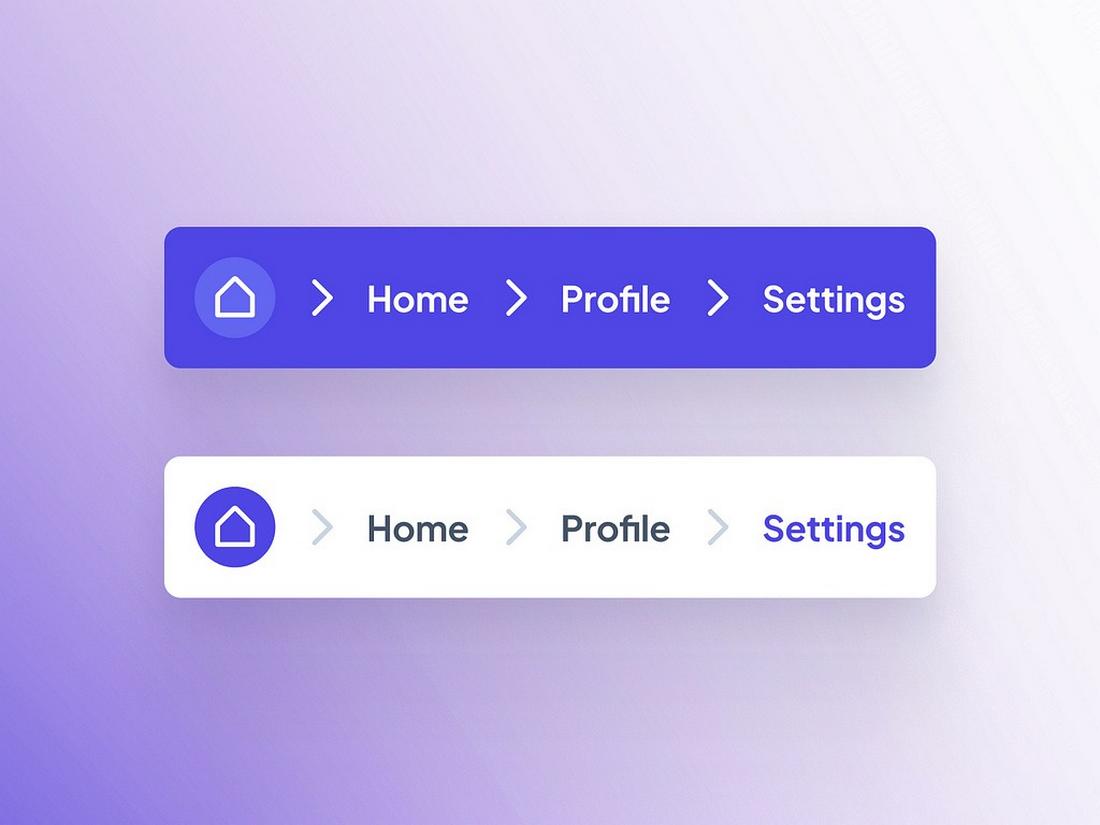
This is the most common and most recommended type of breadcrumb. It shows the user where they are within the site’s structure and how many steps it takes to get back to the homepage. The path is static and does not change based on how the user arrived at the page.
Example: Home > Products > Laptops > BrandX Model Y
This type is perfect for any website with a clear, multi-level hierarchy, such as e-commerce stores, large corporate websites, and content-heavy blogs.
2. Attribute-Based Breadcrumbs

This type of breadcrumb trail displays the attributes or filters a user has selected on a page, typically an e-commerce category page. It shows the user what choices they have made to narrow down the product listing.
Example: Home > Laptops > Screen Size: 15-inch > Processor: Intel i7
Attribute-based breadcrumbs are excellent for e-commerce sites with many product filtering options. They allow users to easily remove a filter or change an attribute without having to start their search over.
3. History-Based (or Path-Based) Breadcrumbs
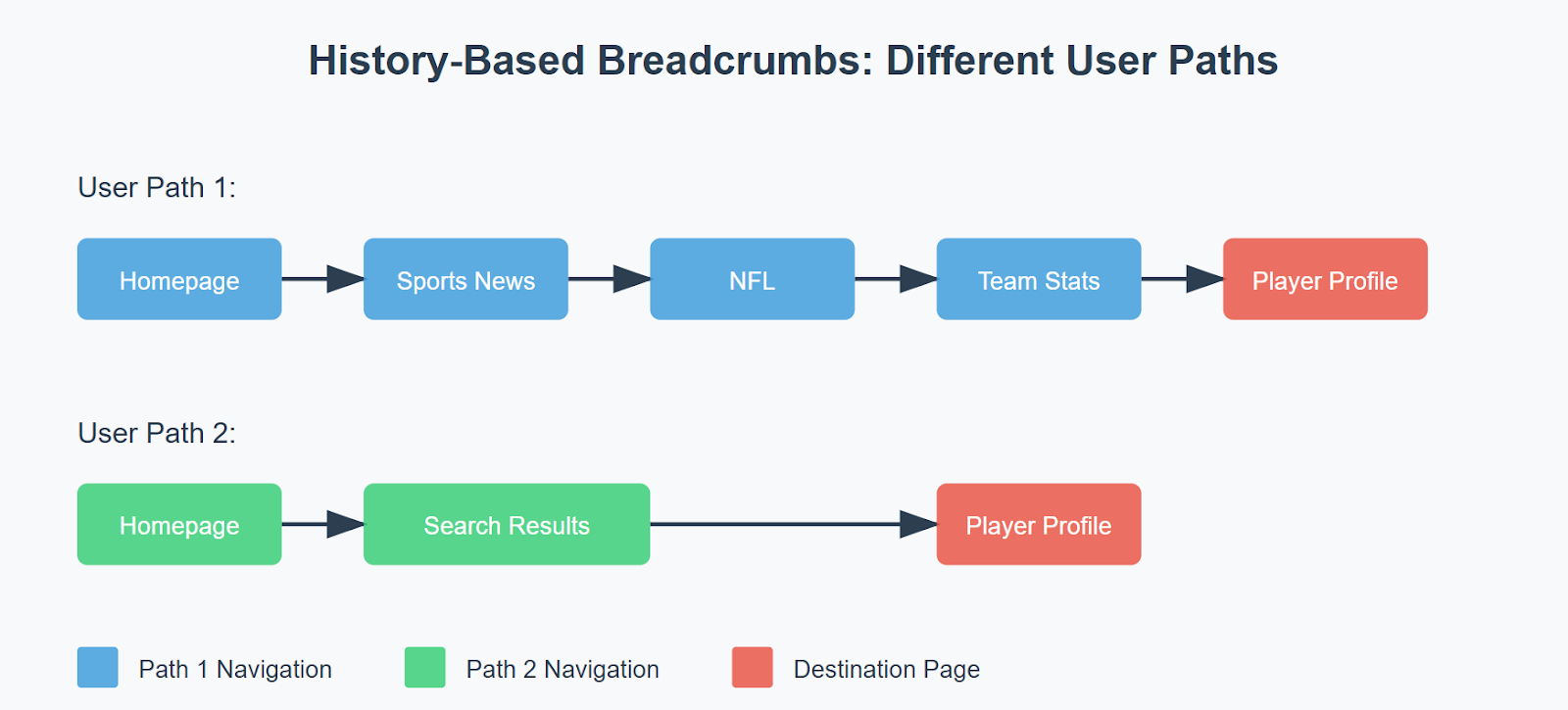
This type of breadcrumb shows the specific path a user has taken to arrive at the current page. It is dynamic and unique to each user’s journey. It essentially functions as a more organized version of the browser’s “Back” button history.
Example: Home > Last Week's Blog Post > Homepage > Current Blog Post
While it might seem useful, this is the least common and generally least recommended type of breadcrumb. It can be confusing for users and offers little SEO value, as the path is not static. For most business websites, hierarchy-based breadcrumbs are the superior choice.
How to Implement Breadcrumb Navigation on Your Website
Implementing breadcrumbs can range from very simple to moderately technical, depending on the platform your website is built on.
For WordPress Websites
If your website runs on WordPress, you are in luck. Leading SEO plugins like Yoast SEO and Rank Math have built-in functionality to add breadcrumb navigation with just a few clicks.
- Enable the Feature: In your plugin’s settings, find the “Breadcrumbs” section and enable it.
- Add the Code Snippet: The plugin will provide you with a small piece of code. You will need to add this code to your theme’s template files (usually
header.phporpage.php) in the location where you want the breadcrumbs to appear. Many modern themes also have a dedicated option in the theme customizer to enable breadcrumbs, making this step even easier. - Configure and Customize: The plugin will also offer options to customize the appearance and structure of your breadcrumb trail, such as choosing the separator (e.g., ‘>’, ‘/’, ‘→’) and deciding what to show as the first step.
For E-commerce Platforms (like Shopify)
Many e-commerce platforms like Shopify have themes that come with breadcrumb navigation built-in. If your theme supports it, you can usually enable it through your theme’s customization settings. If not, you may need to edit your theme’s Liquid code or use an app from the Shopify App Store that is designed to add breadcrumbs.
The Importance of Structured Data (Schema Markup)
To get the most SEO value out of your breadcrumbs and have them appear in Google search results, you must implement them with “structured data.” This is a special code vocabulary that helps search engines understand the content and context of your page.
The specific type of structured data for breadcrumbs is called BreadcrumbList schema. When you use a plugin like Yoast SEO, it automatically adds this necessary schema markup for you. If you are implementing breadcrumbs manually, you will need to ensure your developer includes this markup. Google provides clear documentation on how to implement breadcrumb schema. This step is what turns a simple navigational aid into a powerful SEO feature. A proper breadcrumb navigation implementation always includes this schema.
As a Cameroonian entrepreneur seeking to thrive in a competitive digital market, every advantage counts. Implementing breadcrumb navigation is a simple, low-cost improvement that delivers an outsized return on investment. It directly addresses the needs of your users by making your site easier to navigate, and it directly helps your business by boosting your SEO and reducing bounce rates.
You are putting time, effort, and money into driving traffic to your website. Do not let those potential customers get lost and leave. Give them the clear, simple signposts they need to find their way. By adding breadcrumbs, you are not just adding a line of text to your pages; you are building a more welcoming, professional, and effective online presence.
Take a look at your website today. Is it easy for a new visitor to know exactly where they are? Could they find their way back to a main category with a single click? If not, it’s time to put breadcrumb navigation to work for your business.