
How AI & Marketing Automation Maximizes Cameroon Business Budgets
Marketing budgets in Cameroon don’t come with margin for error. Whether you’re running a professional services firm in Douala, an ecommerce operation in Yaoundé, or a growing agency in Bamenda, every franc you spend on marketing needs to work. And the uncomfortable truth is that most of it doesn’t. Manual processes leak money. Inconsistent follow-up loses warm leads. Generic messaging gets ignored. Staff spend hours on repetitive tasks that a well-configured system could handle in seconds.

AI & marketing automation solves these problems directly. Not by replacing your team, but by giving them leverage. The right automation eliminates the low-value repetitive work that drains time and budget, while AI adds a layer of intelligence, personalizing messages, scoring leads, optimizing timing, and surfacing insights humans would miss. The result isn’t just “doing more with less.” It’s doing the right things consistently, at the right time, for the right people, without hiring three more staff members to make it happen.
This guide is built for Cameroon business realities: budget constraints, mobile-first audiences, WhatsApp-dominant communication, mobile money payment systems, and teams that need practical solutions, not enterprise software demos.
Here’s what you’ll get:
- A clear framework for where automation creates the most budget impact in Cameroon
- Practical strategies adapted to Cameroon’s digital environment
- Tool recommendations at price points that make sense for African businesses
- Implementation guidance that doesn’t require a dedicated tech team
Why Budget Maximization Is a Systems Problem, Not a Spending Problem
The Budget Leak Most Cameroon Businesses Don’t See
Most businesses think their marketing budget problem is size. “If we had more money, we’d get more results.” But when you trace where the current budget actually goes, you find a pattern of systemic waste that no amount of additional spending can fix.
Staff spend 2-3 hours per day manually responding to the same inquiry types. Leads from Facebook Ads sit in an inbox for 24-48 hours before anyone follows up, by which time the prospect has moved on. Ad campaigns run without conversion tracking, so there’s no way to know which campaigns generate revenue and which burn cash. Customer data lives in WhatsApp chat histories, notebooks, and spreadsheets that no one cross-references. Past customers who would happily buy again never hear from you after the first transaction.
These aren’t marketing strategy problems. They’re system problems. And AI & marketing automation is specifically designed to solve systems problems at scale.
Consider a Douala-based consulting firm that spends 300,000 FCFA monthly on Facebook Ads. Their ads generate 150 inquiries per month. But because follow-up is manual and inconsistent, only 40% get a response within 24 hours. Of those, roughly 20% convert to consultations. The conversion math: 150 leads × 40% contacted × 20% converted = 12 consultations per month.
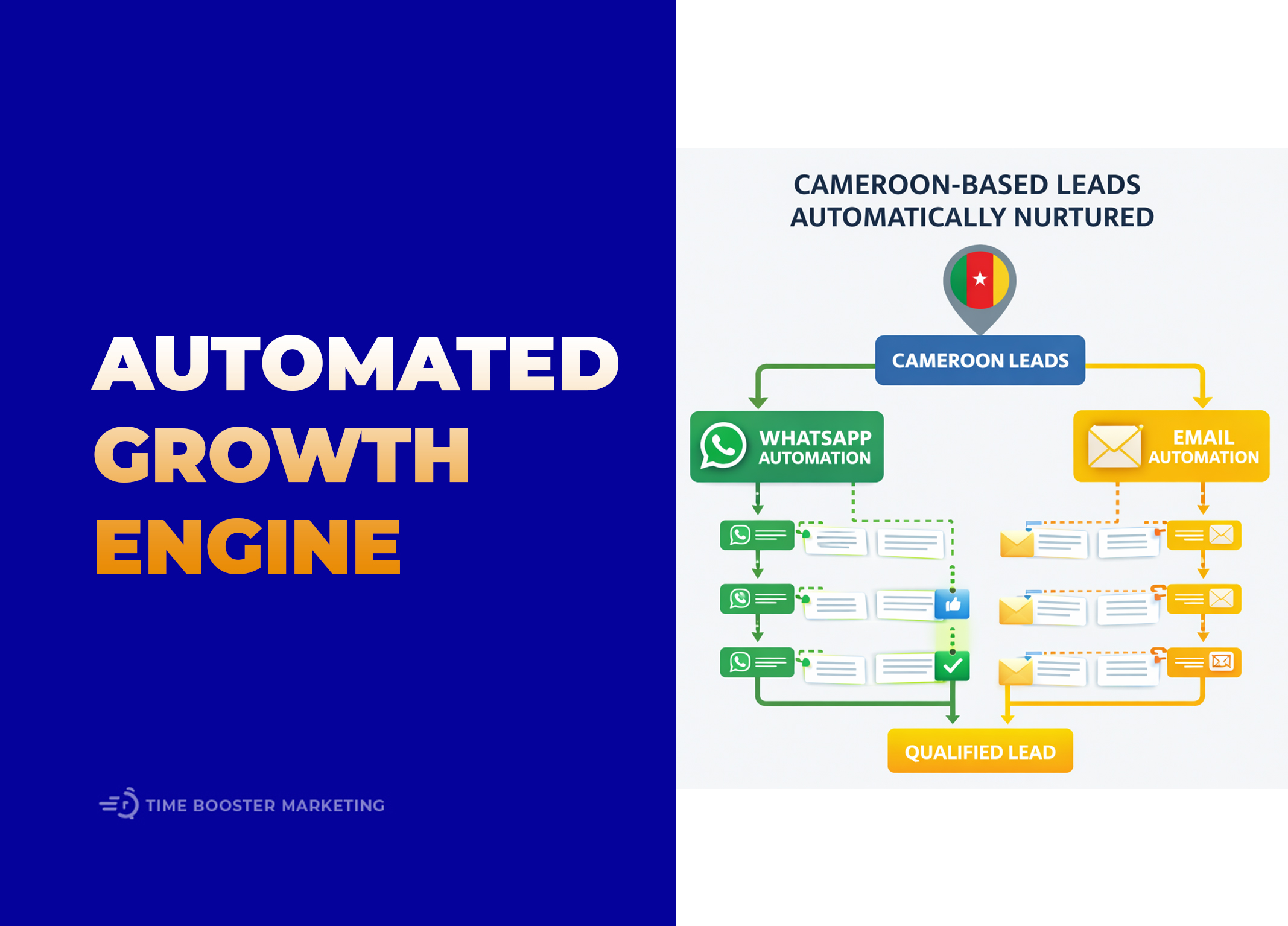
Now add basic automation: instant WhatsApp auto-reply, a 5-message nurture sequence, and a booking link. Response rate jumps to 95% within minutes. Consultation bookings increase even if the close rate stays the same: 150 × 95% × 20% = 28.5 consultations. That’s 2.4x more consultations from the same ad spend. No budget increase. Just better systems.
The Automation Advantage in Cameroon’s Market Context

Cameroon’s digital environment creates specific conditions where automation delivers outsized returns compared to more mature markets.
WhatsApp’s dominance creates an automation opportunity. WhatsApp is the primary business communication channel in Cameroon. Most businesses manage it manually—one phone, one person, inconsistent response times. WhatsApp Business API and automation tools can handle initial responses, qualify inquiries, send order updates, and trigger follow-up sequences automatically. This single automation point often produces the biggest immediate ROI for Cameroon businesses.
Mobile money integration enables automated transactions. MTN MoMo and Orange Money are standard payment methods. Automating payment reminders, receipts, and follow-up sequences tied to mobile money transactions reduces manual billing work and accelerates cash collection.
Bilingual markets require systematic content management. Serving French and English audiences means every manual message effectively doubles in effort. Automation handles language routing and template management, ensuring consistent communication in both languages without doubling staff time.
Lean teams need leverage, not more headcount. Most Cameroon SMEs operate with small marketing teams—often one or two people handling everything. Automation gives these small teams the output capacity of a much larger operation, without the payroll burden.
Where AI & Marketing Automation Creates the Most Budget Impact
Not all automation is equal. Some deliver marginal convenience. Some transform your economics. For Cameroon businesses focused on budget maximization, prioritize these high-impact areas in order.

Priority 1: Speed-to-Lead Automation (Highest Immediate ROI)
The single fastest way to improve your marketing ROI is to respond to leads faster. Research consistently shows that leads contacted within 5 minutes are 10-21x more likely to convert than those contacted after 30 minutes. In Cameroon, where most businesses respond within hours or days, automating instant response creates an enormous competitive advantage.
What to automate:
- Instant WhatsApp reply when someone fills a form or sends a message (“Thanks for reaching out! Here’s what happens next…”)
- SMS confirmation with a booking link or next step
- Email auto-response with relevant information based on the inquiry type
- Internal notification to the responsible team member via WhatsApp or Slack
- CRM record creation with source, timestamp, and inquiry details
Cameroon-specific implementation: Use WhatsApp Business API tools like WATI, Respond.io, or Twilio to automate first responses. For businesses not ready for API access, even WhatsApp Business app’s quick replies and away messages provide meaningful improvement over nothing. The key is eliminating the gap between “lead arrives” and “lead hears from you.”
Budget impact: If you currently lose 40-60% of leads to slow response, fixing this alone can double your effective return on ad spend without changing a single ad.
Priority 2: Lead Nurturing Sequences (Converting “Not Yet” Into “Yes”)
Most leads aren’t ready to buy immediately. In traditional Cameroon business marketing, these leads are effectively lost—they inquired, didn’t convert on the first interaction, and nobody followed up systematically. This represents the largest pool of wasted budget in most businesses.
What to automate:
- A 5-7 message nurture sequence delivered via WhatsApp and/or email over 2-3 weeks
- Content that addresses common objections and builds trust (testimonials, case studies, FAQs)
- Progressive calls-to-action that escalate from information to consultation to purchase
- Behavior-triggered messages (if they click a pricing link, send a comparison guide; if they open but don’t respond, send a different angle)
Cameroon-specific implementation: Keep messages conversational and brief, WhatsApp culture in Cameroon favors short, direct messages over long marketing emails. Use voice notes where appropriate (they feel personal and are popular in Cameroon’s WhatsApp culture). Include a human handoff trigger so that when a lead responds with high-intent signals, a real person takes over immediately.
Budget impact: A well-built nurture sequence typically converts 15-25% of leads who would otherwise have been lost entirely. For a business generating 100 monthly leads, that’s 15-25 additional opportunities from budget already spent.
Priority 3: Customer Retention and Repeat Revenue Automation
Acquiring a new customer costs 5-7x more than retaining an existing one. Yet most Cameroon businesses have no systematic process for staying in touch with past customers. Automation fixes this with minimal ongoing effort.
What to automate:
- Post-purchase follow-up sequence (thank you → delivery/service check-in → review request)
- Periodic value messages (tips, updates, relevant content) to stay top of mind
- Reactivation campaigns for customers who haven’t purchased in 60-90 days
- Loyalty triggers (special offers for repeat customers, referral requests)
- Birthday or anniversary messages (personal touch that costs nothing to automate)
Cameroon-specific implementation: Mobile money transaction data can trigger automated follow-up. When an MTN MoMo payment is confirmed, the system can automatically send a receipt, schedule a delivery update, and queue a satisfaction check-in for 7 days later. For service businesses, automate a “How was your experience?” message 48 hours after service delivery, followed by a Google review or referral request.
Budget impact: Increasing customer retention by just 5% can increase profits by 25-95%, according to Harvard Business Review research. Automation makes consistent retention efforts possible even for businesses with one-person marketing teams.
Priority 4: Ad Spend Optimization Through Data Feedback Loops
Most Cameroon businesses running digital ads have no feedback loop between ad spend and actual revenue. They see clicks and form submissions but cannot trace which campaigns produce paying customers versus tire-kickers. AI & marketing automation closes this loop.
What to automate:
- Conversion tracking that follows leads from click to sale (not just to form submission)
- Lead source tagging so every CRM record carries its origin campaign
- Automated reports showing cost per qualified lead (not just cost per click) by campaign
- AI-powered budget allocation recommendations based on which campaigns produce revenue
Cameroon-specific implementation: Even without sophisticated attribution tools, you can implement basic source tracking. Tag every lead with UTM parameters, capture those in your CRM, and run monthly reports comparing ad spend per channel against actual closed revenue per channel. This simple feedback loop often reveals that 70-80% of ad budget is going to campaigns that produce clicks but not customers, allowing you to reallocate to what actually works.
Budget impact: Businesses that implement proper attribution and feedback loops typically find they can reduce ad spend by 20-30% while maintaining or increasing revenue, simply by cutting wasteful campaigns they couldn’t previously identify.
Priority 5: AI-Powered Personalization on Limited Budgets
Personalization used to require expensive enterprise software. Today, AI makes it accessible to businesses of any size. Personalized messages get 2-3x higher engagement than generic ones, which means your existing audience produces more results without additional spend.
What to automate:
- Dynamic email/WhatsApp content based on customer segment (industry, purchase history, location)
- Product or service recommendations based on past behavior
- Language-appropriate messaging (French vs English) based on user preference or location
- Personalized follow-up based on which pages a lead visited or which content they engaged with
Cameroon-specific implementation: Start simple. Segment your contacts into 3-5 groups based on the most relevant differentiator (industry, location, service interest, purchase frequency). Create message templates for each segment. Use your automation tool to route contacts to the right template automatically. This basic segmentation outperforms one-size-fits-all messaging dramatically, and it takes hours to set up, not weeks.
Budget impact: Higher engagement rates from personalized messaging mean fewer wasted messages, lower unsubscribe rates, and more conversions per send—directly improving the ROI of every communication.
Practical Tool Stack for Cameroon Business Budgets
Enterprise tools with enterprise pricing don’t make sense for most Cameroon businesses. Here’s a practical stack organized by budget level.
Starter (under 50,000 FCFA/month):
WhatsApp Business App (free) handles basic quick replies and catalogs. Brevo (formerly Sendinblue) offers a free tier for email automation. Google Sheets + Google Forms handle basic CRM needs. Google Analytics 4 (free) provides web tracking.
Growth (50,000-200,000 FCFA/month):
WATI or Respond.io for WhatsApp API automation. Zoho CRM or HubSpot Free for contact management and basic automation. Mailchimp or Brevo paid tier for email sequences. Zapier (free tier or starter) to connect tools.
Scale (200,000-500,000 FCFA/month):
HubSpot Starter or ActiveCampaign for full marketing automation. WhatsApp Business API via Twilio for high-volume messaging. Calendly for automated booking. Hotjar or Microsoft Clarity for user behavior analysis.
The key principle: start with one tool that solves your biggest bottleneck, get it working, then add. Businesses that buy five tools simultaneously usually configure none of them properly.
Implementation Roadmap: 30 Days to Budget Impact
Week 1: Audit and Foundation
Map your current lead flow from first touch to sale. Identify where leads are lost (slow response, no follow-up, no tracking). Choose your primary automation channel (WhatsApp for most Cameroon businesses). Set up basic CRM or contact management if you don’t have one.
Week 2: Speed-to-Lead
Configure instant auto-reply on your primary lead channel. Set up lead notification to responsible team member. Create a booking link or clear next-step CTA. Test the flow end-to-end from a customer’s perspective.
Week 3: Nurture Sequence
Write a 5-message follow-up sequence for leads who don’t convert immediately. Set up automated delivery (WhatsApp, email, or both). Include at least one testimonial, one FAQ/objection handler, and one direct CTA. Build a human handoff trigger for high-intent responses.
Week 4: Measurement and Optimization
Tag all active campaigns with source tracking. Pull your first report: leads by source, response time, conversion rate by source. Identify your highest-ROI channel and your biggest leak. Plan next month’s automation priority based on data, not assumptions.
Measuring Budget Impact: The Numbers That Matter
Track these metrics monthly to quantify automation’s budget impact:
Efficiency metrics tell you whether automation is reducing waste. Cost per qualified lead (not just cost per click) should decrease. Lead response time (in minutes, not hours) should drop dramatically. Staff hours spent on repetitive tasks should decline measurably.
Effectiveness metrics tell you whether automation is improving outcomes. Lead-to-customer conversion rate should increase. Customer retention rate should climb. Revenue per lead should grow as nurturing converts previously lost prospects.
The calculation that proves ROI:
Take your monthly marketing spend (ads + tools + staff time allocated to marketing). Divide by the number of paying customers acquired. That’s your true customer acquisition cost. After 90 days of automation, recalculate. The difference is your automation ROI.
For most Cameroon businesses implementing the priorities outlined here, the first 90 days typically show a 25-40% improvement in effective customer acquisition cost, not from spending less, but from converting more of what you already spend.
Common Mistakes Cameroon Businesses Make With Automation
Automating before fixing the fundamentals. If your offer is weak, your pricing is unclear, or your website is broken, automation will just deliver disappointed prospects faster. Fix the foundation first.
Over-automating human moments. Closing a high-value B2B deal requires human conversation. Automation should get you to that conversation faster, not replace it. Use automation for the repetitive parts (first response, scheduling, reminders, follow-up) and humans for the relationship parts (consultation, negotiation, onboarding).
Setting it and forgetting it. Automation requires a monthly review. Messages go stale. Sequences need updating. New objections emerge. Treat your automation like a garden; it needs regular tending.
Collecting data without acting on it. Your CRM full of untagged contacts is just an expensive address book. The value comes from segmenting, analyzing, and acting on the data automation collects.
Future Outlook: Where AI & Marketing Automation Is Heading in Cameroon
Cameroon’s automation landscape is evolving rapidly as mobile internet penetration increases, digital payment adoption grows, and more businesses recognize the competitive advantage of systematic marketing.
Conversational AI will become more sophisticated and more accessible, enabling Cameroon businesses to offer WhatsApp-based customer experiences that feel human while operating at scale, handling inquiries in French, English, and eventually local languages with natural fluency. Voice-based AI interactions will grow as voice note culture in Cameroon’s WhatsApp ecosystem creates demand for voice-responsive automation.
Payment automation will deepen as MTN MoMo and Orange Money APIs become more accessible, enabling fully automated purchase flows from inquiry to payment to delivery confirmation without manual intervention. Businesses that build these automated payment loops now will have significant operational advantages as digital commerce adoption accelerates.
AI-powered content generation will make personalized, bilingual marketing communication feasible for small teams. A single marketer will be able to produce segmented, personalized campaigns in both French and English that previously required a full content team, democratizing sophisticated marketing for Cameroon SMEs.
Your First Step: Find Your Biggest Leak
AI & marketing automation isn’t about buying software. It’s about building systems that eliminate waste and multiply results from your existing budget. For Cameroon businesses, the opportunity is enormous because most competitors are still operating manually, which means even basic automation creates a significant competitive advantage.
Here’s your action for today:
Identify the one manual marketing task that consumes the most staff hours each week. Is it responding to WhatsApp inquiries? Following up with leads? Sending invoices? Posting on social media? Compiling reports?
That task is your starting point. Automate it first. Measure the time saved. Measure the improvement in speed or consistency. Then move to the next one.
The businesses that win in Cameroon’s digital economy won’t be the ones with the biggest budgets. They’ll be the ones with the smartest systems. AI & marketing automation is how you build those systems, one automated workflow at a time.