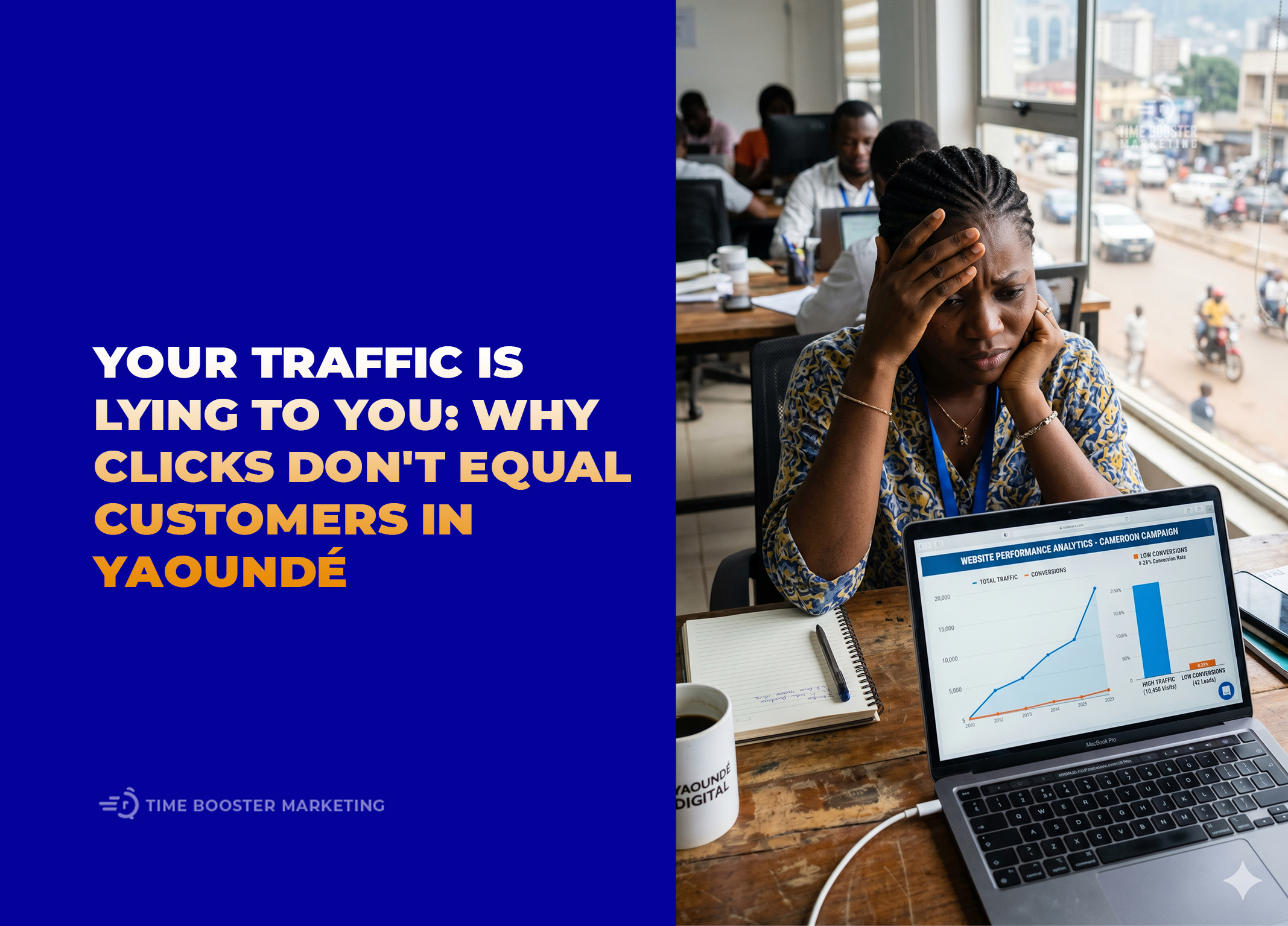
Website Traffic: Why Your Website Gets Clicks but Not Customers in Yaoundé
The first thing to understand is this: traffic is not the same as demand.
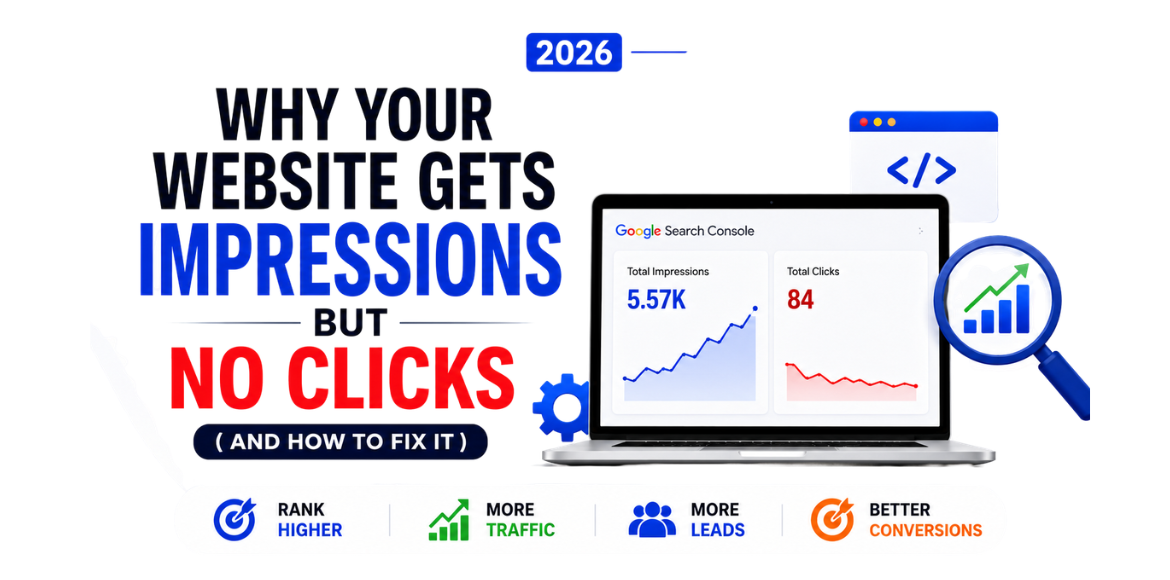
A visitor is not automatically a buyer. A page view is not a lead. A high number of clicks does not mean your website is working. It only means people are arriving.
What happens after they arrive is what determines whether your website is a business asset or just a digital brochure.
For many small businesses in Yaoundé, this is where the frustration begins. You may have invested in a website, shared the link on social media, added it to your business card, maybe even run ads or worked on SEO. The traffic numbers look encouraging. People are visiting. But your phone is not ringing enough. Your WhatsApp is quiet. Your booking form is barely used. Your quote requests are inconsistent.
That gap between clicks and customers is not random. It usually means your website has a conversion problem.
And in a market like Yaoundé, where trust, clarity, reputation, and direct communication matter deeply, conversion is not only about design. It is about whether your website helps a cautious visitor become confident enough to act.
The Vanity Metric Trap: Why Traffic Can Mislead You
Traffic is one of the easiest marketing numbers to celebrate because it is visible. You can open your analytics dashboard and see visitors, sessions, page views, impressions, and clicks.

Those numbers feel objective. They make it look like something is happening.
But traffic can become a vanity metric when you treat it as proof of business growth without asking whether it is producing real outcomes.
If 1,000 people visit your website and only two contact you, the problem is not simply that you need 2,000 visitors. The deeper question is: why did 998 people leave without taking action?
That question is uncomfortable, but it is useful.
Traffic should not be treated as the final goal. It should be treated as a diagnostic signal. It tells you that people are reaching your website. It does not tell you whether the right people are arriving, whether they understand your offer, whether they trust you, or whether your next step is easy enough to follow.
For a business in Yaoundé, this distinction matters because many customers do not buy immediately after one website visit. They may compare you with another provider. They may ask a friend. They may check your social media. They may want to confirm whether you are real, reachable, and reliable. They may prefer WhatsApp before making any commitment.
If your website does not support that decision process, traffic will leak.
Clicks Are a Symptom, Not a Solution
When a website gets traffic but no customers, many business owners assume they need more promotion.
More ads. More SEO. More social media posts. More backlinks. More campaigns.
Sometimes more traffic helps. But if your website cannot convert the traffic it already receives, sending more visitors to the same weak page only increases the size of the leak.
Think of your website like a shop in a busy area of Yaoundé. If many people walk in but almost nobody buys, you would not only ask, “How do I bring more people inside?” You would also ask:
- Are the right people entering?
- Do they understand what we sell?
- Are the prices and options clear?
- Do they trust the quality?
- Is anyone helping them make a decision?
- Is the buying process simple?
- Is something making them hesitate?
Your website needs the same level of inspection.
Clicks tell you that the door is open. Conversions tell you whether the experience inside is persuasive enough.
Warm Traffic vs Window Shoppers
Not all website visitors have the same level of intent.

Some visitors are warm traffic. They have a real problem, they are actively looking for a solution, and they may be ready to contact you if your website gives them enough confidence.
Other visitors are window shoppers. They are browsing, comparing, researching, or simply curious. They may not be ready to act now. Some may never act.
Your conversion strategy depends on knowing the difference.
What Warm Traffic Looks Like
Warm traffic usually comes from people who already have some level of need or trust.
They may arrive from a referral, a Google search with clear intent, a WhatsApp recommendation, a social media post that directly addressed their problem, or a previous interaction with your brand.
A warm visitor is likely to look for specific information:
- What exactly do you offer?
- Are you based in Yaoundé?
- Can you serve my area or situation?
- How much does it cost, or how do I request a quote?
- Can I trust you?
- What happens after I contact you?
- Is there proof that others have worked with you?
- Can I reach you easily?
If your website answers these questions clearly, warm traffic can convert.
If it does not, even serious buyers may leave.
What Window Shoppers Look Like
Window shoppers behave differently.
They may click because your headline was interesting, your ad was attractive, or your post was shared. They may browse quickly, skim one page, and leave. They may not have budget, urgency, or trust yet.
This does not mean window shoppers are useless. Some can become future customers if your website captures them properly through useful content, retargeting, newsletter signups, WhatsApp opt-ins, or social follow prompts.
But you should not judge your website only by total traffic. You need to know whether your traffic includes people with buying intent.
A website that attracts many window shoppers but fails to guide warm visitors will look busy but produce little revenue.
Why This Matters in Yaoundé
In Yaoundé, many service-based buying decisions involve trust and verification.
Whether you offer consulting, construction services, training, legal support, accounting, beauty services, healthcare-related services, event planning, real estate support, education, logistics, or professional services, your website visitor may not be ready to pay immediately.
They may need reassurance before contacting you.
This is especially true if your service is expensive, sensitive, technical, or tied to personal reputation. A visitor may want to know whether your business is legitimate, whether your team is qualified, whether your process is clear, and whether contacting you will lead to pressure or useful guidance.
That is why conversion rate optimization in Cameroon cannot simply copy generic advice like “change button color” or “add urgency.” Those details may help, but the bigger issue is often trust, clarity, and decision support.
3 Conversion Killers Hiding in Your Analytics
Your analytics can reveal why your website traffic is not converting, but only if you know what to look for.
Many business owners check total visits and stop there. That is like checking how many people entered your shop without asking what they touched, where they paused, what they asked, and why they left.
Here are three conversion killers that often hide behind decent traffic numbers.
Conversion Killer 1: You Are Attracting the Wrong Intent
High traffic with low conversions often means your website is attracting people who are not ready, able, or likely to buy.
This can happen when your content is too broad, your SEO keywords are informational but not commercial, your ads target the wrong audience, or your social media posts attract curiosity instead of qualified interest.
For example, if you run a business consulting firm in Yaoundé and your blog attracts people searching “what is entrepreneurship,” you may get traffic. But many of those visitors may be students, researchers, or early-stage dreamers with no immediate budget for consulting.
That traffic is not bad, but it should not be confused with sales-ready demand.
If you want leads, your website also needs pages targeting higher-intent searches, such as:
- Business registration support in Yaoundé
- Accounting services for small businesses in Cameroon
- Digital marketing agency in Yaoundé
- Website design for SMEs in Cameroon
- Corporate training provider Yaoundé
- Real estate agency Yaoundé
- Event planner Yaoundé
The more specific the intent, the more your page must speak to action.
What to Check in Analytics
Look at your top landing pages. Ask:
- Which pages bring the most traffic?
- Are those pages designed to convert or only inform?
- What search terms or campaigns bring visitors?
- Are visitors landing on pages that match their likely intent?
- Do high-traffic pages have clear calls to action?
- Are people spending enough time to understand the offer?
- Are they leaving after one page?
Tools like Google Analytics and Google Search Console can help you understand which pages and search queries are bringing visitors, but the strategic work is interpreting whether that traffic has business value.
If your most visited pages are educational but have no pathway to your services, you may be building attention without building leads.
Conversion Killer 2: Your Page Message Is Too Vague
The second conversion killer is weak messaging.
A visitor should understand your business within seconds. They should know what you do, who you help, where you operate, and why they should choose you.
Many websites fail because they use broad phrases that sound professional but do not create clarity.
Examples include:
- “We provide innovative solutions.”
- “Your trusted partner for excellence.”
- “Quality services for all your needs.”
- “We help businesses grow.”
- “Professional support tailored to you.”
These statements are not necessarily wrong, but they are too vague. They do not tell the visitor what you actually do or why it matters.
A stronger message is specific.
For example:
“Website design and SEO support for small businesses in Yaoundé that need more qualified inquiries, not just a prettier homepage.”
Or:
“Accounting and tax support for Cameroon SMEs that need cleaner records, fewer compliance surprises, and better financial visibility.”
Or:
“Event planning in Yaoundé for companies that need organized, professional execution without last-minute chaos.”
Specific messaging improves conversion because it reduces mental effort. The visitor does not have to decode your offer. They can immediately decide whether you are relevant.
What to Check on Your Website
Open your homepage and service page on your phone. Without scrolling, ask:
- Is it clear what we do?
- Is it clear who we serve?
- Is Yaoundé or Cameroon context visible where relevant?
- Is the main benefit specific?
- Is the next step obvious?
- Would a first-time visitor trust this page enough to contact us?
- Are we speaking like a real business or hiding behind generic language?
If your above-the-fold section does not answer these questions, you may be losing visitors before they even explore the page.
Conversion Killer 3: Your Next Step Is Unclear or Too Weak
The third conversion killer is a weak call to action.
Many websites say “Contact us” and assume that is enough.
But “Contact us” is often too vague, especially for a cautious visitor. Contact you for what? A quote? A consultation? A price list? A booking? A diagnosis? A callback? A WhatsApp conversation? A site visit?
A strong call to action tells the visitor what will happen next.
For example:
- “Request a website audit”
- “Book a 20-minute consultation”
- “Get a quote for your project”
- “Send your requirements on WhatsApp”
- “Check availability for your event date”
- “Ask for the service package list”
- “Schedule a site visit in Yaoundé”
- “Request a callback today”
These actions are clearer because they match the visitor’s decision stage.
If someone is not ready to buy, “Book now” may feel too strong. But “Request a quote” or “Ask for package details” may feel easier. If someone is ready, “Send us a WhatsApp message to confirm availability” may convert better than a long contact form.
In Cameroon’s small business environment, WhatsApp often plays a major role in conversion because it feels direct, familiar, and low-friction. If your website hides your WhatsApp button, forces people through a complicated form, or does not explain what to send, you may be creating unnecessary friction.
What to Check in Analytics
Look for pages with traffic but no clicks on your call-to-action buttons.
If people are reading but not clicking, the issue may be:
- The CTA is too generic.
- The offer is unclear.
- The page does not build enough trust.
- The button is hard to find on mobile.
- The visitor is not ready for that level of commitment.
- The form asks for too much information.
- The page does not explain what happens after submission.
A good CTA does not only ask for action. It reduces uncertainty around the action.
Other Hidden Reasons Your Website Gets Clicks but Not Customers
While intent, messaging, and CTA clarity are the three biggest issues, other factors can also reduce conversions.
Your Website Loads Too Slowly on Mobile
Many visitors in Yaoundé will access your website from a mobile phone. If your page loads slowly, they may leave before reading anything.
Slow speed is not just a technical issue. It is a revenue issue.
A beautiful website that frustrates mobile users will lose leads. Large images, unnecessary animations, heavy scripts, poor hosting, and unoptimized layouts can all damage conversion.
You can test your website with PageSpeed Insights to identify performance issues, but the practical question is simple: can a potential customer open your page quickly on a normal mobile connection and understand your offer without struggling?
Your Website Lacks Trust Signals
If your website asks people to trust you, it must show why they should.
Trust signals can include:
- Client testimonials
- Case studies
- Project photos
- Before-and-after examples
- Certifications
- Team profiles
- Office location
- Google reviews
- Clear contact information
- Business registration details where appropriate
- Media mentions
- Partner logos
- Transparent process explanations
Trust signals are especially important when your service requires payment before delivery, personal information, technical expertise, or a long-term commitment.
If your website has traffic but no inquiries, ask whether the page gives enough proof for a first-time visitor to feel safe contacting you.
Your Offer Is Not Packaged Clearly
Sometimes the problem is not the website design. It is the offer.
If visitors cannot understand what they are buying, what is included, who it is for, or how pricing works, they may leave.
This is common with service businesses. You may offer customized work, but that does not mean everything should feel unclear.
Even if you cannot list exact prices, you can explain:
- Starting price ranges
- Package types
- What affects cost
- Who each option is best for
- What the process includes
- How to request an accurate quote
- What information the customer should prepare
Clear packaging helps visitors move from curiosity to inquiry.
Your Website Does Not Match the Traffic Source
If someone clicks from an ad promising “affordable website design in Yaoundé” but lands on a generic homepage about “digital transformation,” there is a mismatch.
If someone clicks from a post about tax deadlines and lands on a general accounting page with no mention of tax support, there is a mismatch.
If someone searches for “event planner Yaoundé” and lands on a page that does not clearly show event planning services in Yaoundé, there is a mismatch.
Message match matters because visitors arrive with expectations. If your page does not continue the conversation that brought them there, they may leave quickly.
Every major traffic source should lead to a page that matches the visitor’s intent.
The 20-Minute Fix to Start This Week
You do not need a full website redesign to start improving conversions.
Start with a 20-minute homepage or landing page conversion audit.
Choose one important page — ideally the page receiving the most traffic or the page linked from your ads, social media bio, or Google Business Profile.
Then review it using this simple process.
Minute 1–5: Rewrite the First Screen for Clarity
Open the page on your phone.
Look only at what appears before scrolling.
Ask yourself: would a first-time visitor know exactly what we do, who we help, where we operate, and what action to take?
If not, rewrite your headline and subheadline.
Use this structure:
We help [specific audience] in [location] achieve [specific outcome] through [specific service].
Examples:
“We help small businesses in Yaoundé turn their websites into lead-generation tools through SEO, conversion copywriting, and landing page optimization.”
“We provide reliable accounting support for SMEs in Yaoundé that need organized records, tax clarity, and better financial control.”
“We design professional websites for Cameroon businesses that need more inquiries, clearer messaging, and stronger online credibility.”
This one change can improve conversion because it immediately tells the right visitor, “This is for you.”
Minute 6–10: Replace the Generic CTA
Find your main button.
If it says “Contact Us,” consider replacing it with a more specific action.
Use a CTA that matches the customer’s likely next step.
Examples:
- “Request a free website review”
- “Send your project details on WhatsApp”
- “Get a quote for your website”
- “Book a 20-minute consultation”
- “Ask for our service packages”
- “Check availability this week”
Then add a short line below the button explaining what happens next.
Example:
“Send your website link and we will review the biggest conversion issue before recommending next steps.”
This reduces uncertainty and makes the action feel safer.
Minute 11–15: Add One Trust Block
Add one trust-building section near the top of the page.
This does not need to be complicated.
You can add:
- One strong testimonial
- Three client logos
- A short case example
- A before-and-after result
- A photo of your team or workspace
- A short explanation of your process
- A “why clients choose us” section
- A Google review screenshot, if appropriate and permission-safe
The goal is to answer the visitor’s silent question: “Can I trust this business?”
If you do not yet have testimonials, use process proof. Explain how you work, how you communicate, how you protect the customer’s time, and how you ensure quality.
Minute 16–20: Make WhatsApp or Contact Frictionless
Finally, test your contact path.
Click your WhatsApp button, form, phone number, or booking link as if you were a customer.
Ask:
- Does it work on mobile?
- Is the button easy to find?
- Does the WhatsApp message pre-fill with useful text?
- Does the form ask only for necessary information?
- Is the phone number clickable?
- Does the page explain response time?
- Does the customer know what to send?
A strong WhatsApp pre-filled message can increase action because it removes effort.
Example:
“Hello, I found your website and would like help with [service]. My business is in Yaoundé, and I want to know the next step.”
This makes it easier for the visitor to start the conversation.
What to Measure After the Fix
After making these changes, do not only watch traffic.
Track conversion actions.
Depending on your business, that may include:
- WhatsApp button clicks
- Phone calls
- Contact form submissions
- Quote requests
- Consultation bookings
- Email inquiries
- Downloaded price lists
- Clicks from service pages to contact page
- Returning visitors
- Time on key pages
You do not need a complex dashboard at first. Even a simple weekly record can help.
Track:
- Website visits
- Number of inquiries
- Inquiry source
- Number of qualified leads
- Number of customers
- Most common questions asked before buying
This helps you understand whether your website is attracting attention, creating trust, and moving people toward action.
When More Traffic Is Actually the Right Move
More traffic is useful when your website already converts reasonably well.
If visitors understand your offer, trust your business, click your CTA, and contact you at a healthy rate, then increasing traffic can multiply results.
But if your website has weak messaging, unclear CTAs, no trust signals, and poor mobile experience, more traffic will mostly create more missed opportunities.
The right order is:
- Clarify the offer.
- Improve trust.
- Reduce friction.
- Track conversion actions.
- Then increase traffic.
This order protects your budget. It ensures that when you invest in SEO, ads, content, or social media promotion, your website is ready to turn attention into leads.
Final Thoughts
If your website gets clicks but not customers in Yaoundé, do not assume traffic is the victory. Traffic is only the beginning of the conversation.
The real question is what your website does with that attention.
Does it attract the right people? Does it explain your value clearly? Does it build enough trust? Does it guide visitors toward a specific next step? Does it make contacting you easy on mobile? Does it support the way customers in Yaoundé actually make decisions?
When you answer those questions honestly, you stop chasing vanity metrics and start building a website that works like a sales asset.
You do not need to fix everything this week. Start with one page, one clearer headline, one stronger CTA, one trust block, and one easier contact path.
That small 20-minute improvement can reveal the bigger truth: your website may not need more clicks first. It may need a better reason for the right visitors to become customers.