Why Traffic, Leads, and Sales Are Not the Same Thing in Bamenda
Many Bamenda businesses are not failing because nobody sees them.
They are failing because they misunderstand what “being seen” means.
You may post on Facebook and get thousands of views. You may upload a flyer on WhatsApp Status and see hundreds of viewers. You may boost a post and get reactions. But after all that attention, only a few people ask for the price, and even fewer actually pay.
That does not always mean digital marketing failed.
It may mean your funnel is leaking.
![Marketing Funnel Automation Secrets [THE ULTIMATE GUIDE]](https://marketmegood.com/blog/wp-content/uploads/2017/09/ezgif.com-crop-1.gif "Why Traffic, Leads, and Sales Are Not the Same Thing in Digital Marketing 1")
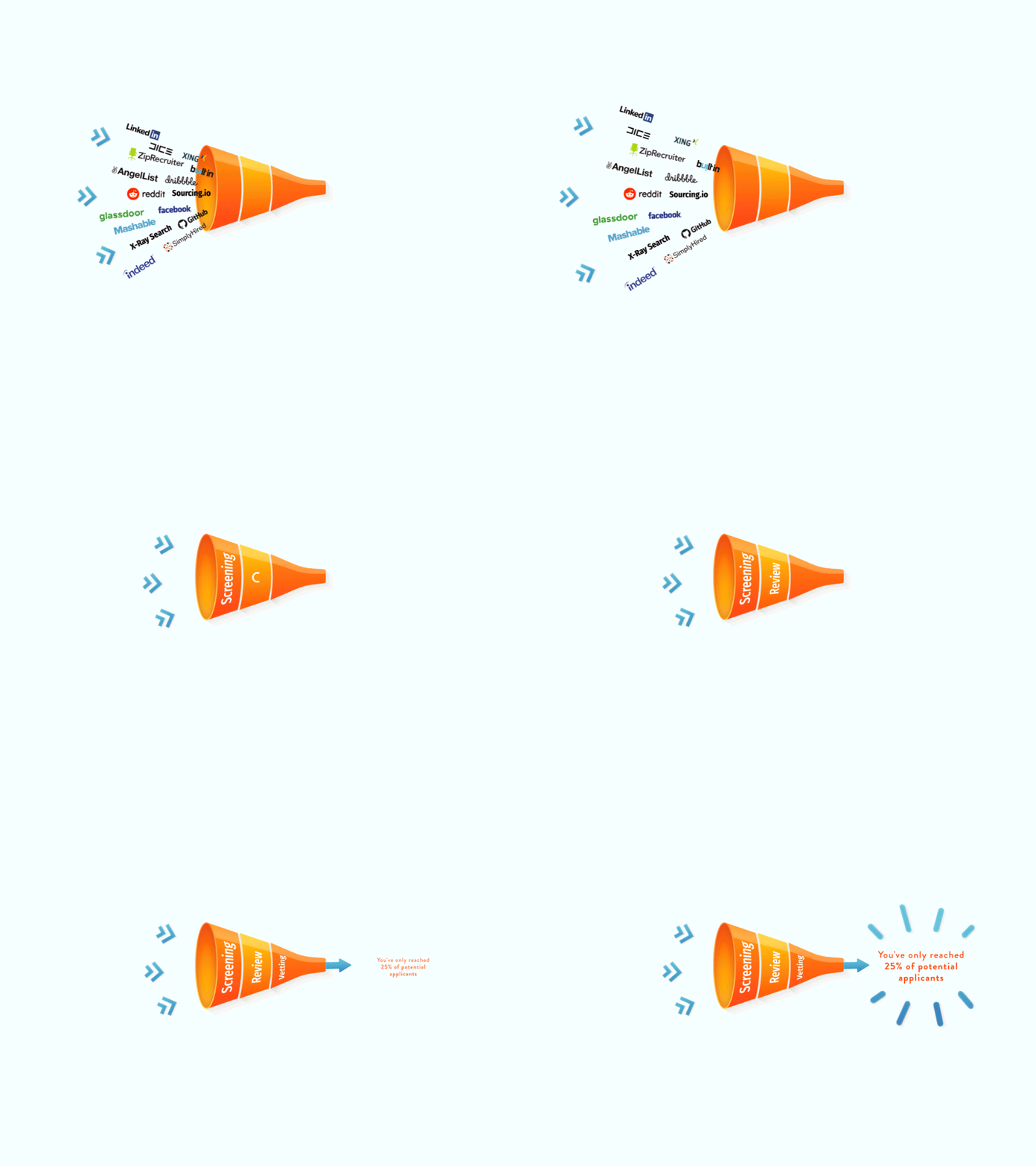
A sales funnel is the journey a prospect takes from awareness to purchase, with each stage helping a business understand where people are progressing or dropping off. Salesforce describes it as the path from first awareness of a product or service to purchase. (Salesforce)
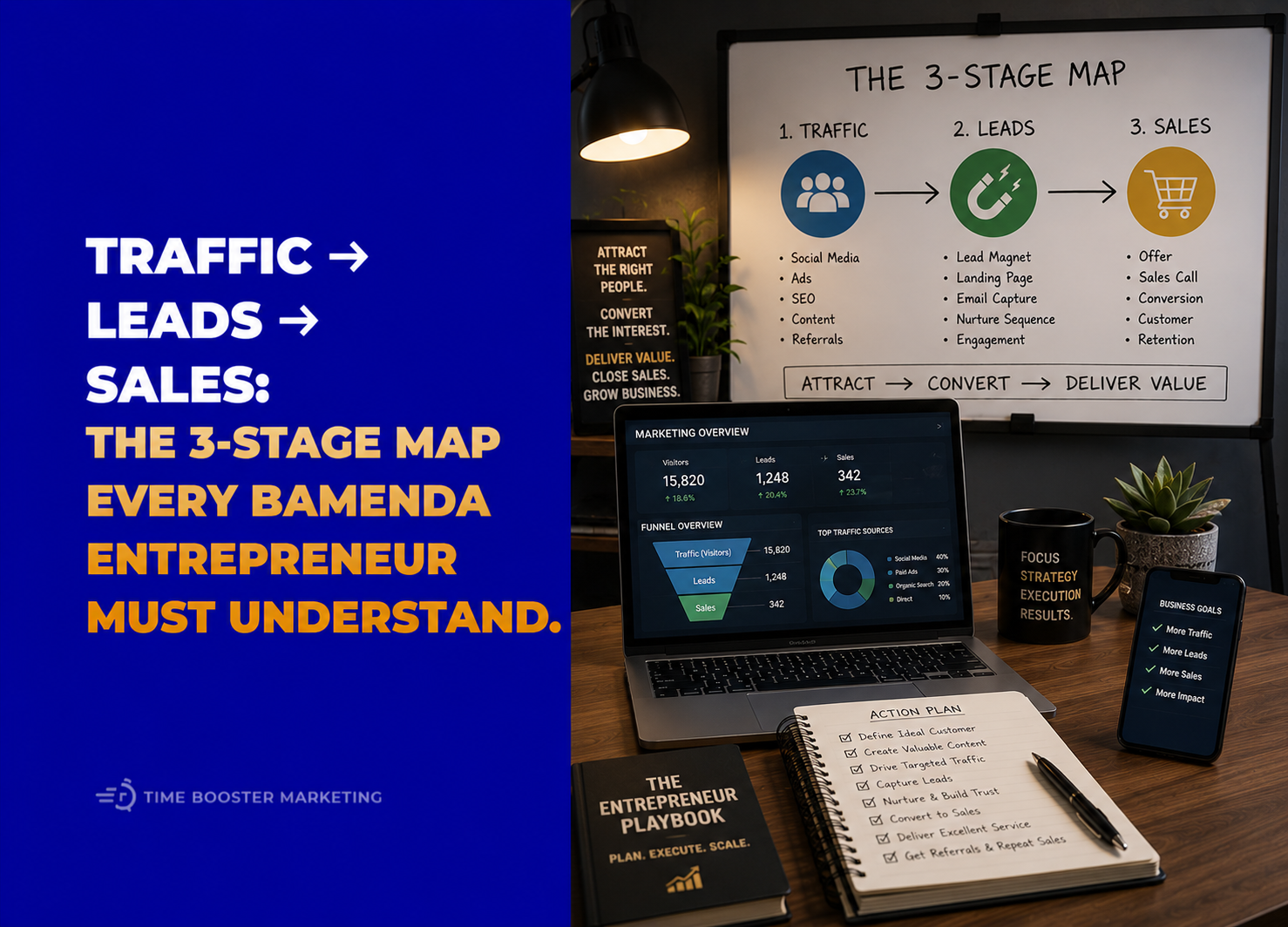
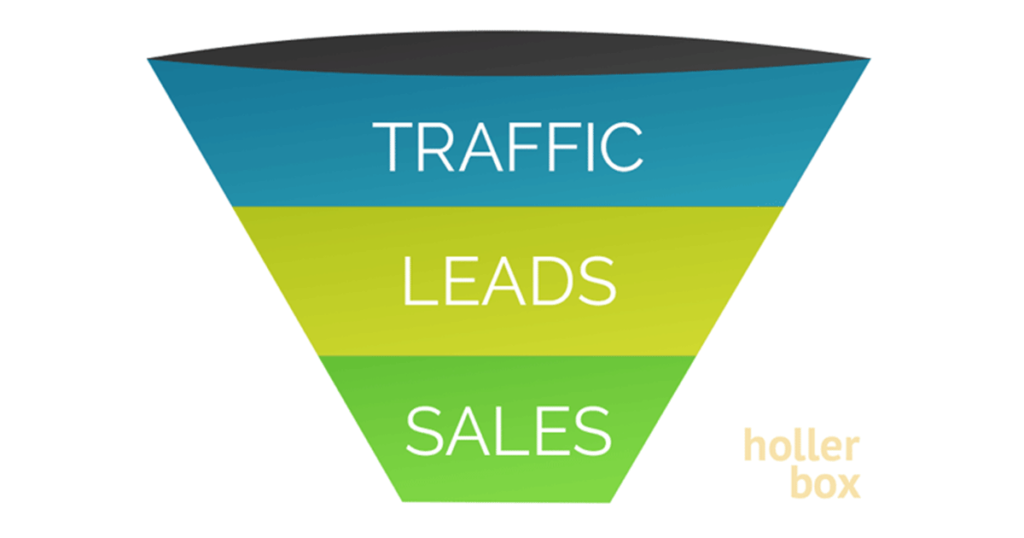
For Bamenda businesses, the funnel is simple:
- Traffic: people see or visit your content.
- Leads: some of them show interest and can be contacted.
- Sales: some of those leads trust you enough to pay.
Those three are connected, but they are not the same thing.
Why Traffic and Leads Are Not the Same Thing
Traffic means attention.
Examples of traffic include:
- Someone views your WhatsApp Status.
- Someone sees your Facebook post.
- Someone watches your product video.
- Someone visits your landing page.
- Someone clicks your boosted advert.
- Someone checks your Instagram profile.
Traffic tells you people noticed something. It does not prove they are ready to buy.
A lead is different. A lead is someone who takes an action that gives your business a chance to continue the conversation. Mailchimp explains lead generation as converting potential customers into interested prospects for a business’s products or services. (Mailchimp)
For a Bamenda business, leads may include people who:
- Send a WhatsApp message.
- Call your business number.
- Ask for price.
- Request your catalogue.
- Ask for your location.
- Book an appointment.
- Fill a form.
- Request a quotation.
- Ask about availability.
- Comment with clear buying intent.
Traffic is visibility.
A lead is identifiable interest.
This difference matters because you cannot follow up properly with anonymous viewers. But when someone messages, calls, or fills a form, you now have a real sales opportunity.
Why Leads and Sales Are Not the Same Thing
A lead is not money.
This is where many Bamenda business owners get frustrated.
Someone asks, “How much?” You reply. They disappear. You feel annoyed because you thought they were ready to buy.
But asking for price is not the same as paying.
A lead may still be:
- Comparing vendors.
- Checking affordability.
- Asking on behalf of someone else.
- Waiting for salary.
- Unsure whether to trust you.
- Confused about your offer.
- Interested but not urgent.
- Needing proof before payment.
This is why leads need conversion.
Your sales conversation must move the person from curiosity to confidence. That means your reply should not only state the price. It should also explain value, answer doubts, show proof, and guide the next step.
Weak reply:
- “25k.”
Better reply:
- “Yes, it is 25,000 FCFA. It includes delivery within Bamenda town, and we have it available in black and brown. I can send real pictures now. What size do you need?”
The second reply does more selling because it gives clarity, options, proof, and a next question.
The Bamenda Digital Marketing Funnel in Plain English
A practical funnel for a Bamenda SME has five stages.
1. Attention
This is where people first notice you.
They may see:
- A flyer.
- A reel.
- A boosted post.
- A WhatsApp Status update.
- A customer repost.
- A Google Business Profile.
- A referral message.
At this stage, your message must quickly answer: “Who is this for, and why should I care?”
Weak message:
- “Quality services available.”
Better message:
- “Affordable bridal makeup in Bamenda for court weddings, traditional weddings, and photo shoots. Home service available.”
Specific messages attract better traffic.
2. Interest
This is where people slow down and consider you.
They may:
- Read your caption.
- Check comments.
- Look at pictures.
- Compare prices.
- Ask a friend.
- Visit your page.
- Save the post.
At this stage, confusion kills conversion. Make your offer easy to understand.
3. Lead Capture
This is where a viewer becomes someone you can follow up with.
Lead capture can happen through:
- WhatsApp clicks.
- Phone calls.
- Booking forms.
- Direct messages.
- Inquiry forms.
- Store visits.
- Consultation requests.
Google Analytics calls important business actions “key events,” meaning actions that matter to business success, such as form submissions, purchases, or other valuable interactions. (Google Help)
For a Bamenda SME, a WhatsApp message may be one of your most important key events.
4. Sales Conversation
This is where most revenue leaks.
A person has shown interest, but now your response decides what happens next.
Your sales conversation should:
- Reply quickly.
- Answer clearly.
- Ask useful questions.
- Send proof.
- Explain the process.
- Handle objections.
- Follow up professionally.
If this stage is weak, more traffic will only create more missed opportunities.
5. Payment
This is the actual sale.
Payment may mean:
- Full payment.
- Deposit.
- Confirmed booking.
- Registration fee.
- Product order.
- Signed agreement.
- Service confirmation.
Until this happens, you have potential revenue, not revenue.
Conversion Rate Benchmarks at Each Stage
Benchmarks are useful, but they are not laws.
A Bamenda restaurant, salon, real estate agency, school, gym, boutique, and consultant will not convert at the same rate. Price, trust, urgency, audience quality, offer clarity, and follow-up all matter.
Unbounce reports a 6.6% median landing page conversion rate across industries from its 2024 benchmark data, while also treating that number as a broad baseline rather than a universal target. (Unbounce)
Use these ranges as practical diagnostic guides:
Traffic to Lead Conversion
This shows how many viewers or visitors become leads.
Formula:
- Traffic-to-lead rate = leads ÷ traffic x 100
Directional ranges:
- Cold social media traffic: 0.5%–3%
- Warm WhatsApp Status audience: 3%–10%
- Focused landing page: 3%–8%+
- Referral traffic: often higher because trust is already present
If this number is low, check:
- Your headline.
- Your offer clarity.
- Your audience targeting.
- Your call-to-action.
- Your contact instructions.
Lead to Qualified Lead Conversion
Not every lead is serious.
A qualified lead is someone who has a real need, reasonable budget, suitable location, and possible buying timeline.
Directional ranges:
- Low-intent inquiries: 20%–40%
- Clear service inquiries: 40%–70%
- Referral inquiries: 60%–85%
If many leads are not serious, your marketing may be attracting the wrong people or hiding important details like price range, location, or service scope.
Sales Conversation to Sale Conversion
This shows how many serious conversations become paying customers.
Directional ranges:
- Low-ticket products: 20%–50%
- Mid-priced services: 10%–30%
- High-ticket offers: 5%–20%
If this number is weak, your issue is probably not traffic. It may be trust, proof, follow-up, price framing, or poor sales communication.
Where Most Bamenda Businesses Are Actually Leaking Revenue
Most businesses think they need more visibility.
Many actually need a better funnel.
Leak 1: Vague Messaging
Vague messages attract weak attention.
Poor examples include:
- “Quality services available.”
- “Contact us for your needs.”
- “Best products in town.”
- “Affordable prices.”
Better messages are specific:
- “Clean furnished rooms in Bamenda for weekend stays, short trips, and visiting families.”
- “Professional CV writing for Bamenda job seekers applying to NGOs, banks, schools, and remote roles.”
- “Lunch delivery in Bamenda for offices, students, and busy workers.”
Specificity turns random attention into useful interest.
Leak 2: No Clear Next Step
Many posts create interest but do not tell people what to do.
Every serious marketing message should include one clear action:
- “Send MENU on WhatsApp.”
- “Call to book inspection.”
- “Send your size for available options.”
- “Request the price list.”
- “Book your appointment before Friday.”
- “Send LOCATION for directions.”
Do not make people guess.
Leak 3: Slow WhatsApp Response
In Bamenda, WhatsApp is often where the real sale happens.
A slow or lazy reply can kill a warm lead.
Weak reply:
- “Available.”
Better reply:
- “Yes, it is available. The price is 18,000 FCFA, and we have sizes M, L, and XL. We are at [location], and delivery is possible within Bamenda. Which size should I reserve for you?”
That reply moves the buyer forward.
Leak 4: Weak Proof
People need reasons to trust you.
Use proof such as:
- Customer reviews.
- Before-and-after photos.
- Real product pictures.
- Delivery screenshots.
- Customer reposts.
- Testimonials.
- Clear business location.
- Staff or process videos.
- Google Business Profile updates.
Proof reduces fear. Without it, many leads will hesitate.
Leak 5: No Follow-Up
Many businesses answer once and disappear.
But customers are busy. They forget. They compare. They delay. They wait for you to guide them.
Follow-up messages can be simple:
- “Hello [Name], just checking if you still need the item we discussed yesterday.”
- “I can reserve it today if you want, because only two pieces are left.”
- “Based on your budget, this option fits best. Should I send payment details?”
- “Do you want me to confirm your appointment for Saturday?”
Follow-up is not begging. It is part of selling.
How to Convert Traffic to Leads in Bamenda
To turn traffic into leads, make the next step easy.
Use:
- A specific offer.
- A clear audience.
- Strong visuals.
- One main call-to-action.
- A WhatsApp link or phone number.
- Simple pricing guidance.
- Proof that you are credible.
Example:
- “Planning a birthday in Bamenda? Send CAKE on WhatsApp to get our cake sizes, prices, and delivery options.”
That is better than:
- “We make cakes. Contact us.”
How to Convert Leads to Sales
Once someone becomes a lead, stop marketing broadly and start guiding personally.
Your sales process should include:
- Fast response.
- Clear price explanation.
- Helpful questions.
- Relevant recommendations.
- Proof of previous work.
- Simple payment instructions.
- Polite follow-up.
A good sales reply feels organized, not desperate.
Example:
- “Hello [Name], yes, the package is available. It costs 85,000 FCFA and includes makeup, gele styling, and home service within Bamenda. I can send recent work samples. What date is your event?”
That reply helps the buyer decide.
The Simple Funnel Scorecard
Track these numbers every week:
- Traffic: How many people saw or visited your offer?
- Leads: How many people messaged, called, clicked, or inquired?
- Qualified leads: How many were serious and suitable?
- Sales conversations: How many received a proper response?
- Sales: How many paid?
- Revenue: How much money came from each channel?
This scorecard helps you stop guessing.
Instead of saying, “Marketing is not working,” you can say:
- “We have traffic but no leads.”
- “We have leads but poor qualification.”
- “We have conversations but no sales.”
- “We have sales but low profit.”
- “We have attention but weak follow-up.”
That is how you fix the right problem.
The Shareable Explanation
Traffic means people noticed you.
Leads mean people showed interest.
Sales mean people paid.
Do not celebrate traffic as if it is money.
Do not treat every lead as a buyer.
Do not blame marketing before checking where the funnel is leaking.
Conclusion
Bamenda businesses do not need to make digital marketing complicated. But they do need to stop mixing up attention, interest, and revenue.
Traffic is useful because it creates visibility. Leads are valuable because they create sales opportunities. Sales matter because they bring money into the business.
When you separate these stages, you can finally see what needs fixing.
Sometimes you need better content. Sometimes you need a clearer offer. Sometimes you need faster WhatsApp replies. Sometimes you need stronger proof. Sometimes you need follow-up. Sometimes you need better pricing or a better payment process.
More traffic is not always the answer.
A better funnel is often the real solution.