LinkedIn Premium Cameroon: Is the Paid Plan Worth It?
Paying for LinkedIn Premium without a strategy is money out the window.
Many Cameroonian professionals see the Premium badge, InMail access, profile-viewer insights, job insights, and LinkedIn Learning features and assume the paid plan will automatically bring jobs, clients, recruiters, or international opportunities.
It will not.
LinkedIn Premium can be valuable, but only when your profile, positioning, networking habits, and outreach system are already strong enough to convert attention into opportunity. If your headline is vague, your profile is incomplete, your content is inactive, and your messages sound desperate, Premium will mostly give you more tools to use badly.
According to DataReportal’s Digital 2026 Cameroon report, LinkedIn had a meaningful professional presence in Cameroon, with LinkedIn’s advertising resources indicating about 1.6 million registered members in late 2025. That makes the platform worth taking seriously, but it does not mean every user needs to pay immediately.
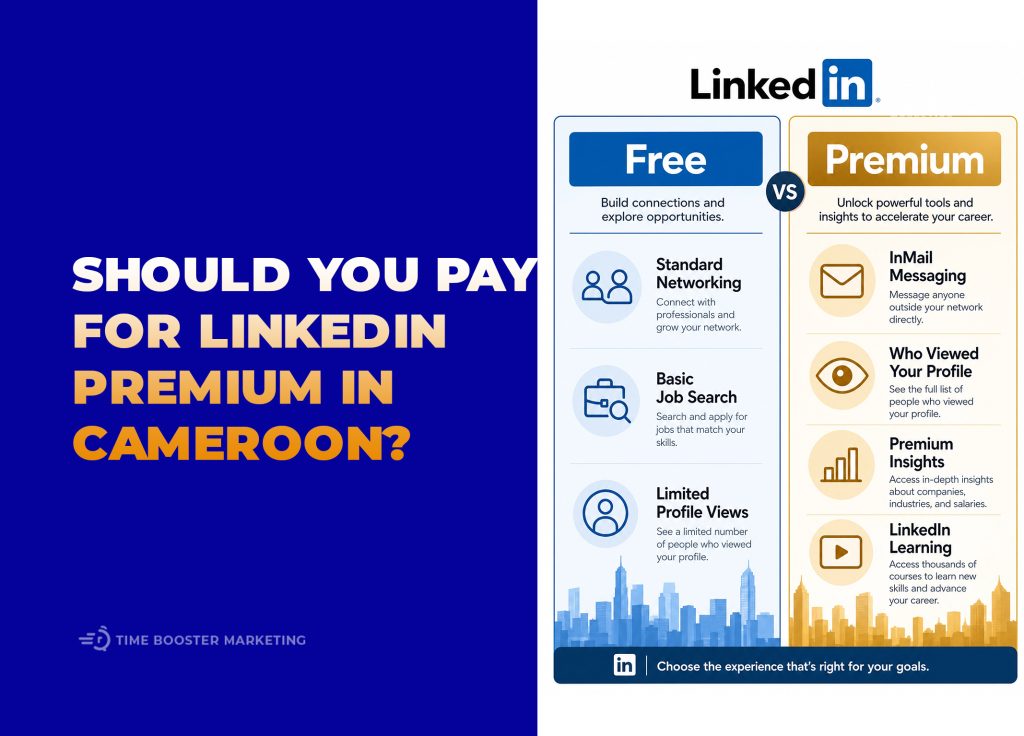
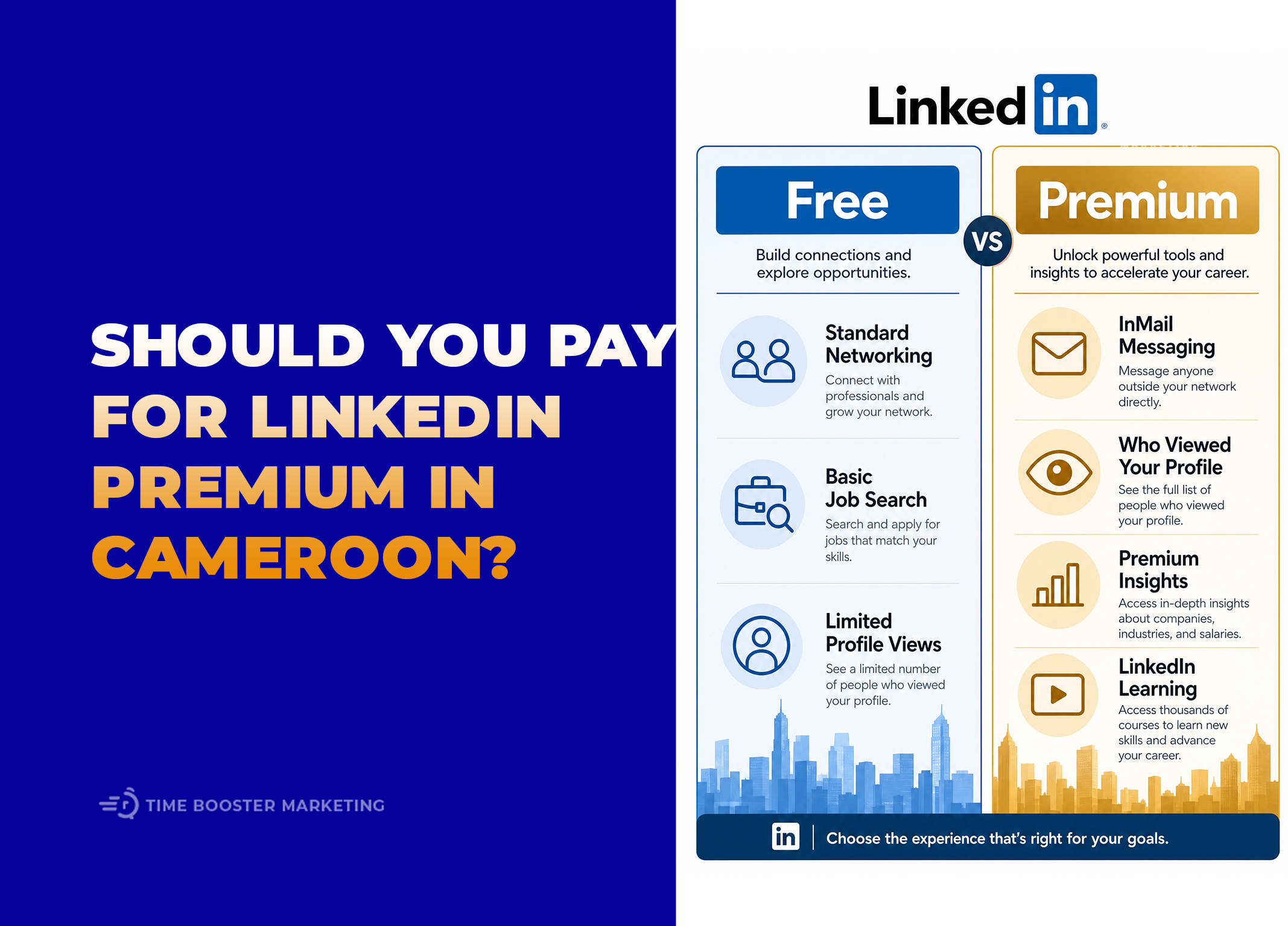
What LinkedIn Premium Actually Offers
LinkedIn explains in its official Introduction to LinkedIn Premium that Premium subscriptions are designed to give job seekers, professionals, and businesses enhanced tools for visibility, networking, insights, and growth.
The exact features can vary by plan and location, but the most relevant Premium benefits usually include:
- InMail messages
- More profile-viewer insights
- Job and applicant insights
- LinkedIn Learning access
- Advanced search filters
- Open Profile visibility
- Business and company insights
- Sales or recruiting tools on higher-tier products
LinkedIn’s own comparison of the free version and LinkedIn Premium explains that Premium Career is mainly built for job seekers, while Premium Business supports broader professional networking and business insight.
The real question is not, “Does Premium have useful features?”
The better question is, “Will these features help me act on a clear career, client acquisition, recruiting, or business development strategy?”
InMail: Useful, but Not Magic
InMail is one of the most attractive Premium features because it allows you to message LinkedIn members you are not connected to. LinkedIn’s InMail Messages guide explains that free Basic accounts can directly message first-degree connections, while InMail allows Premium users to contact people outside their network, unless the recipient’s settings prevent it.
That can help if you need to reach recruiters, hiring managers, founders, consultants, investors, clients, or senior professionals.
But InMail does not make a weak message persuasive.
A bad InMail says:
Hello, I need a job. Please help me.
A stronger InMail says:
Hello Ms. Talla, I saw that your company is hiring for customer success roles across Africa. I have experience handling client communication, CRM updates, and follow-up coordination for service businesses. I would be glad to connect or share my profile if this background is relevant.
Premium gives you access. Strategy earns the response.
LinkedIn’s InMail credit guide also shows that different Premium plans include different monthly InMail allotments. This matters because InMail is limited; wasting credits on random messages destroys the value of the subscription.
Job Insights: Helpful for Serious Job Seekers
For job seekers in Cameroon, Premium Career may be useful when you are actively applying and want more information about roles, applicants, and skills.
LinkedIn’s Getting started with LinkedIn Premium page mentions job and applicant insights, Top Choice jobs, advanced search filters, and career insights as part of the Premium experience.
These tools can help you understand:
- How your profile compares with other applicants
- Which skills appear important for a role
- Whether a job is receiving heavy competition
- Which opportunities deserve more focused effort
- Where your profile may need improvement
This is useful if you are applying deliberately.
It is not useful if you apply randomly to 100 jobs without tailoring your profile, CV, or message.
A Cameroonian finance graduate applying for remote bookkeeping roles may benefit from seeing skill gaps and applicant comparisons. A software developer targeting international roles may use insights to refine keywords, tools, and project proof. A mid-career HR professional may use Premium to identify better-fit roles instead of applying blindly.
Premium helps most when you are already focused.
LinkedIn Learning: Valuable if You Actually Use It
Some Premium plans include access to LinkedIn Learning, which offers professional courses across business, technology, creative, and career topics. LinkedIn’s LinkedIn Learning platform includes courses, skill-building pathways, and certificates that can be added to your profile.
For Cameroonian professionals, this can be useful if you need to build practical skills in areas such as:
- Excel
- project management
- digital marketing
- data analysis
- customer service
- leadership
- software development
- remote work communication
- sales
- business writing
But certificates alone will not make you competitive.
A course becomes valuable when you apply the skill, produce work samples, improve your profile, and explain the new capability clearly.
Do not pay for Premium just to collect certificates. Pay only if you have a learning plan tied to a real career or business objective.
Open Profile: Useful for Consultants and Visible Professionals
Premium may also give access to Open Profile. LinkedIn’s Open Profile guide explains that this feature allows any LinkedIn member to message a Premium member for free, even if they are outside the Premium member’s network.
This can be useful for:
- consultants
- recruiters
- freelancers
- coaches
- founders
- trainers
- speakers
- agency owners
- business development professionals
If your profile clearly explains your offer, Open Profile can reduce friction for potential clients, partners, or candidates who want to contact you.
But again, the profile must be worth contacting.
If your headline says only “CEO” and your About section is empty, Open Profile will not create serious enquiries.
Who Genuinely Benefits From LinkedIn Premium in Cameroon?
LinkedIn Premium may be worth it for five types of users.
1. Active Job Seekers With a Clear Target Role
Premium may help if you know the roles you want, apply consistently, use job insights, message recruiters professionally, and improve your profile based on what the market is demanding.
It is less useful if you have no target role and apply to everything.
2. Freelancers and Consultants Selling B2B Services
If you sell services to founders, SMEs, NGOs, corporate teams, or international clients, Premium Business or Sales Navigator-style tools may help with search, outreach, and prospect research.
However, you still need a strong offer, proof, content, and follow-up system.
3. Recruiters and Hiring Professionals
Recruiters may benefit from paid tools because hiring requires search, filtering, messaging, and candidate management. LinkedIn also has dedicated recruiting products such as Recruiter Lite, which are separate from basic Premium plans.
4. Business Developers and Sales Professionals
If your job involves finding decision-makers, researching accounts, and starting professional conversations, Premium or Sales Navigator may create real value.
But if you are not tracking prospects, follow-ups, and outcomes, the subscription becomes expensive browsing.
5. Professionals Targeting International Remote Opportunities
If you are in Cameroon and targeting global recruiters, remote-first companies, or international clients, Premium can help you message people outside your network and study job competitiveness.
But the foundation remains the same: strong profile, clear positioning, portfolio proof, and professional outreach.
Who Should Not Pay Yet?
You probably should not pay for LinkedIn Premium yet if:
- Your profile is incomplete
- Your headline does not explain your value
- You have no clear job or client target
- You rarely post, comment, or connect strategically
- You do not know who you want to message
- You have no portfolio, proof, or recommendations
- You expect Premium to “bring opportunities” automatically
- You are under financial pressure and cannot use it consistently
Premium should amplify a working strategy. It should not replace one.
If the free version is not producing any conversations because your positioning is weak, paying may not solve the real problem.
How to Get Maximum Value From the Free Version First
Before upgrading, use the free version properly for 30 days.
Fix Your Profile
Update your photo, banner, headline, About section, experience, skills, Featured section, and contact details.
Your profile should clearly answer:
What do I do?
Who do I help?
What proof do I have?
What opportunity am I looking for?
Build a Relevant Network
Send personalized connection requests to recruiters, hiring managers, founders, clients, colleagues, alumni, and professionals in your target field.
Do not connect randomly.
Publish Useful Content
Post once or twice a week about your expertise, lessons, projects, industry observations, or client problems.
A job seeker can write about lessons from training. A freelancer can explain common business mistakes. A consultant can share frameworks. A developer can explain projects. A recruiter can share hiring advice.
Use Free Job Alerts
LinkedIn allows job seekers to create alerts for searches and receive notifications when relevant roles appear. Use this before paying for Premium.
Track Conversations
Create a simple spreadsheet with:
- person contacted
- company
- role
- date
- message sent
- response
- next step
- outcome
If you cannot manage free outreach systematically, Premium will not fix that habit.
When to Upgrade
Upgrade only when you can answer these questions clearly:
Who exactly will I contact with InMail?
Which roles, clients, or companies am I targeting?
What message will I send?
What proof will they see when they open my profile?
How will I measure whether Premium is working?
Use a clear 30-day test.
For a job seeker, success may mean recruiter replies, interviews, better-fit applications, or useful hiring conversations.
For a freelancer, success may mean qualified discovery calls, proposals, or new client conversations.
For a recruiter, success may mean shortlisted candidates and faster hiring communication.
For a founder, success may mean partner, investor, client, or talent conversations.
If Premium does not create measurable progress, cancel it and return to strengthening your free strategy.
LinkedIn Premium Is a Tool, Not a Shortcut
LinkedIn Premium may be worth it for some Cameroonians. It can help serious job seekers, consultants, recruiters, freelancers, founders, and business developers move faster.
But it is not a shortcut around unclear positioning.
If your profile is weak, your target audience is vague, your outreach is careless, and your follow-up is inconsistent, Premium will only make the mistake more expensive.
Start with the free version. Build a profile that makes your value obvious. Create proof. Connect strategically. Publish useful content. Start real conversations. Then upgrade only when you know exactly how Premium will help you reach people, learn faster, or close better opportunities.
Paying for LinkedIn Premium can be smart. Paying without a plan is just another subscription.