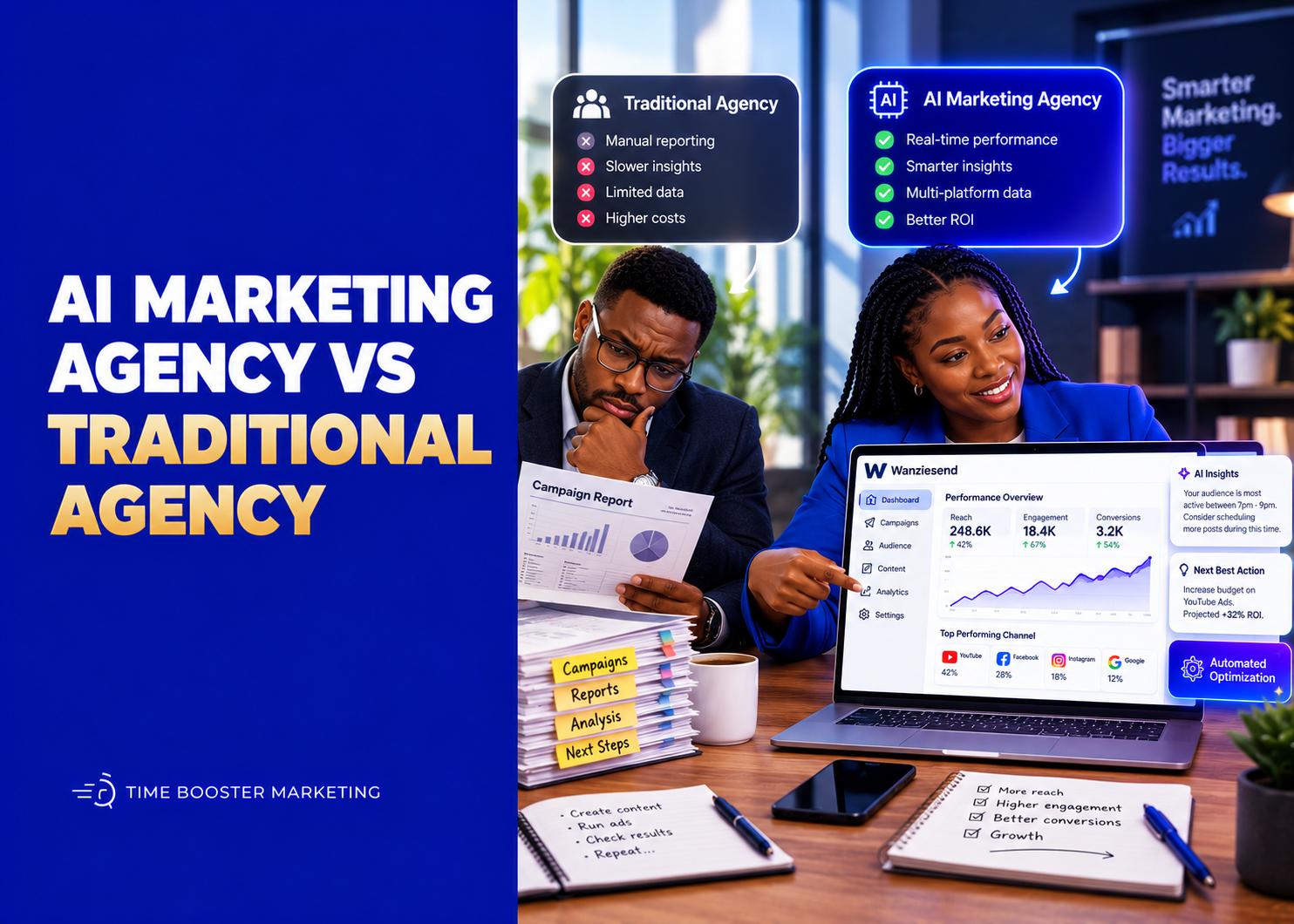
Digital marketing has changed significantly. Businesses can now use artificial intelligence to research audiences, generate content ideas, automate customer communication, analyze campaign performance, and improve advertising processes. However, traditional marketing strategies still offer important advantages, particularly when they involve experienced marketers who understand customers, markets, and business objectives.
So, when comparing an AI marketing agency vs traditional agency Cameroon which option should a business choose?
The answer depends on your goals, budget, internal team, marketing needs, and the level of support you expect from an agency.
This guide explains how both agency models work, compares their services, explores their limitations, and helps you determine which approach is best for your business.
What Is an AI Marketing Agency?
An AI marketing agency uses artificial intelligence tools and technologies to support and improve marketing activities.
These agencies combine marketing knowledge with AI-powered platforms to handle tasks such as audience research, content development, advertising analysis, customer segmentation, reporting, and marketing automation.
Rather than depending entirely on manual processes, an AI marketing company in Cameroon may use specialized tools to improve efficiency, process information faster, and support data-driven decisions.
For example, an agency may use AI to:
- Analyze customer behavior and identify audience patterns.
- Generate content ideas based on industry trends and search intent.
- Develop initial drafts for blogs, advertisements, and social media posts.
- Automate repetitive customer communication.
- Segment leads based on their interests and interactions.
- Analyze advertising performance and identify areas for improvement.
- Support personalized marketing campaigns.
- Generate reports that help businesses understand their performance.
However, using AI does not automatically make an agency effective. The technology must be guided by people who understand marketing strategy, customer behavior, brand positioning, and business objectives.
An effective AI marketing agency uses technology to strengthen human expertise rather than replace it.
What Is a Traditional Digital Marketing Agency?
A traditional digital marketing agency provides marketing services through established strategies, platforms, and human-led processes.

Its work may include social media management, search engine optimization, paid advertising, email marketing, content creation, website development, and brand strategy.
Traditional agencies generally depend more heavily on marketers, designers, copywriters, analysts, and account managers to research, plan, execute, and evaluate campaigns.

For example, a traditional digital marketing agency in Cameroon may:
- Research a client’s market and competitors manually.
- Develop marketing strategies based on business goals.
- Create social media content and promotional campaigns.
- Manage Google Ads and Meta advertising campaigns.
- Write website articles and optimize pages for search engines.
- Monitor campaign performance and prepare reports.
- Manage customer engagement and brand communication.
The main strength of this model is its reliance on human judgment, creativity, experience, and direct client collaboration.
However, when processes are entirely manual, some activities may take longer, require more resources, or become difficult to scale.
AI Marketing Agency vs Traditional Digital Marketing Agency Cameroon: Key Differences
Although both agency models aim to improve business growth, they may approach marketing activities differently.
The following comparison explains how their approaches can differ across important marketing functions.
1. Market Research and Audience Analysis
Market research helps businesses understand their customers, competitors, industry conditions, and opportunities.
A traditional agency may rely on surveys, interviews, competitor reviews, platform insights, and manual research to understand a target audience.
An AI-powered agency can use additional tools to process large amounts of information, identify patterns, analyze customer feedback, and organize audience insights more efficiently.
The difference: AI can accelerate information processing, while human marketers provide context and determine which findings are relevant to the business.
For example, an AI tool may identify that customers frequently ask about delivery costs. A skilled marketer must determine how this insight should influence the company’s messaging, offers, and customer experience.
2. Content Production and Creative Strategy
Content is central to digital marketing. Businesses need consistent social media posts, videos, graphics, website articles, email campaigns, and advertising materials.
Traditional agencies generally depend on content writers, designers, videographers, and social media managers to develop and produce these materials.
AI-powered agencies can use tools to support:
- Content research and topic generation.
- First drafts of articles and captions.
- Content calendars and campaign planning.
- Image and video production workflows.
- Content repurposing across platforms.
- Grammar, editing, and optimization.
This can reduce the time required to complete certain production tasks.
However, AI-generated content may contain inaccurate information, generic messaging, repetitive ideas, or language that does not reflect a brand’s personality.
Human marketers are still needed to verify information, refine messaging, maintain brand consistency, and create content that connects with the intended audience.
The difference: Traditional production may rely more heavily on manual creation, while AI-assisted production can improve speed and support higher content output. Neither approach guarantees quality without proper creative direction.
3. Advertising Management
Paid advertising is an important part of customer acquisition for many businesses.
Traditional agencies typically manage campaigns through platforms such as Google Ads and Meta Ads Manager. Their responsibilities include audience selection, campaign setup, budget allocation, creative testing, optimization, and performance monitoring.
An AI marketing agency may use additional tools to support:
- Advertising copy variations.
- Creative testing and development.
- Audience analysis.
- Performance pattern identification.
- Campaign reporting.
- Lead segmentation and follow-up automation.
These tools can help marketers work more efficiently, but they do not eliminate the need for advertising expertise.
A poorly structured campaign can still waste money even when AI tools are involved. Successful advertising requires clear objectives, accurate tracking, relevant audiences, persuasive offers, and continuous optimization.
The difference: AI can support campaign analysis and execution, but experienced marketers must decide how to allocate budgets, interpret results, and make strategic changes.
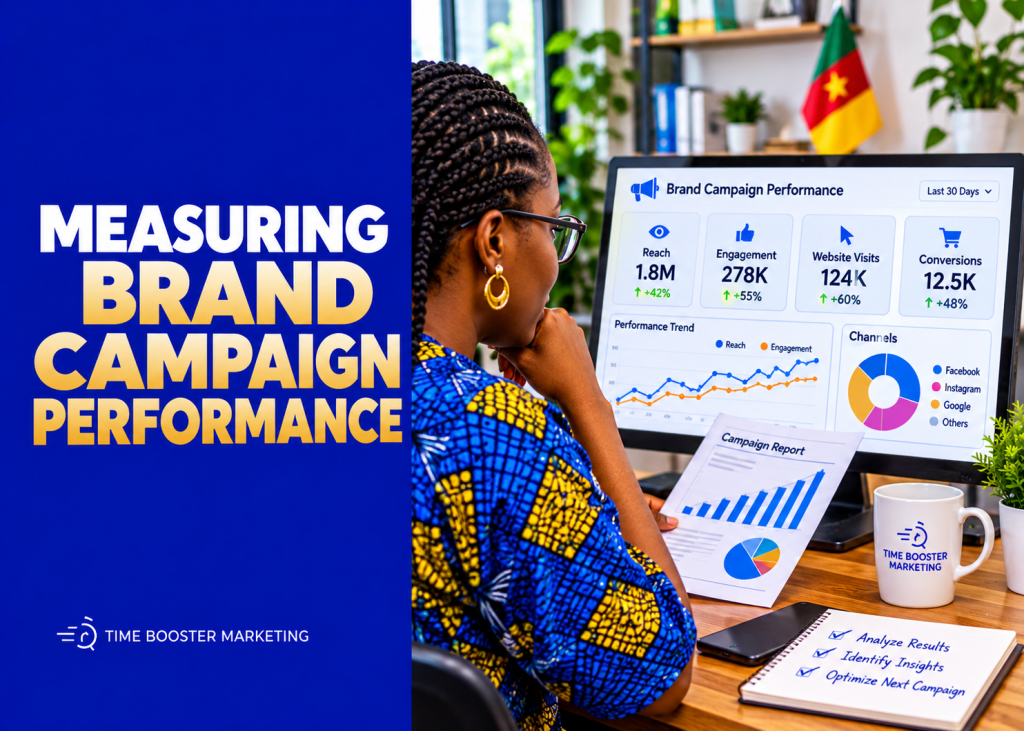
4. Reporting and Performance Analysis
Businesses need to know whether their marketing investments are producing meaningful results.
Traditional agencies often collect data from social media platforms, advertising dashboards, websites, and other marketing tools before preparing reports.
An AI-assisted agency can use automation and analytics tools to consolidate information, identify trends, and generate performance summaries.
For example, an agency may use automated reporting to monitor:
- Website traffic.
- Social media reach and engagement.
- Advertising expenditure.
- Leads generated.
- Cost per lead.
- Conversion rates.
- Sales attributed to marketing activities.
However, reporting should go beyond presenting numbers.
A business owner needs to understand what the results mean, why performance changed, and what actions should follow.
The difference: AI can make reporting faster and help identify patterns, while human marketers interpret the findings and translate them into practical decisions.
5. Marketing Automation and Customer Follow-Up
One of the biggest differences between AI-supported marketing and more traditional approaches is the use of automation.
Traditional agencies may manage customer communication through manual follow-ups, email campaigns, social media interactions, and direct messaging.
An AI marketing company in Cameroon may introduce automation tools that help businesses manage repetitive communication and customer journeys.
Examples include:
- Automated WhatsApp responses.
- Email marketing sequences.
- Lead capture and qualification workflows.
- Appointment reminders.
- Customer segmentation.
- Automated follow-up messages.
- CRM updates and lead tracking.
Consider a business that receives 100 enquiries every month. If its team handles every follow-up manually, some potential customers may be forgotten or contacted too late.
A properly configured automation system can organize enquiries, send timely responses, and remind sales representatives to follow up.
However, automation must be designed carefully. Customers may become frustrated by irrelevant messages, repetitive responses, or systems that cannot recognize when a human representative is needed.
The difference: Traditional processes may involve more manual communication, while AI-supported systems can improve consistency and follow-up speed. Human support remains essential for complex questions and important customer relationships.
Comparison at a Glance
| Marketing function | Traditional agency | AI-powered agency |
|---|---|---|
| Research | Manual research and platform insights | AI-assisted research and pattern analysis |
| Content | Human-led creation | AI-assisted creation with human editing |
| Advertising | Manual setup and optimization | AI-supported analysis and creative testing |
| Reporting | Manually compiled reports | Automated reporting and analysis |
| Customer follow-up | Manual communication and campaigns | Automated workflows and human support |
| Strategy | Human-led planning | Human-led planning supported by AI insights |
These are general differences, not fixed rules. Many traditional agencies already use AI tools, while many AI-focused agencies still depend on conventional marketing methods.
The real distinction is how extensively technology is integrated into the agency’s processes and how effectively its team uses it.
The Limitations and Risks of Both Agency Models
Before choosing an agency, business owners should understand that neither model is perfect.
Limitations of Traditional Digital Marketing Agencies
Traditional agencies can deliver excellent results, but some may face challenges associated with manual processes.
Common limitations include:
Slower production workflows: Research, content development, reporting, and repetitive administrative tasks can take considerable time when handled entirely manually.
Higher resource requirements: Producing large volumes of content or managing multiple campaigns may require additional staff and resources.
Limited automation: Businesses may miss opportunities to improve lead follow-up, customer segmentation, and repetitive communication if their marketing processes are not automated.
Difficulties scaling: As a business grows, manual processes may become harder to manage without increasing operational costs.
These limitations do not apply to every traditional agency. Many have adopted technology and automation to improve their operations.
Limitations of AI Marketing Agencies
AI-powered marketing also comes with risks that business owners should consider.
Inaccurate information: AI tools can produce incorrect statistics, misleading claims, or outdated information. Human verification is essential.
Generic content: Overdependence on AI-generated content can result in repetitive messaging that fails to communicate a brand’s unique value.
Lack of local market understanding: AI tools may not fully understand local customer behavior, cultural context, language preferences, or the realities of doing business in Cameroon.
Privacy and data protection: Businesses must understand how customer information is collected, processed, stored, and shared when using AI and automation platforms.
Overreliance on technology: Automated campaigns can continue producing poor results if nobody monitors their performance or corrects underlying problems.
Additional software costs: Some AI platforms, automation systems, and integrations require ongoing subscriptions and setup expenses.
The lesson is simple: AI can improve marketing processes, but it cannot guarantee good marketing decisions.
Why AI Tools Still Require Skilled Marketers
One of the biggest misconceptions about AI marketing is that businesses can achieve effective results simply by subscribing to AI tools.
In reality, tools do not replace the need for a clear marketing strategy.
An AI platform can generate dozens of social media captions, but it cannot independently determine whether those captions support a company’s positioning, appeal to the right audience, or contribute to its sales objectives.
A skilled marketer must understand:
- The business’s products and services.
- Its ideal customers and purchasing behavior.
- Its competitors and market position.
- The message the brand needs to communicate.
- The right marketing channels for reaching customers.
- The budget available for campaigns.
- The results that should define success.
Human expertise also matters when unexpected situations arise.
For example, if a business receives many enquiries but very few sales, an AI tool may help identify patterns in the available data. However, a marketer must investigate whether the problem is pricing, product positioning, lead quality, customer service, or the sales process.
This is why the strongest AI marketing approach combines technology with experienced professionals.
Which Agency Is Right for Your Business?
The best option depends on what your business needs today and where you want it to go.
Choose a Traditional Digital Marketing Agency If:
- Your business needs strong brand development and creative direction.
- You require hands-on marketing support and close collaboration.
- Your marketing activities are relatively straightforward.
- You need specialists to manage social media, advertising, SEO, or content.
- You prefer a more human-led approach to campaign planning and execution.
A traditional agency can be a good fit when your main priority is establishing your brand, building a consistent online presence, or receiving hands-on marketing support.
Choose an AI Marketing Agency If:
- Your business handles a high volume of customer enquiries.
- You need to improve lead management and follow-up.
- Your marketing team spends too much time on repetitive tasks.
- You want to use data more effectively when making marketing decisions.
- You need to scale content and campaign workflows.
- You want to integrate marketing automation into your operations.
An AI-powered approach may be particularly useful for businesses looking to improve operational efficiency and manage larger marketing activities without relying entirely on manual processes.
Consider a Hybrid Agency If:
Your business needs both human expertise and technology-driven efficiency, a hybrid agency may be the most practical option.
A hybrid agency combines established digital marketing services with AI tools and automation.
It may use AI for research, reporting, content assistance, and lead management while relying on experienced professionals for strategy, creative direction, advertising decisions, and client communication.
For many businesses, this approach offers a practical balance between efficiency, creativity, and human judgment.
A Decision Checklist for Business Owners in Cameroon
Before hiring an agency, evaluate your business needs using the following questions.
- What is my primary marketing objective? Do you want more brand awareness, enquiries, appointments, website traffic, or sales?
- Where is my current marketing process struggling? Are you struggling with content production, advertising, lead follow-up, reporting, or customer engagement?
- How much of my marketing work is repetitive? If your team spends significant time on routine activities, automation may offer value.
- Does my business need more human support? Some businesses need close collaboration, creative direction, and hands-on campaign management.
- Can my team manage the technology? AI tools and automation platforms require setup, maintenance, and monitoring.
- What is included in the agency’s pricing? Understand the service fees, software subscriptions, advertising budget, setup costs, and ongoing support.
- How will success be measured? The agency should connect its activities to measurable business objectives rather than focusing only on content volume or social media engagement.
- Who will oversee the strategy? Ensure that experienced professionals are responsible for interpreting results, making decisions, and improving campaign performance.
Do not choose an agency simply because it advertises itself as AI-powered or traditional. Choose one that understands your business and can explain how its approach will help you achieve your goals.
What Should Businesses Consider When Comparing Agency Costs?
The cost of hiring an AI marketing agency versus a traditional digital marketing agency depends on the scope of work, complexity of the services, resources required, and level of support provided.
An AI-powered agency is not automatically cheaper. While automation can reduce the time spent on certain activities, businesses may still need to pay for software subscriptions, system integration, technical setup, and professional management.
Traditional agencies may have different cost structures based on the size of their teams, the amount of content required, campaign management responsibilities, and the services included.
When comparing proposals, separate the following expenses:
- Agency management fees: The cost of strategy, execution, management, and reporting.
- Advertising budget: The money paid directly to advertising platforms such as Google and Meta.
- Software subscriptions: Fees for AI tools, CRM systems, email platforms, and automation software.
- Setup and integration costs: Expenses associated with connecting systems and configuring workflows.
- Additional services: Website development, photography, video production, graphic design, and other specialized work.
Rather than choosing the lowest-priced option, evaluate the value of the services, the expected outcomes, and the agency’s ability to support your business over time.
The Future of Digital Marketing in Cameroon
As more businesses adopt digital tools, the way marketing is planned and executed will continue to evolve.
AI is creating opportunities for businesses to improve research, content production, advertising analysis, customer communication, and marketing automation.
For businesses in Cameroon, these developments could make sophisticated marketing processes more accessible. Small and growing companies can explore tools that previously required larger teams or more extensive resources.
However, technology adoption alone will not determine success.
Businesses still need a clear understanding of their customers, a competitive offer, reliable marketing channels, and professionals who can turn information into meaningful action.
The future is unlikely to be a simple choice between AI and traditional marketing. It will increasingly involve combining the strengths of both approaches.
AI marketing agency vs traditional agency Cameroon
The discussion around AI marketing agency vs traditional agency Cameroon should not focus only on which model uses newer technology. It should focus on which approach can solve your business challenges and support your growth objectives.
Traditional digital marketing agencies offer valuable human expertise, creativity, and hands-on support. AI marketing agencies can introduce greater efficiency, automation, and data-driven processes. Hybrid agencies bring these capabilities together.
For most businesses, the ideal choice is an agency that understands marketing fundamentals, uses technology responsibly, and has the expertise to connect marketing activities to measurable business results.
At Time Booster Marketing, we believe effective marketing requires more than simply producing content or adopting new tools. It requires understanding your business, identifying opportunities, developing the right strategy, and using the appropriate resources to achieve your goals.
Whether you need social media management, digital advertising, SEO, content marketing, or marketing automation, our team can help you identify the services and strategies that fit your objectives.