Whether you are introducing a new business, promoting an existing product, entering a new market, or improving brand recognition, a well-planned campaign can help you build awareness, attract potential customers, and create stronger relationships with your audience.
However, not every campaign produces the results a business expects. Some companies invest in promotional graphics, videos, and paid advertisements without first determining who they want to reach or what they want people to do after seeing their message.
The result is often content that receives attention but does not contribute meaningfully to business growth.
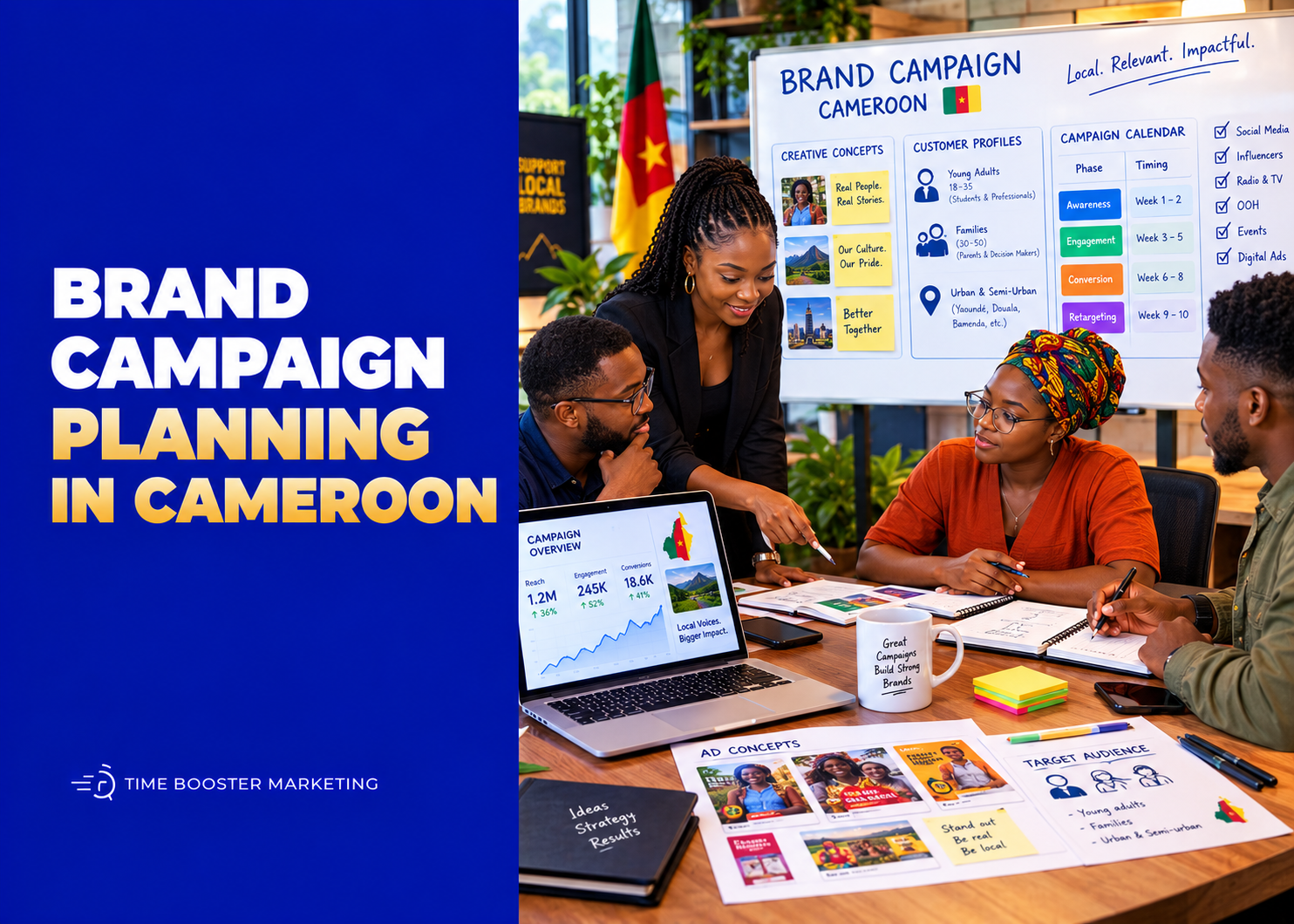
This guide explains how to plan a brand campaign in Cameroon, from setting objectives and identifying your target customers to developing your campaign message, choosing marketing channels, establishing a budget, and measuring results.
What Is a Brand Campaign?
A brand campaign is a coordinated marketing effort designed to communicate a business’s identity, values, products, services, or unique selling proposition to a specific audience.
Unlike a single promotional post or advertisement, a campaign involves multiple activities working together to achieve a defined marketing objective.
These activities may include:
- Social media content and promotional graphics.
- Video advertisements and brand storytelling.
- Influencer partnerships and collaborations.
- Google and Meta advertising campaigns.
- Website content and landing pages.
- Email and WhatsApp marketing.
- Public relations and offline promotional activities.
For example, a fashion business in Douala launching a new clothing collection may develop a campaign that introduces the collection, highlights its designs, shares customer testimonials, promotes available sizes, and encourages people to place orders.
Each activity supports the same central message and contributes to the overall campaign objective.
A brand campaign can focus on several goals, including increasing brand awareness, introducing a new product, improving customer perception, generating enquiries, or encouraging purchases.
The important thing is to ensure that every campaign activity has a clear purpose.
Why Your Business Needs a Brand Campaign in Cameroon
The Cameroonian business environment includes companies competing across different industries, customer segments, and digital platforms. Businesses need to communicate clearly if they want potential customers to recognize their brands and understand what makes their products or services relevant.

A structured brand campaign can support several business objectives.
1. Increase Brand Awareness
People cannot consider a business they do not know exists.
A brand awareness campaign introduces your business to potential customers and helps them become familiar with your name, products, services, and identity.
For example, a newly established restaurant in Buea may use short videos, location-based advertisements, food photography, and promotional posts to introduce its menu and location to nearby customers.
The objective is to make the business recognizable among the people it wants to reach.
2. Build Trust and Credibility
Customers are more likely to consider businesses they understand and trust.
A campaign can communicate credibility by showcasing customer experiences, business achievements, product quality, expertise, and behind-the-scenes activities.
For a professional service provider, this could involve sharing educational content, client testimonials, team introductions, and examples of previous work.
Consistent communication helps potential customers develop a clearer understanding of what the business offers.
3. Promote Products and Services
A brand campaign can also support the introduction or promotion of specific products and services.
Rather than publishing isolated promotional messages, businesses can create a series of coordinated activities that explain the product’s benefits, demonstrate how it works, address customer concerns, and encourage enquiries or purchases.
4. Reach New Customer Segments
Businesses looking to expand into new locations or attract different customer groups can use campaigns to introduce their brands to those audiences.
For example, a business based in Buea that wants to attract customers in Douala may develop a targeted campaign highlighting its products, delivery arrangements, service availability, and value proposition for that market.
5. Support Long-Term Business Growth
Brand campaigns are not only about immediate sales.
They can help businesses establish stronger market recognition, communicate their positioning, develop customer relationships, and create a foundation for future marketing activities.
A successful campaign should contribute to the broader business strategy rather than operate as an isolated promotional exercise.
Step 1: Define Your Brand Campaign Objectives
Before creating content or selecting advertising platforms, determine what you want the campaign to achieve.
A common mistake is trying to accomplish too many things with one campaign. A business may want more followers, website visits, enquiries, sales, and brand recognition at the same time without deciding which result matters most.
Your campaign should have one primary objective, supported by secondary objectives where necessary.
Common brand campaign objectives include:
Brand Awareness
The goal is to introduce your business to more people within your target market.
Relevant indicators include:
- Reach.
- Impressions.
- Video views.
- Brand searches.
- Audience growth.
Audience Engagement
The goal is to encourage people to interact with your brand and its content.
Relevant indicators include:
- Likes and reactions.
- Comments.
- Shares.
- Saves.
- Video engagement.
- Direct messages.
Lead Generation
The goal is to encourage potential customers to express interest in your products or services.
Relevant indicators include:
- Enquiries received.
- Form submissions.
- WhatsApp conversations.
- Phone calls.
- Qualified leads.
- Cost per lead.
Sales and Conversions
The goal is to encourage customers to complete a purchase or another valuable action.
Relevant indicators include:
- Orders received.
- Revenue generated.
- Conversion rate.
- Cost per acquisition.
- Return on advertising spend.
Example:
A skincare business launching a new product line may set the following objectives:
- Primary objective: Increase awareness of the new product line among its target audience.
- Secondary objective: Generate enquiries through WhatsApp.
- Campaign duration: 30 days.
- Main channels: Facebook, Instagram, TikTok, and WhatsApp.
This gives the campaign a clear direction and makes it easier to evaluate performance.
Step 2: Identify Your Target Customers
A brand campaign cannot effectively reach everyone. It needs to focus on the people most likely to be interested in the business.
Before developing your campaign message, identify your target customers and understand what influences their decisions.
Consider the following factors.
Demographics
Demographic information helps you understand the general characteristics of your audience.
These may include:
- Age range.
- Gender, where relevant to the product or service.
- Occupation.
- Income range.
- Education level.
- Family or professional status.
For example, a business selling professional workwear may target employed adults, entrepreneurs, and organizations that purchase uniforms for their teams.
Location
Geography is particularly important when planning a brand campaign in Cameroon.
A business should consider whether it wants to reach customers in a specific town, city, region, or across the country.
For example:
- A restaurant may focus on people living or working near its location.
- A clothing retailer may target customers in Douala, Yaoundé, and Buea.
- An online service provider may target customers across Cameroon.
- A tourism business may target both local and international visitors.
Your campaign location should reflect where your products or services are available.
Customer Needs and Challenges
Understanding customer needs helps you develop messages that connect with real problems.
Ask questions such as:
- What problem does my product or service solve?
- What motivates customers to consider this product?
- What concerns might prevent them from buying?
- What alternatives are they currently using?
- What information do they need before making a decision?
For example, customers considering a home cleaning service may be concerned about reliability, pricing, convenience, and the quality of the service.
A campaign that addresses these concerns will be more useful than one that simply says the business offers cleaning services.
Online Behavior
Consider where your audience spends time online and how they prefer to discover businesses.
Some customers may use Facebook groups and WhatsApp to find local services. Others may rely on Instagram, TikTok, Google Search, or LinkedIn.
Your campaign should reflect these behaviors instead of selecting platforms simply because they are popular.
Step 3: Develop a Clear Campaign Message
Once you understand your target audience, determine what you want them to remember about your brand.
Your campaign message should communicate the most important reason someone should pay attention to your business.
A strong message answers three questions:
- What does your business offer?
- Who does it serve?
- Why should customers choose it?
This is where your unique selling proposition becomes important.
Your unique selling proposition explains what makes your business, product, or service different from available alternatives.
For example:
A furniture company may position itself around affordable, locally produced furniture designed for modern homes.
A medical service provider may focus on accessible healthcare services, convenient appointments, and professional support.
A fashion brand may emphasize locally inspired designs, quality materials, and custom-made clothing.
These messages provide a direction for the campaign’s content, advertising, and creative materials.
Keep Your Message Consistent
Your campaign may appear on several platforms, but the central message should remain consistent.
The wording and format can change depending on the platform, but the audience should recognize the same brand promise.
For example, a campaign promoting a new restaurant may use:
- A short promotional video on TikTok.
- Food photography on Instagram.
- A location-focused advertisement on Facebook.
- A menu and booking link on WhatsApp.
- A detailed menu page on the website.
Each platform communicates the same campaign message through a format suited to its audience.
Step 4: Choose the Right Marketing Channels
Choosing the right channels is an important part of planning a brand campaign in Cameroon.
Your decision should be based on your audience, campaign objective, budget, and the type of content you intend to produce.
You do not need to advertise on every available platform. It is often more effective to select a few channels that your target customers use regularly and manage them properly.
<text>Facebook is useful for businesses looking to build awareness, share promotional content, communicate with customers, and run targeted advertising campaigns.</text>
Businesses can use Facebook for:
- Brand announcements.
- Promotional graphics and videos.
- Customer testimonials.
- Community engagement.
- Location-based advertising.
- Lead generation campaigns.
Instagram is particularly useful for visually driven businesses.
Fashion brands, restaurants, beauty businesses, lifestyle companies, and creative businesses can use it to showcase products, share Reels, and build a recognizable visual identity.
Useful formats include:
- Reels.
- Stories.
- Carousel posts.
- Product photography.
- Customer-generated content.
TikTok
TikTok can help businesses introduce their brands through short-form video content.
It can be useful for demonstrations, behind-the-scenes videos, product showcases, educational content, and creative storytelling.
The content should be designed around the interests of the intended audience rather than relying entirely on trends.
WhatsApp can support direct communication with potential and existing customers.
Businesses can use it to:
- Share product catalogues.
- Respond to enquiries.
- Distribute campaign updates to opted-in audiences.
- Send promotional information.
- Follow up with interested customers.
- Support customer service and sales.
WhatsApp is especially useful when the campaign needs to move people from discovering a brand to having a direct conversation with the business.
Google Search and Google Ads
Google can help businesses reach people actively searching for specific products and services.
Google Business Profile can support local visibility, while Google Ads can help businesses target relevant search queries and other eligible placements.
For example, a customer searching for a printing service in Douala may be closer to making a purchase than someone who has only encountered a general promotional post.
Businesses should ensure that their website, landing pages, and contact information are accurate before investing in search advertising.
LinkedIn may be suitable for businesses targeting professionals, corporate clients, organizations, and decision-makers.
It can support brand positioning through industry insights, professional updates, case studies, company announcements, and thought leadership.
Offline Marketing Channels
Digital channels are important, but some campaigns may benefit from offline activities.
Depending on the audience and business objectives, these may include:
- Posters and flyers.
- Billboards.
- Event sponsorships.
- Product demonstrations.
- Trade fairs and exhibitions.
- Branded merchandise.
- Community activations.
For example, a retail business opening a new branch may combine social media advertising with local posters, promotional events, and in-store activities.
The most effective channel mix depends on how your customers discover and interact with businesses.
Step 5: Plan Your Campaign Content and Creative Assets
Your campaign needs content that communicates the central message and encourages the audience to take the intended action.
Instead of producing random promotional materials, organize your content around specific campaign themes.
A useful brand campaign may include the following content categories.
Introduction and Awareness Content
Introduce the brand, product, service, or campaign.
Examples include:
- Brand introduction videos.
- Campaign announcement graphics.
- Product launch teasers.
- Founder or team introductions.
- Brand story content.
Educational Content
Help your audience understand your products or services.
Examples include:
- Product demonstrations.
- Frequently asked questions.
- Explainer videos.
- Educational carousel posts.
- Tips related to your industry.
Trust-Building Content
Give potential customers reasons to trust your business.
Examples include:
- Customer testimonials.
- Reviews and feedback.
- Behind-the-scenes content.
- Case studies.
- Previous work or project highlights.
Promotional Content
Encourage customers to take action.
Examples include:
- Special offers.
- Product bundles.
- Limited-time promotions.
- Service packages.
- Direct calls to action.
Engagement Content
Encourage interaction and help your business understand its audience.
Examples include:
- Polls.
- Questions.
- Quizzes.
- Product preference discussions.
- Customer participation campaigns.
Create a Campaign Content Calendar
A content calendar helps you organize what will be published, when it will be published, and which objective each item supports.
Here is an example of a four-week brand campaign for a business introducing a new product.
| Week | Content focus | Example activities |
|---|---|---|
| Week 1 | Awareness | Campaign announcement, teaser video, brand introduction |
| Week 2 | Education | Product demonstration, benefits, frequently asked questions |
| Week 3 | Trust and engagement | Customer feedback, behind-the-scenes content, interactive posts |
| Week 4 | Promotion and conversion | Special offer, product reminders, direct sales call to action |
The calendar should also account for the time needed to prepare graphics, record videos, approve content, and launch advertisements.
Step 6: Establish Your Campaign Budget
A brand campaign needs a realistic budget that reflects the work required to execute it.
Your budget should account for both production and distribution.
A business may have excellent campaign content but limited reach because it has not allocated enough resources to promotion.
Likewise, spending heavily on advertising without quality content or a clear offer can lead to poor results.
Consider the following budget categories.
Content Production
This may include:
- Graphic design.
- Photography.
- Video production.
- Copywriting.
- Editing.
- Creative direction.
Paid Advertising
This is the money allocated to platforms such as Facebook, Instagram, TikTok, and Google Ads.
The amount should reflect your target audience, campaign duration, advertising objectives, and expected reach.
Influencer and Partnership Costs
If the campaign involves influencers, content creators, or business partnerships, include their fees and any associated production expenses.
Offline Promotion
For campaigns involving physical activities, consider printing, event materials, venue costs, transportation, and promotional merchandise.
Agency and Management Fees
If you are working with a marketing agency, establish what is included in its service fees.
Clarify whether strategy, content production, advertising management, reporting, and campaign coordination are included or charged separately.
Include a Contingency
It is useful to reserve part of your budget for unexpected expenses or opportunities that arise during the campaign.
Do not allocate your entire budget before considering possible adjustments.
How Should You Divide Your Campaign Budget?
There is no universal budget allocation that works for every business.
A campaign focused on awareness may require more investment in reach and video distribution, while a campaign focused on lead generation may require more investment in conversion-focused advertisements and landing pages.
Start by identifying the activities most directly connected to your primary objective. Allocate resources accordingly and review performance before making major changes.
Step 7: Set a Campaign Timeline
A campaign timeline helps ensure that all activities are completed in the correct order.
Launching content before the website, contact channels, or sales team are ready can create unnecessary problems.
A practical timeline should include four phases.
Phase 1: Research and Planning
During this phase, the business and marketing team:
- Define campaign objectives.
- Research the target audience.
- Review competitors.
- Develop the central message.
- Select marketing channels.
- Establish the budget.
- Define performance indicators.
Phase 2: Creative Development
Prepare the campaign materials.
This may involve:
- Designing promotional graphics.
- Recording and editing videos.
- Writing captions and advertising copy.
- Developing landing pages.
- Preparing email or WhatsApp messages.
- Reviewing and approving creative assets.
Phase 3: Campaign Launch and Execution
Publish the campaign and activate the planned promotional activities.
Monitor:
- Content performance.
- Audience reactions.
- Advertising delivery.
- Customer enquiries.
- Website activity.
- Sales or registrations.
Make adjustments when the available data indicates that something needs attention.
Phase 4: Evaluation and Reporting
At the end of the campaign, compare actual performance against the original objectives.
Identify:
- What performed well.
- Which audiences responded most positively.
- Which channels generated meaningful results.
- Where the campaign underperformed.
- What should be improved in the next campaign.
A campaign should produce useful insights, even when it does not achieve every target.
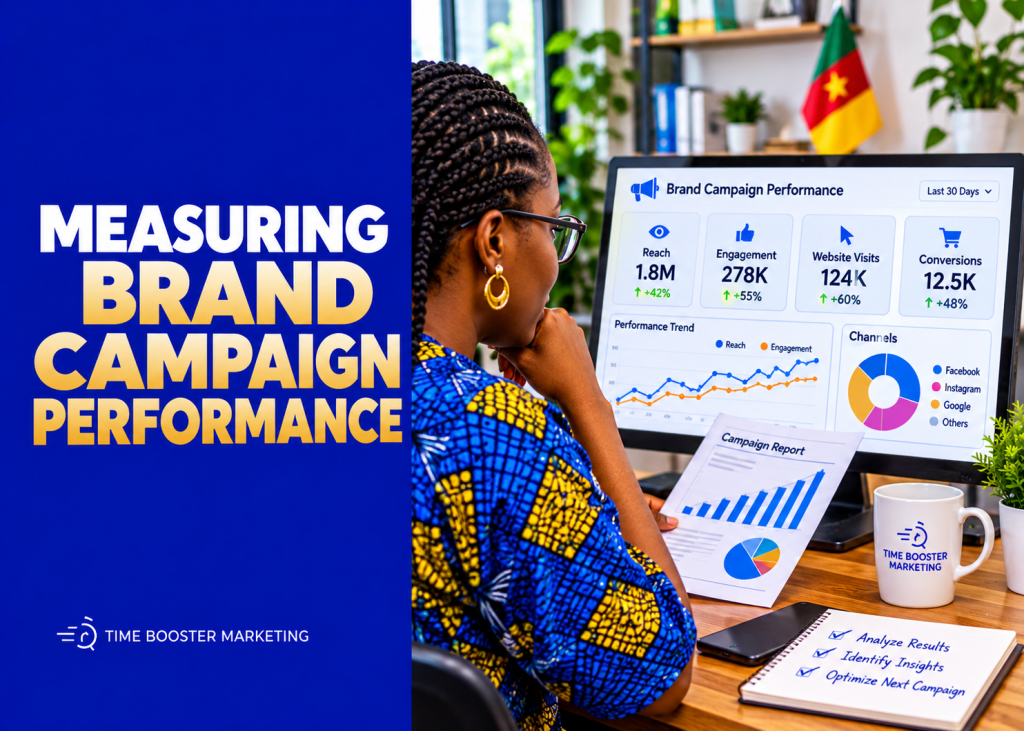
Step 8: Measure Your Brand Campaign Performance
You cannot determine whether your campaign succeeded simply by looking at how many posts were published or how many people liked them.
The metrics you track should reflect the campaign’s objectives.
Three important measurement areas are awareness, engagement, and conversion.
Brand Awareness Metrics
These help you understand how many people were exposed to your campaign.
Track:
- Reach: The number of unique people who saw your content or advertisement.
- Impressions: The total number of times your content or advertisement was displayed.
- Video views: The number of views recorded according to the platform’s measurement definition.
- Brand searches: Changes in searches for your business or brand name, where reliable data is available.
A campaign designed to introduce a new business may prioritize these indicators.
Engagement Metrics
These help you understand how people interacted with your campaign.
Track:
- Likes and reactions.
- Comments.
- Shares.
- Saves.
- Video watch time.
- Profile visits.
- Direct messages.
High engagement may indicate that your content is attracting attention, but it does not automatically mean that people intend to purchase.
Conversion Metrics
These help you understand whether the campaign encouraged people to take meaningful business actions.
Depending on your objective, track:
- Qualified enquiries.
- WhatsApp conversations.
- Website form submissions.
- Phone calls.
- Bookings.
- Purchases.
- Revenue generated.
If your campaign aims to generate sales, conversion metrics should carry more weight than likes or impressions alone.
Calculate Your Engagement Rate
One simple way to evaluate content interaction is to calculate engagement rate by reach:
For example, if a campaign post reaches 5,000 people and receives 250 engagements:
The engagement rate is 5%.
Calculate Your Conversion Rate
You can also measure how many people who took a relevant action went on to complete a desired outcome.
For example, if 200 people visit a campaign landing page and 20 complete a registration form, the conversion rate is 10%.
Always use a consistent definition of the action being measured so that campaign results can be compared accurately.
Common Mistakes to Avoid When Planning a Brand Campaign
Even businesses with good products and marketing budgets can struggle when campaign planning is not properly structured.
Avoid these common mistakes.
1. Trying to Reach Everyone
A campaign designed for everyone often lacks a clear message.
Define the audience you want to reach and tailor the campaign to its needs, interests, and behavior.
2. Focusing Only on Promotional Content
Constantly telling people to buy can make a campaign repetitive.
Balance promotional messages with educational, informative, entertaining, and trust-building content.
3. Choosing Platforms Without Research
Do not assume that every social media platform is suitable for your business.
Choose channels based on where your customers spend time and how they prefer to discover products or services.
4. Ignoring the Customer Journey
A campaign should consider what happens after someone sees an advertisement.
If a potential customer clicks an ad but cannot find clear product information, pricing, or contact details, the opportunity may be lost.
Prepare your website, WhatsApp account, landing pages, and sales process before launching.
5. Spending Without Tracking Results
Advertising expenditure should be connected to measurable objectives.
Monitor campaign performance and understand which activities contribute to your desired outcomes.
6. Changing the Strategy Too Quickly
Not every campaign performs as expected immediately.
Give campaigns enough time and data to produce useful insights, while still responding to clear technical problems, poor delivery, or ineffective creative materials.
7. Inconsistent Brand Communication
Your visual identity, messaging, tone, and promotional materials should communicate a consistent brand image.
Inconsistency can make it difficult for customers to recognize and remember your business.
A Practical Brand Campaign Planning Checklist
Before launching your next campaign, make sure the following elements are in place:
- The primary campaign objective is clearly defined.
- The target audience has been identified.
- The audience’s needs and challenges are understood.
- The central campaign message is established.
- The brand’s unique selling proposition is clear.
- Appropriate marketing channels have been selected.
- Content themes and creative assets are planned.
- A content calendar has been prepared.
- The campaign budget has been approved.
- The campaign timeline is established.
- Website and customer contact channels are ready.
- Tracking and reporting systems are in place.
- Awareness, engagement, and conversion metrics are defined.
The team responsible for executing and monitoring the campaign is identified.
This checklist helps prevent important activities from being overlooked and gives the campaign a clear structure before execution begins.
Final Thoughts: Build a Brand Campaign That Reaches the Right Customers
A successful brand campaign in Cameroon starts with understanding who you want to reach and what you want your business to achieve.
Publishing more content or spending more money on advertising does not automatically produce better marketing results. Your campaign needs a defined audience, a compelling message, appropriate channels, coordinated creative assets, and a realistic budget.
Most importantly, every activity should contribute to a clear objective that can be measured and evaluated.
Whether your business is introducing a new product, building brand awareness, entering another market, or strengthening its existing position, a structured campaign can help you communicate more effectively and reach the customers who matter.
At Time Booster Marketing, we help businesses develop marketing strategies, create campaign content, manage digital advertising, and improve their online visibility.