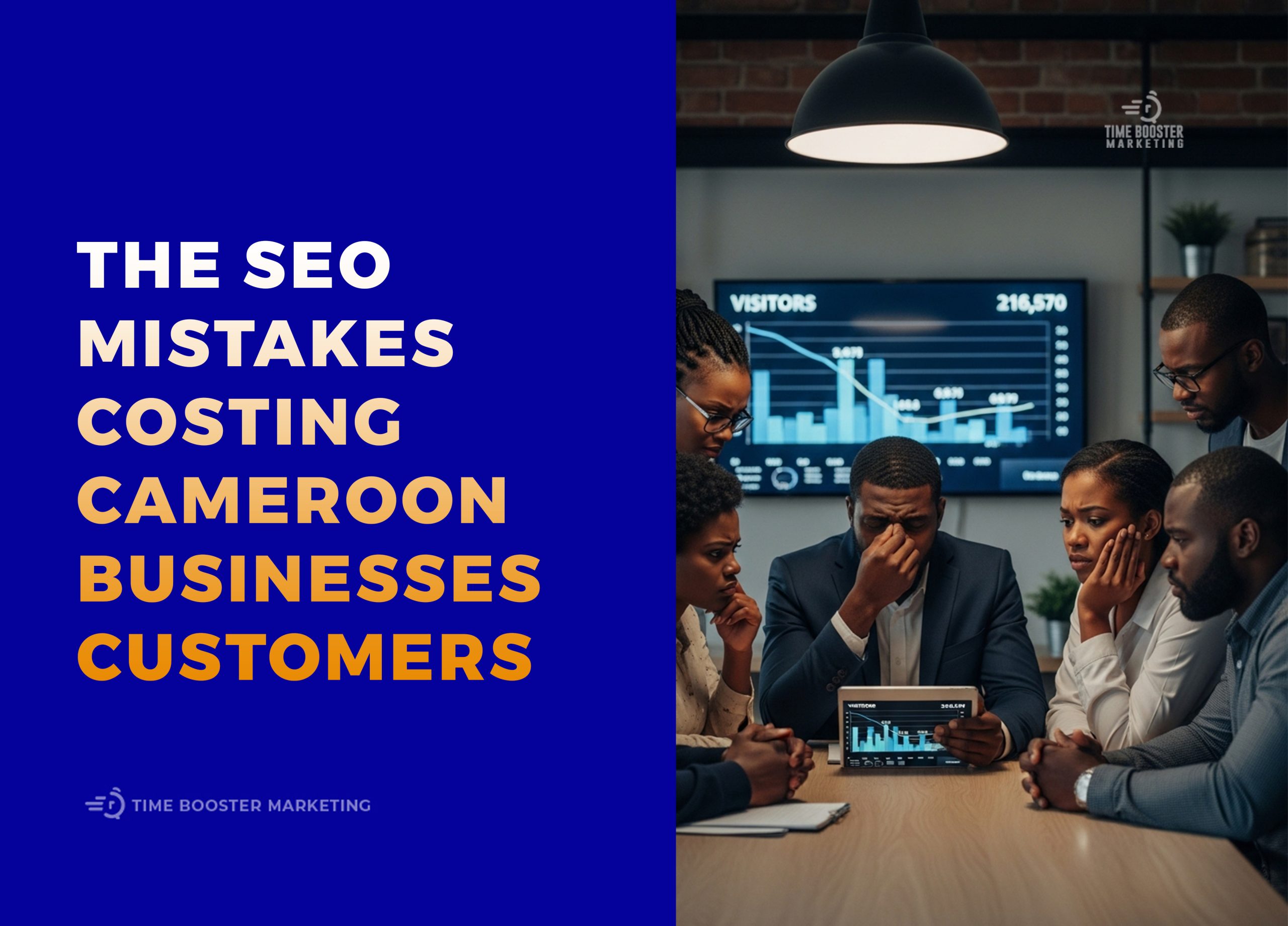
You’ve launched your business in Cameroon, built a website, and are ready to welcome a flood of new customers. But there’s a problem: the customers aren’t coming. Your website feels like a beautiful storefront on a deserted street. This frustrating experience is often the result of a few simple, yet critical, online mistakes.
This guide is here to shine a light on those issues and show you how to fix the most common SEO errors that prevent Cameroonian businesses from succeeding online.
Search Engine Optimization (SEO) can sound like a complex, technical mystery, but at its heart, it’s about making it easy for search engines like Google to find your website and show it to people who are looking for what you offer. You don’t need to be a tech genius to make a huge impact. By understanding and correcting a few key mistakes, you can dramatically increase your visibility, attract more qualified traffic, and turn your website into a powerful engine for growth. Let’s walk through these errors together and get your business on the path to the front page of Google.
The Cameroonian Context: Why These Errors Matter More Here

Before we dive into the specific errors, it’s vital to understand the local digital landscape. An SEO mistake that is a minor issue in Europe can be a major roadblock for a business in Cameroon.
- Mobile is Everything: For the majority of Cameroonians, a smartphone is their primary, and often only, device for accessing the internet. A website that is not perfectly optimized for mobile is essentially broken for most of your potential customers.
- Data is Valuable: Many users are on prepaid data plans where every megabyte is precious. A slow, heavy website doesn’t just waste time; it costs your visitors real money, causing them to leave before your page even loads.
- Local Trust is Key: In a growing market, consumers look for signals that a business is legitimate and local. A lack of a clear local presence online can make your business seem untrustworthy or foreign, driving customers to competitors they can verify.
Keeping these local realities in mind transforms SEO from a simple marketing checklist into a user-centric strategy for building trust and providing value.
Error 1: Ignoring Local SEO and the Power of “Near Me”
The Problem: This is arguably the biggest and most common SEO error for businesses with a physical location or service area. You could have the best restaurant in Yaoundé or the most skilled tailor in Douala, but if you don’t show up when someone searches “restaurant near me” or “tailor in Douala,” you are invisible to the majority of ready-to-buy customers. You have failed to tell Google that you exist in the local community.
Why It’s Critical in Cameroon: Local searches are incredibly powerful. People use their phones to find businesses in their immediate vicinity. By neglecting local SEO, you are handing customers on a silver platter to your competitors who have taken the simple steps to claim their digital location.
How to Fix It: Your Local SEO Action Plan
This is one of the most impactful fixes you can make, and it’s completely free.
- Claim Your Google Business Profile (GBP):
-
- Go to google.com/business and search for your business name and address.
- If a profile exists, claim it. If not, create a new one.
- You will need to verify your business, usually by receiving a postcard with a code at your physical address. This step is crucial; it proves to Google you are a legitimate local business.
- Fully Optimize Your GBP: Don’t just claim it; complete it. A complete profile ranks higher.
-
- Business Name, Address, Phone Number (NAP): Ensure this is 100% accurate and consistent everywhere online.
- Categories: Choose the most specific primary category possible (e.g., ” Cameroonian Restaurant” instead of just “Restaurant”). Add secondary categories as well.
- Business Hours: Keep these updated, especially for public holidays.
- Photos: Upload high-quality, authentic photos of your storefront, your products, your team, and happy customers. This builds immense trust.
- Services/Products: List everything you offer.
- Q&A: Proactively ask and answer common questions your customers might have.
- Encourage Customer Reviews: Positive reviews are a massive ranking factor. Ask your happy customers to leave a review on your Google profile. Respond to all reviews, both positive and negative, to show you are engaged.
- Create Local Content: Write pages on your website specifically about your local area. For example, a tour operator could write a blog post on “The Top 5 Things to Do in Kribi.”
Fixing this one error can put your business on the map, literally.
Error 2: Having a Slow, Heavy Website
The Problem: Your website takes more than a few seconds to load. The images are blurry for a moment before they sharpen, and the text appears slowly. Users get impatient and click the “back” button. This is a huge problem, as page speed is a confirmed Google ranking factor.
Why It’s Critical in Cameroon: On a slow or unstable network with limited data, a 5-second load time can feel like an eternity. A heavy page that uses 10MB of data is a major expense for the user. They will not wait, and Google knows this. A slow site is a poor user experience, and Google will penalize you for it in the rankings.
How to Fix It: Speed Optimization Basics
Start by testing your site with Google’s PageSpeed Insights tool. It will give you a score and a list of opportunities. Here are the most common fixes:
- Aggressively Compress Your Images: This is the #1 cause of slow websites. Before you upload any image, use a tool like TinyPNG or Squoosh to drastically reduce its file size. A 2MB image can often be shrunk to 200KB with no noticeable loss in quality. If you use WordPress, install an image optimization plugin like Smush.
- Choose the Right Image Format: Use modern formats like WebP where possible, as they offer the best compression. Use JPEG for photos and PNG for graphics that need transparency.
- Leverage Browser Caching: This tells a visitor’s browser to save parts of your website (like your logo and CSS files). When they visit another page, it loads much faster. Caching plugins for WordPress (like W3 Total Cache or WP Rocket) can set this up with a few clicks.
- Choose Good Hosting: Extremely cheap hosting often means slow server response times. Investing in reliable hosting from a reputable provider is a foundational part of site speed.
A faster website means happier users and a better ranking from Google.
Error 3: Neglecting Keyword Research for the Local Market
The Problem: You are creating content and writing product descriptions using the words you think people are using, or worse, using generic terms from a global perspective. You write about “real estate” when your customers are searching for “parcelle à vendre.” This is one of the most fundamental common SEO errors.
Why It’s Critical in Cameroon: Language is nuanced. People search using a mix of French, English, and Cameroonian Pidgin English (CPE). They use local slang and specific terminology. If your website’s content doesn’t match the language of your searchers, you will never connect.
How to Fix It: Think Like Your Customer
- Brainstorm from Your Customer’s Perspective: Sit down and write down all the questions a potential customer might have. How would they phrase them? Would they use formal French or Pidgin?
- Use Google’s Free Tools:
-
- Google Autocomplete: Start typing a search query into Google and see what suggestions pop up. These are real searches people are making.
- “People Also Ask” (PAA): Search for a topic and look for the PAA box. This is a goldmine of question-based keywords.
- Related Searches: At the bottom of the search results page, Google gives you a list of related queries.
- Listen to Your Customers: Pay attention to the exact words and phrases your customers use when they call you, email you, or talk to you in person. This is your most valuable keyword research tool.
- Focus on Long-Tail Keywords: Don’t just target “buy shoes.” Target “buy affordable leather sandals in Bafoussam.” These longer, more specific phrases have less competition and are used by people who are much closer to making a purchase.
Integrate these keywords naturally into your page titles, headings, product descriptions, and blog posts.
Error 4: Having Thin, Duplicate, or Generic Content
The Problem: Your product pages have only a single sentence copied from the manufacturer. Your “About Us” page is two lines long. You have no blog, or your blog posts are short, unhelpful articles that don’t truly answer any questions. This “thin” content signals to Google that your site has low value.
Why It’s Critical in Cameroon: Trust is built through information and authenticity. A website with thin, generic content feels impersonal and untrustworthy. In a market where consumers are cautious, providing detailed, helpful, and unique content that showcases your expertise is how you build the confidence needed to make a sale. Addressing these content-related issues is key to fixing common SEO errors.
How to Fix It: Become the Expert
- Write Unique and Detailed Product Descriptions: Go beyond the basic specs. Describe the benefits. How will this product make your customer’s life better? Who is it perfect for? Use your own photos instead of just stock images.
- Create a Compelling “About Us” Page: This is your chance to tell your story. Why did you start this business? What is your connection to Cameroon? People connect with and buy from other people, not faceless websites.
- Start a Blog and Provide Real Value: Create a content strategy around the keywords you researched. Write comprehensive guides, answer common questions, and create tutorials. A tailor could write “How to Take Your Own Measurements for a Custom Suit.” A caterer could post “A Guide to Planning the Menu for a Cameroonian Wedding.”
- Avoid Duplicate Content: Never copy and paste content from other websites or across multiple pages of your own site. Every page should have unique, valuable content.
Error 5: A Poor Mobile Experience
The Problem: Your website is just a shrunken-down version of your desktop site. The text is tiny and unreadable. The buttons are too small to tap accurately. Users have to pinch and zoom constantly to navigate. This is a guaranteed way to lose customers.
Why It’s Critical in Cameroon: As we’ve established, if your site doesn’t work perfectly on a smartphone, it doesn’t work for most of your audience. This isn’t just a minor inconvenience; it makes your site unusable. Google has a “mobile-first” indexing policy, meaning it primarily uses the mobile version of your site for ranking. A bad mobile experience is a direct penalty to your SEO.
How to Fix It: Think Mobile-First
- Use a Responsive Design: This is a non-negotiable standard. A responsive website automatically adapts its layout to fit any screen size. Most modern website builders and themes (like those on WordPress, Shopify, or Squarespace) are responsive by default.
- Test Your Site on a Real Phone: Don’t just rely on desktop simulators. Open your website on your own phone and on your friends’ phones. Navigate through it. Is it easy? Is the text large enough? Can you easily click the menu items?
- Use Google’s Mobile-Friendly Test: This free tool will tell you if Google considers your page mobile-friendly and will point out any specific issues.
- Simplify Navigation: Mobile users need simple, clear navigation. Use a “hamburger” menu icon and ensure your menu options are concise and easy to understand.
Conclusion: Taking Control of Your Online Success
Fixing these common SEO errors is not about chasing a complex algorithm. It’s about taking a step back and focusing on the experience you are providing to your visitors. By making your website faster, more mobile-friendly, more locally relevant, and more genuinely helpful, you are not just doing “SEO.” You are building a better business.
Your action plan starts now.
- Run a speed test on your homepage with Google PageSpeed Insights.
- Go and claim or fully optimize your Google Business Profile.
- Review your website on your smartphone and be honest about the experience.
Don’t feel overwhelmed. Pick one error from this list and commit to fixing it this week. Then move on to the next. This steady, consistent effort is what separates the businesses that thrive online from those that remain invisible. Your customers are searching for you; it’s time to make sure they can find you.