Is Inconsistent Posting Hurting Your Business in Yaoundé?
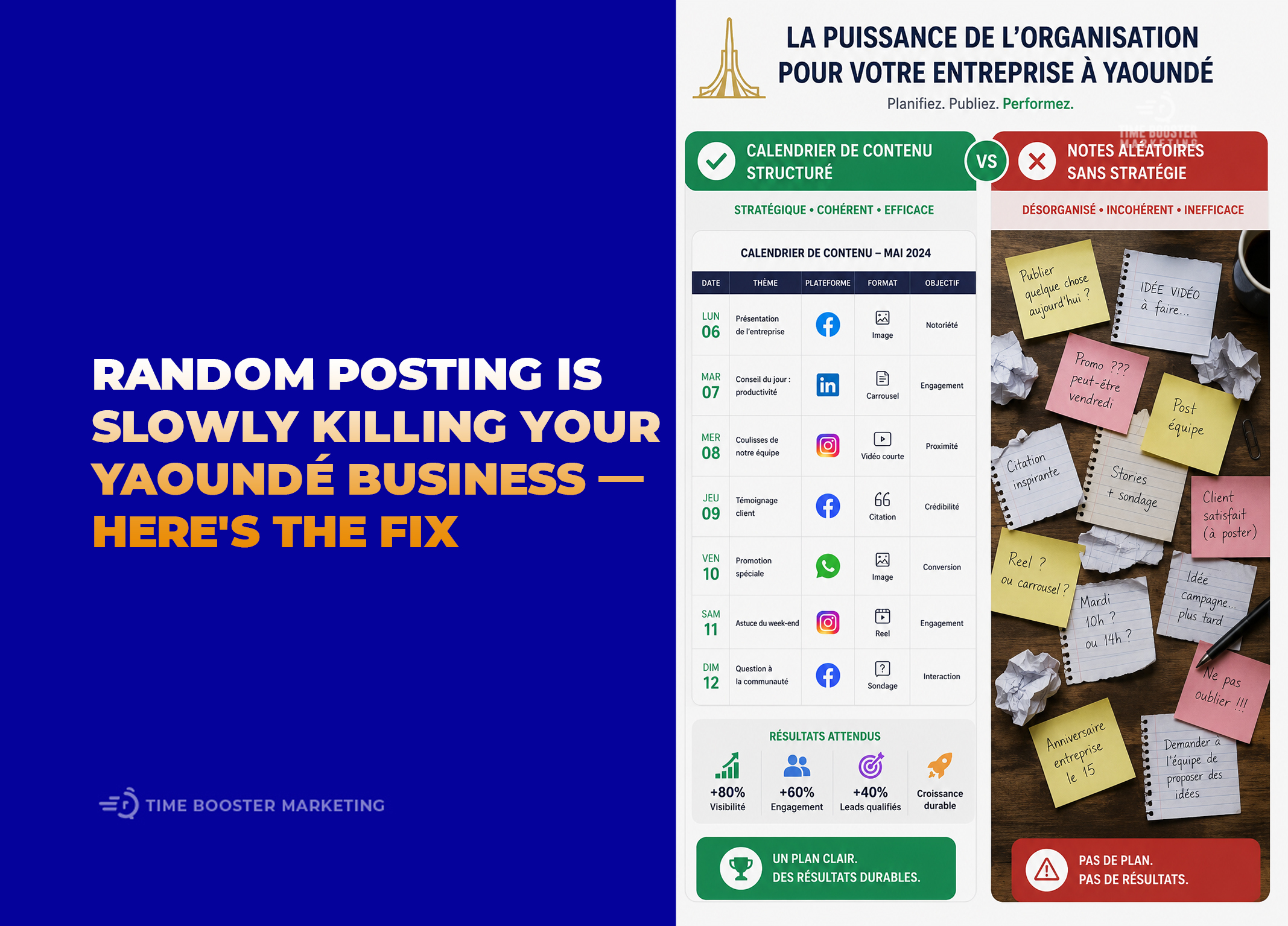
Random posting feels normal when you are busy running a business in Yaoundé. You have customers to serve, suppliers to call, staff to manage, rent to pay, and cash flow to protect. So you post when you have time. One week you post five times. Then you disappear for twelve days. Then you return with a flyer saying “Promo available.”
The problem is not that you missed one post. The problem is that your audience never learns to expect you.
In a market where customers compare businesses through Facebook, Instagram, WhatsApp status, Google, and referrals, silence creates doubt. People may not say it directly, but inconsistent posting makes your business feel less active, less organized, and less present. That matters because Cameroon’s digital audience is already large: DataReportal reported 12.6 million internet users in Cameroon at the end of 2025 and 5.90 million social media user identities in October 2025. (Facebook)

How the Algorithm Punishes Inconsistency
Social media platforms do not usually say, “We punish you for posting randomly.” The damage is more practical than that.
Algorithms need signals. They look at how people interact with your content: whether they watch, save, comment, share, click, message, or ignore. Instagram explains that different parts of the app use ranking systems based on signals such as user activity, post information, interaction history, and the likelihood that someone will engage with a post. (Instagram) TikTok also says its recommendation systems are shaped by user interactions, content information, and user information, with interactions often weighted strongly. (TikTok Support)
When you post inconsistently, you reduce the number of signals your account produces. Your audience stops engaging regularly because they do not see you regularly. Your content has fewer chances to prove relevance. Your account becomes harder to understand because you are not repeatedly showing what you sell, who you serve, and why people should care.
For a Yaoundé restaurant, that means fewer people remember your lunch offer. For a salon, fewer people think of you before the weekend. For a boutique, fewer customers see enough outfit ideas to decide. For a real estate agent, fewer prospects build trust before asking about property.
The algorithm problem is simple: random posting gives platforms less useful data. Less useful data usually means weaker distribution.

The Audience Damage Is Worse Than the Algorithm Damage
The algorithm is not your only problem. Your customers are also learning from your silence.
When people follow your business, they are not ready to buy every day. They may be waiting for salary week, a wedding, a meeting, a trip, a birthday, a relocation, or a recommendation from a friend. Consistent content keeps you present until the buying moment arrives.
Random posting breaks that memory.
If your last post is three weeks old, the customer may wonder if the offer is still available. If your page is active only during promotions, people learn to wait for discounts. If every post is urgent, customers stop trusting the urgency. If your WhatsApp status disappears for long periods, your business becomes less top-of-mind than the competitor who shows up every week.
This is why social media posting consistency in Yaoundé is not about vanity. It is about commercial memory. You are training people to remember your business before they need you.
![Social Media Content Calendar: Step-By-Step Guide [+ Template]](https://api.backlinko.com/app/uploads/2025/05/building-a-minimum-viable-calendar-for-social-media.png "Is Inconsistent Posting Hurting Your Yaoundé Business? 3")
The Minimum Viable Posting Schedule for a 1-Person Business
You do not need to post three times a day. That advice burns out small-business owners.
A one-person Yaoundé business needs a minimum viable schedule: enough content to stay visible, build trust, and create sales conversations without turning the owner into a full-time content creator.
Start here:
| Platform | Minimum Weekly Activity | Purpose |
|---|---|---|
| Instagram or Facebook feed | 3 posts per week | Visibility and credibility |
| Stories or WhatsApp Status | 4–5 short updates per week | Daily presence and reminders |
| Reels or short videos | 1–2 per week | Discovery and personality |
| Customer follow-up message | 1 per week | Conversion and repeat sales |
Three feed posts per week are enough to show consistency. Stories and WhatsApp Status keep you active without needing polished design. One or two short videos help people see the real business behind the page.
Meta Business Suite can help reduce the pressure because it allows businesses to create and schedule Facebook and Instagram content in advance. (Facebook) That matters for owner-led businesses because consistency should not depend on whether you remembered to post during a busy sales day.
What Should You Post Each Week?
Your content calendar does not need to be complicated. It needs to answer the questions customers already have.
Post 1: Show the Offer
This is your direct sales post. Show the product, service, package, room, menu, listing, class, or appointment slot. Make the caption specific.
Weak version: “Quality services available.”
Better version: “Need a clean protective hairstyle before the weekend? Book by Thursday to secure your slot.”
The better version gives context, timing, and a reason to act.
Post 2: Build Trust
This post proves that your business is real and reliable. Use testimonials, before-and-after photos, behind-the-scenes clips, delivery proof, customer results, staff preparation, or process explanations.
Instagram’s creator guidance emphasizes original content and reach-improving practices, which supports the broader point that businesses should not depend only on recycled flyers or copied posts. (Instagram Creators) Your audience wants proof that you can deliver.
Post 3: Educate or Advise
This is where you help the customer make a better decision.
A restaurant can explain how to choose a catering package. A boutique can show how to style one dress three ways. A gym can explain what beginners should do in their first month. A real estate agent can explain what documents a tenant should ask for before paying.
Educational content builds authority without begging for attention.
The 3-Week Content Batching Method
Content batching means creating several posts in one focused session instead of trying to invent content every day.
Here is a simple method that buys you three weeks at once.
Step 1: Pick 3 Core Offers
Choose three things you want to sell or promote. For example, a salon may choose braids, frontal installation, and bridal styling. A restaurant may choose lunch delivery, weekend grills, and corporate catering. A boutique may choose office wear, church outfits, and evening dresses.
Do not start with random content ideas. Start with revenue.
Step 2: Create 3 Angles Per Offer
For each offer, create one sales angle, one trust angle, and one education angle.
That gives you nine feed posts:
| Offer | Sales Post | Trust Post | Education Post |
|---|---|---|---|
| Offer 1 | Promote it | Prove it works | Explain how to choose |
| Offer 2 | Promote it | Show customer proof | Share useful advice |
| Offer 3 | Promote it | Show process | Answer common objections |
Nine posts equals three posts per week for three weeks.
Step 3: Record Short Clips While Working
You do not need a studio. Record simple clips during normal business activity: packaging an order, preparing a dish, styling a client, arranging products, inspecting a property, setting up an event space, or welcoming customers.
Short-form content works best when it feels direct and useful. Instagram’s own Reels guidance has repeatedly pushed creators toward original, consistent content as a growth lever. (Instagram Creators)
Step 4: Schedule the Feed Posts
Once the nine posts are ready, schedule them. Use Meta Business Suite for Facebook and Instagram. Keep WhatsApp Status flexible because it works better when it feels current.
Your posting rhythm could look like this:
| Day | Content Type |
|---|---|
| Monday | Educational post |
| Wednesday | Trust-building post |
| Friday | Offer post |
| Tuesday/Thursday/Saturday | WhatsApp Status updates |
This structure gives you visibility without forcing you to create from scratch every morning.
The 15-Minute Weekly Reset
Even with batching, you need a short weekly review.
Every Monday, ask four questions:
Did we post what we planned?
Which post created the most messages or comments?
What question did customers ask most this week?
What offer should we push next week?
That is enough. You are not trying to become a data analyst. You are trying to stay accountable.
Conclusion
Random posting is not destroying your Yaoundé business overnight. It is doing something quieter: weakening memory, reducing trust, confusing the algorithm, and slowing down customer decisions.
A better system does not require a big team. It requires a simple rhythm. Post three times per week. Use WhatsApp Status to stay present. Batch content around your real offers. Schedule what you can. Review what worked.
When your audience sees you consistently, they understand what you sell, remember you faster, and trust you sooner. In a busy Yaoundé market, that steady presence can be the difference between being noticed once and being chosen repeatedly.