
Digital marketing has become a vital tool for businesses in Cameroon to reach wider audiences, engage customers, and drive sales. However, without tracking your marketing efforts’ return on investment (ROI), you risk spending money without knowing if your campaigns are effective.
To avoid this pitfall, tracking digital marketing ROI helps you understand which strategies work best, maximize your budget, and make data-driven decisions. This article provides easy ways to track your digital marketing ROI in Cameroon, using simple tools and practical tips tailored to local businesses.
Understanding Digital Marketing ROI
Before exploring tools and techniques, it’s important to understand digital marketing ROI. ROI measures the profitability of marketing campaigns by comparing the revenue generated against the cost of the efforts.
Knowing your ROI is essential because it helps you allocate your marketing budget efficiently, identify high-performing campaigns, and make strategic decisions that fuel growth.
In Cameroon’s dynamic market, focusing on the right key performance indicators (KPIs) is crucial. Common KPIs include website traffic, conversion rates, cost per lead, and social media engagement. Here are a few steps to follow:
Step 1: Set Clear Goals and KPIs

The first step in tracking ROI effectively is setting clear, measurable goals. Without defined objectives, it’s impossible to know whether your campaigns succeed.
For example, you might aim to increase online sales by 20% within six months or grow your email subscriber list by 1,000 contacts. Depending on your goals, you’ll select KPIs such as conversion rate or cost per acquisition to track progress.
By establishing these targets upfront, you create a roadmap for your marketing efforts and a benchmark for measuring success.
Step 2: Use Simple and Free Tools to Track ROI
Once your goals are set, the next step is to gather data using accessible tools.
Google Analytics is a powerful, free platform that provides detailed insights into your website traffic and user behavior. Setting up conversion goals in Google Analytics allows you to track actions like purchases or contact form submissions.
Similarly, social media platforms like Facebook, Instagram, and Twitter offer built-in analytics to monitor post reach, engagement, and audience demographics. These insights help you understand which content resonates with your audience.
To track the exact source of your traffic, use UTM parameters. These are small tags added to your URLs that identify specific campaigns or ads. Google’s free UTM builder makes this easy.
For businesses looking to consolidate data, all-in-one dashboards like Cyfe or Zoho Analytics bring multiple data sources together, simplifying performance monitoring.
Step 3: Key Metrics to Monitor and Calculate ROI
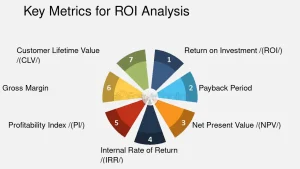
With data flowing in, focus on monitoring the most impactful metrics.
Conversion rate tells you the percentage of visitors who complete desired actions, such as making a purchase or signing up for a newsletter. Customer lifetime value (CLV) estimates the total revenue you can expect from a customer over time, helping you prioritize long-term relationships.
Cost per lead (CPL) and cost per acquisition (CPA) measure how efficiently you’re gaining new customers or leads, while click-through rate (CTR) assesses the effectiveness of your ads or emails.
Important Metrics
-
Conversion Rate: Percentage of visitors completing desired actions
-
Customer Lifetime Value (CLV): Total revenue expected from a customer
-
Cost Per Lead (CPL) and Cost Per Acquisition (CPA): Cost to acquire a lead or customer
-
Click-Through Rate (CTR): Effectiveness of ads or emails
Simple ROI Formula
ROI=Revenue−Marketing CostMarketing Cost
Example:
If you spend 100,000 FCFA on a campaign and earn 300,000 FCFA in sales:
ROI=300,000−100,000100,000=2
Meaning you earn 2 FCFA for every 1 FCFA spent (200% return).
Step 4: Regular Review and Optimization
Tracking ROI is not a one-time task; it requires ongoing attention.
Schedule weekly or monthly reviews to analyze your campaign performance. Use A/B testing to experiment with different ad creatives, email subject lines, or landing pages, identifying what resonates best.
Based on your insights, adjust your budget allocation to focus on high-performing channels and refine your messaging to better connect with your audience.
Step 5: Reporting and Sharing Insights
Clear communication of your findings is key to collaborative success.
Create simple, visual reports using dashboards or spreadsheets that highlight wins and areas for improvement. Sharing these insights with your team or partners fosters transparency and encourages data-driven decision-making.
Common Mistakes to Avoid
While tracking ROI, be mindful of common pitfalls.
Avoid setting vague or unrealistic goals, as these make it difficult to measure success. Don’t overwhelm yourself by tracking too many irrelevant metrics—focus on KPIs that align with your objectives.
Remember to account for offline impacts, such as in-store visits influenced by your digital campaigns, by using promo codes or dedicated phone numbers. Finally, always act on your data insights, because collecting information without applying it limits your growth potential.
Practical Tips for Cameroonian Businesses
To get started effectively:
-
Begin with free tools like Google Analytics and Facebook Insights.
-
Localize your tracking by segmenting campaigns by city or region to gain actionable insights.
-
Train your team on basic analytics to interpret data confidently.
-
Maintain consistency in tracking and reporting to build a reliable performance history.
Conclusion
Measuring your digital marketing ROI doesn’t have to be complex or expensive. Using simple tools and a structured approach, Cameroonian businesses can confidently track campaign effectiveness, optimize budgets, and achieve sustainable growth. Start implementing these easy tracking methods today to ensure every marketing franc you spend delivers maximum value.