Optimizing for Impact: Why Web Design & Development is the Secret to CRO in Cameroon
CRO sounds like a marketing topic, but in Cameroon, it behaves like an engineering problem wearing a marketing hat. You can drive traffic with Facebook, Google, and influencers, but if your pages load slowly on mobile data, your offer is unclear, or your checkout forces the wrong payment method, conversions will stall. That is why Web Design & Development is the quiet secret behind the brands that consistently turn clicks into calls, chats, deposits, and repeat customers.

Most Cameroon businesses pour money into driving traffic to their websites through ads, social media, and SEO. Yet when those visitors land on the site, the majority leave without taking a single meaningful action. No inquiry. No purchase. No phone call. The instinct is to blame the traffic source, tweak the ad copy, or increase the budget. But the real problem is almost always staring you in the face: the website itself. Your Web Design & Development is silently determining your conversion rate every single day, and for most Cameroon businesses, it is actively working against them.
Conversion Rate Optimization (CRO) is the discipline of increasing the percentage of website visitors who complete a desired action, whether that is filling out a contact form, making a purchase, calling your business, or sending a WhatsApp message. In Cameroon’s digital environment, where mobile dominates, internet speeds fluctuate, and consumer trust must be earned through every interaction, Web Design & Development is not a supporting player in CRO. It is the foundation on which every conversion is built or broken. Getting this right means your existing traffic works harder, your ad spend becomes more efficient, and your revenue grows without necessarily increasing your marketing budget.
Here is what this guide will give you:
- A clear understanding of why CRO in Cameroon starts with your website’s architecture, not your ad campaigns
- The specific Web Design & Development factors that determine whether Cameroonian visitors convert or bounce
- Actionable strategies to rebuild or refine your site for measurable conversion improvements
- Real patterns from Cameroon businesses that fixed their sites and saw immediate results
Why CRO in Cameroon Starts with Web Design & Development, Not More Traffic

The Cameroon Digital Environment Your Website Must Survive
Before a single design decision or line of code is written, you need to understand the technical and behavioral environment your website operates within. Cameroon’s digital landscape imposes specific constraints that directly affect whether your website can convert visitors, and ignoring them is the single fastest way to waste every franc you spend on marketing.
The majority of Cameroonians accessing the internet do so through mobile devices, primarily mid-range Android smartphones. Network speeds vary dramatically depending on location, carrier, and time of day. A user in central Douala on MTN 4G may have a reasonable connection, while someone in a secondary city or on the outskirts of Yaoundé may be dealing with slow, unreliable 3G. Your website must perform under the worst of these conditions, not the best, because the visitors you lose to slow load times are invisible losses you never see in your analytics.
Beyond connectivity, Cameroonian users have specific behavioral patterns that affect conversion. WhatsApp is the dominant communication channel, meaning that a “Contact Us” form alone is insufficient if you do not offer a direct WhatsApp option. MTN MoMo and Orange Money are the primary payment methods, and any e-commerce checkout that relies solely on credit card processing will lose the vast majority of potential buyers. Trust is earned through visible signals like local phone numbers, physical addresses, recognizable local imagery, and social proof from other Cameroonians.
Critical factors your Web Design & Development must account for:
- Device reality: 75%+ of traffic comes from mobile, mostly mid-range Android devices with smaller screens and limited processing power.
- Network constraints: Inconsistent speeds ranging from slow 3G to moderate 4G, with frequent interruptions outside major urban centers.
- Data cost sensitivity: Many users are on limited data plans, making lightweight pages essential.
- Language duality: French dominates in most regions, English in the Northwest and Southwest, and bilingual users exist across urban centers.
- Payment preferences: MTN MoMo and Orange Money are the standard for online transactions.
- Communication habits: WhatsApp is the preferred channel for business inquiries and follow-up.
The Hidden Cost of a Website That Doesn’t Convert
Most Cameroon businesses do not track their conversion rate with any precision. They know they have a website, they know they run ads, and they have a general sense of whether business is good or slow. But without understanding the specific percentage of visitors who take action, you cannot identify or fix the problem. A website with a 0.5% conversion rate and one with a 3% conversion rate look identical from the outside. The difference is that the second site generates six times more leads or sales from the exact same traffic.
Every visitor who lands on your site and leaves without converting represents a tangible cost. If you paid for that click through Google Ads or Facebook Ads, you literally spent money to bring someone to a digital experience that failed them. If they arrived through organic search, you invested time and effort in SEO that produced a visit but not a result. The compounding effect of a low conversion rate is devastating over time, quietly eroding your marketing ROI month after month while you focus on acquiring more traffic instead of fixing the experience that receives it.
Consider this scenario: a Cameroon business spends 200,000 FCFA per month on Facebook Ads, driving 2,000 visitors to their website. If their conversion rate is 1%, they get 20 leads. If they improve their Web Design & Development to push that rate to 3%, they get 60 leads from the same spend. That is three times the results without a single additional franc in advertising. This is why CRO through web design and development is the highest-ROI investment most Cameroon businesses can make.
A Brief History of Web Design & Development in the Context of CRO
The relationship between Web Design & Development and conversion optimization has evolved significantly over the past two decades. In the early days of the web, sites were primarily informational and static. Success was measured by visits, not conversions. As e-commerce and lead generation grew, businesses began to recognize that design choices directly affected revenue. The emergence of A/B testing tools in the late 2000s formalized the practice of testing different page versions against each other. Landing page optimization became a specialized discipline, and tools like Google Analytics made it possible to track user behavior with precision.
In markets like Cameroon, this evolution has been compressed. Many businesses jumped from having no website to having a mobile-accessible site within a few years, often skipping the iterative learning process that Western businesses went through over a decade. The result is that many Cameroonian websites are built on outdated assumptions about user behavior, device capabilities, and conversion mechanics. They look like websites from five or ten years ago, designed for desktop screens and fast broadband, when the reality of their audience is entirely different.
The current state of CRO globally emphasizes mobile-first design, page speed as a primary ranking and conversion factor, personalized user experiences, and continuous data-driven iteration. For Cameroon businesses, adopting these principles within Web Design & Development is not about following trends; it is about closing the gap between what their websites currently deliver and what their audience actually needs to convert.
The Web Design & Development Pillars That Drive CRO in Cameroon

To transform your website from a passive digital brochure into an active conversion engine, you need to address specific pillars within your Web Design & Development that directly influence whether Cameroonian visitors take action or abandon your site.
Pillar 1: Mobile-First Architecture That Respects the User’s Reality
In Cameroon, mobile-first is not a design philosophy. It is the literal operating environment for the vast majority of your audience. Building a mobile-first site means designing and developing for the smallest screen and slowest connection first, then scaling up for larger screens, rather than the reverse.
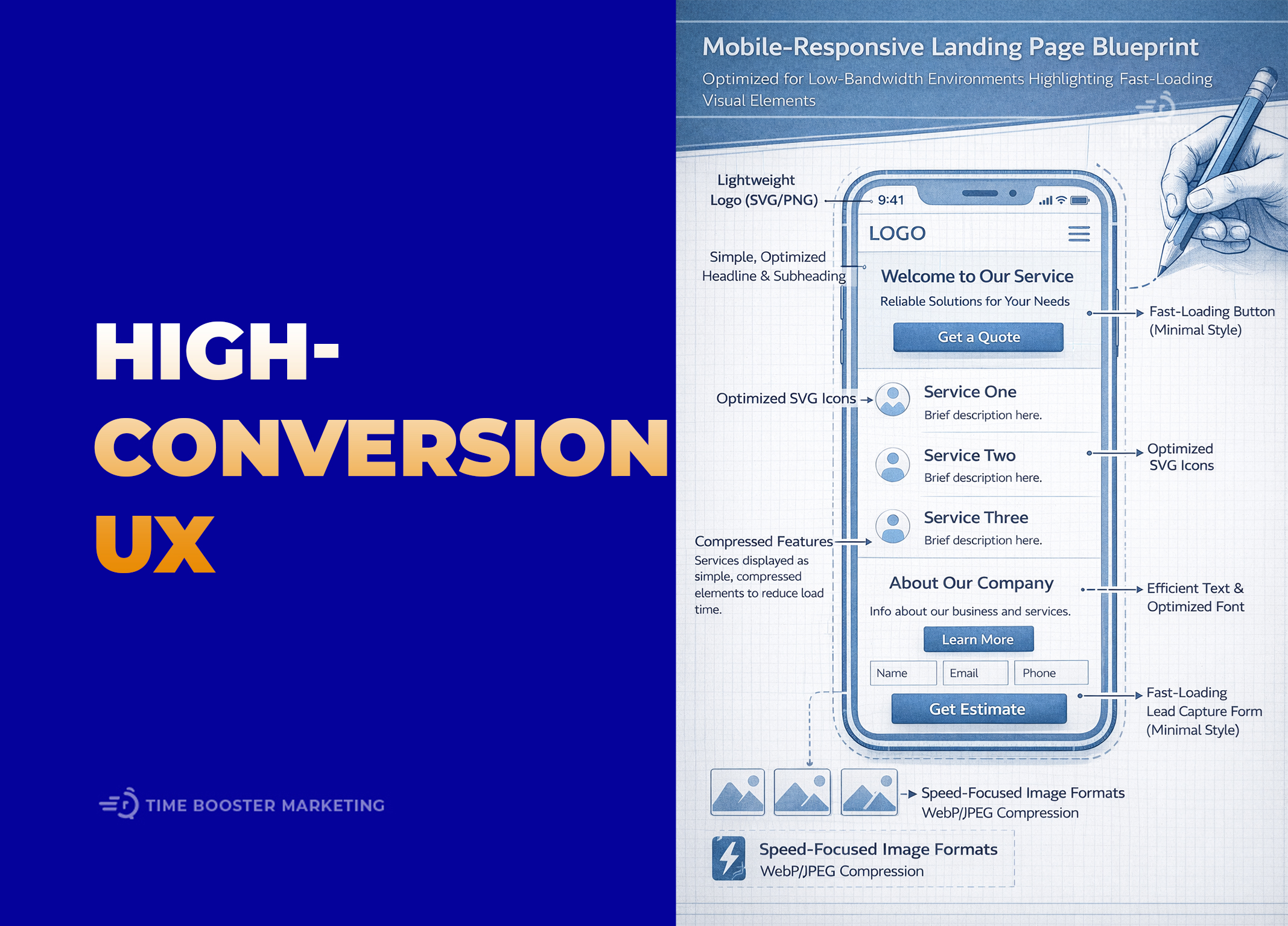
This pillar requires specific technical decisions that go far beyond simply making a desktop site “responsive.” True mobile-first architecture means your HTML, CSS, and JavaScript are structured so that mobile devices receive only the assets they need, without downloading heavy desktop resources and hiding them. Images must be served in next-generation formats like WebP at appropriate sizes for mobile screens. Fonts should be limited to system fonts or a single lightweight custom font to reduce load times. Interactive elements like buttons and form fields must be large enough for thumb navigation, with adequate spacing to prevent accidental taps.
For Cameroon specifically, this also means testing your site on the actual devices your audience uses. A site that looks perfect on an iPhone 15 but struggles on a Tecno Spark or Samsung Galaxy A series phone is not mobile-first. Test on mid-range Android devices over a 3G connection, and if your site loads in under three seconds under those conditions, you have a strong foundation. If it takes five or more seconds, you are losing a significant percentage of visitors before they even see your content.
Pillar 2: Page Speed as a Conversion Multiplier
Speed is arguably the single most impactful Web Design & Development factor for CRO in Cameroon. Google’s own research shows that as page load time increases from one second to five seconds, the probability of bounce increases by 90%. In a market where connection speeds are inconsistent and data costs are real, this effect is amplified.
Achieving fast load times requires work at every layer of your site. On the server side, choose hosting that provides a server physically closer to Cameroon or use a Content Delivery Network (CDN) with African edge locations to reduce latency. Implement server-side caching so that repeat visitors and common pages load from stored copies rather than being rebuilt on every request. On the code side, minify all HTML, CSS, and JavaScript files. Remove unused code, plugins, and libraries that add weight without contributing to functionality. On the content side, compress every image aggressively, lazy-load images and videos so they only download when the user scrolls to them, and avoid auto-playing video on landing pages.
For Cameroon businesses, a practical benchmark is to aim for a Largest Contentful Paint (LCP) under 2.5 seconds on a mobile connection. Use Google PageSpeed Insights or GTmetrix to test from a mobile device perspective, and treat any score below 70 on mobile as a priority fix. Every tenth of a second you shave off your load time translates directly into more visitors who stay, engage, and convert.
Pillar 3: Localized User Experience That Builds Immediate Trust
Trust is the currency of conversion in Cameroon. Your Web Design & Development must actively communicate trustworthiness from the first moment a visitor lands on your page. This goes far beyond having a professional-looking design; it means embedding specific, locally relevant trust signals throughout the experience.
A localized UX for Cameroon includes several critical elements. First, language. Your site must be available in French for the majority of your audience, with English available for Anglophone regions. This is not optional. A site that only serves English copy to a Francophone visitor in Douala has already lost that conversion. Second, local contact information. Display a Cameroonian phone number prominently, ideally with a direct WhatsApp click-to-chat button. Include a physical address in Cameroon if you have one, and show a map. Third, social proof. Feature testimonials from Cameroonian clients, display logos of local businesses you have worked with, and show case studies that describe results achieved in Cameroon. Fourth, familiar payment options. If you sell online, integrate MTN MoMo and Orange Money as primary payment methods, not afterthoughts buried below Visa and Mastercard options.
According to the Baymard Institute’s UX research, perceived trustworthiness of a site is one of the top reasons users decide to complete or abandon a transaction. In Cameroon, where online commerce is still earning consumer confidence, every trust signal you embed in your Web Design & Development directly improves your conversion rate.
Pillar 4: Conversion-Focused Layout and Information Architecture
The way information is organized and presented on your site determines whether visitors find what they need and take action, or get lost and leave. Conversion-focused layout means structuring every page with a clear hierarchy that guides the eye toward the most important content and the primary call-to-action.
Effective information architecture for a Cameroon business site starts with simplifying navigation. Limit your primary menu to five or six items maximum. Place your most important conversion action, whether it is “Contact Us,” “Get a Quote,” or “Shop Now,” in the most prominent position on every page. Use a sticky header on mobile so the navigation and primary CTA remain accessible as the user scrolls. Structure content in a logical flow: headline that addresses the visitor’s need, supporting evidence (benefits, features, social proof), and a clear call-to-action. Repeat the CTA at natural intervals throughout longer pages rather than placing it only at the top or bottom.
For service-based businesses in Cameroon, the most effective conversion path is often the shortest one. A visitor who arrives from a Google Ad should land on a page that immediately confirms they are in the right place, presents the core value proposition, provides social proof, and offers a clear way to take action, all without requiring excessive scrolling or clicking. Every additional step between landing and converting is a point where you lose people.
Pillar 5: Forms and CTAs Engineered for Cameroon User Behavior
Your forms and calls-to-action are the literal conversion points on your site, and they must be designed for the way Cameroonian users actually behave. Generic contact forms with seven fields, tiny submit buttons, and no alternative contact method will underperform dramatically compared to streamlined, mobile-optimized conversion elements.
For forms, reduce the number of fields to the absolute minimum needed to qualify a lead. Name, phone number, and a brief description of need is often sufficient for a service business. Make the phone number field the most prominent, as many Cameroonians prefer to be called back rather than exchange emails. Ensure form fields are large enough for mobile input, with appropriate keyboard types (numeric keyboard for phone numbers, email keyboard for email fields). Add a prominent WhatsApp button as an alternative to the form, since many users will prefer to message you directly rather than fill out a web form.
For calls-to-action, use clear, action-oriented language in the local language. “Demandez un devis gratuit” or “Contactez-nous sur WhatsApp” is more effective than a generic “Submit” or “Learn More.” Make CTA buttons large, high-contrast, and easy to tap on mobile. Place them above the fold on landing pages and repeat them after key content sections. Test different CTA placements, colors, and text to find what drives the highest click-through and conversion rates for your specific audience.
Pillar 6: Security and Performance Monitoring as Ongoing CRO Practice
Security and ongoing performance monitoring are not one-time tasks in Web Design & Development; they are continuous disciplines that directly affect conversion rates. A site that gets hacked, goes down during a traffic spike, or gradually slows as content accumulates will lose conversions over time in ways that are hard to diagnose without proper monitoring.
Implement SSL (HTTPS) across your entire site. Display security badges and trust seals where appropriate, especially on checkout and contact pages. Keep your CMS, plugins, and server software updated to prevent vulnerabilities. Set up automated uptime monitoring so you are alerted immediately if your site goes down. Use analytics tools to track page speed over time and flag any degradation. Monitor your conversion rate weekly and investigate any significant drops promptly.
For Cameroon businesses, server reliability is a particular concern. Choose hosting providers with strong uptime guarantees and, if possible, server locations that minimize latency for African users. If you experience traffic spikes from seasonal promotions or ad campaigns, ensure your hosting can handle the increased load without slowing down or crashing. A site that crashes during your peak ad campaign is the most expensive kind of wasted ad spend.
Putting It All Together: A CRO-Driven Web Design & Development Framework for Cameroon
Implementing these pillars is not a one-time project but a continuous cycle of building, measuring, and improving. Here is a practical framework for approaching CRO through Web Design & Development in the Cameroon context.
Start with a baseline audit. Test your current site’s mobile speed, review your analytics for bounce rates and conversion rates by device and location, and walk through your own site on a mid-range Android phone over a mobile connection. Document every friction point you encounter: slow-loading images, confusing navigation, broken forms, missing WhatsApp buttons, absent French-language options, and checkout processes that do not support mobile money. This audit gives you a prioritized list of fixes.
Address the highest-impact issues first. In most cases, this means fixing mobile speed and adding WhatsApp integration, since these two changes alone can produce measurable conversion improvements within weeks. Then move to localizing content, simplifying forms, and improving your information architecture. Each change should be tracked against your conversion rate baseline so you can quantify the impact and prioritize the next round of improvements.
Build a habit of monthly CRO review. Pull your conversion data, compare it to the previous month, identify any new drop-off points, and plan the next set of tests or improvements. This continuous iteration is what separates businesses that achieve sustained conversion growth from those that launch a redesigned site and then ignore it for two years while performance gradually degrades.
For comprehensive guidance on CRO principles and testing methodologies, CXL Institute publishes in-depth resources. Google’s official web.dev platform provides detailed technical guidance on performance, accessibility, and best practices for modern Web Design & Development.
Future Outlook: Where CRO and Web Design & Development Are Heading in Cameroon
Cameroon’s digital environment is evolving rapidly, and the businesses that stay ahead of these shifts will hold a compounding conversion advantage over competitors who wait.
Mobile internet speeds will continue to improve as 4G coverage expands and 5G eventually arrives, which will make richer media formats more viable but will also raise user expectations for speed and interactivity. Progressive Web Apps (PWAs) will become more relevant for Cameroon businesses, offering app-like experiences through the browser without requiring users to download from app stores, which is particularly valuable in a market where storage space on mid-range phones is limited.
Personalization will move from a luxury to an expectation. Websites that dynamically adjust content, language, and offers based on user behavior, location, and device will convert at significantly higher rates than static sites. First-party data collection through forms, WhatsApp interactions, and purchase history will become the foundation for this personalization, and the Web Design & Development infrastructure must support it.
Voice search and conversational interfaces will gradually gain traction, requiring sites to be structured for natural language queries and to integrate seamlessly with messaging platforms. The businesses that begin building these capabilities into their web architecture now will be positioned to capture conversions that competitors miss as user behavior shifts.
Your First Step Toward Higher Conversions This Month

You now have a clear, actionable understanding of why Web Design & Development is the secret to CRO in Cameroon. The pillars are straightforward: mobile-first architecture, relentless speed optimization, localized trust signals, conversion-focused layouts, Cameroon-specific forms and CTAs, and ongoing performance monitoring. The businesses that apply these principles consistently will convert more of their existing traffic into revenue without increasing their marketing spend.
Here is your action list for this week:
- Run a mobile speed test on your site using Google PageSpeed Insights and note your mobile score and LCP time.
- Visit your own site on a mid-range Android phone over a mobile connection and document every friction point you encounter.
- Check your conversion paths: Do you have a visible WhatsApp button, a simplified contact form, and clear CTAs on every key page?
- Review your language coverage: Is your site fully available in French if you serve Francophone customers?
- Verify your payment options: If you sell online, are MTN MoMo and Orange Money prominently integrated?
Run a mobile speed test on your website from a Cameroon network connection today and note your load time. That single number will tell you more about your conversion potential than any traffic report, and improving it is the fastest path to turning your existing visitors into paying customers through smarter Web Design & Development.