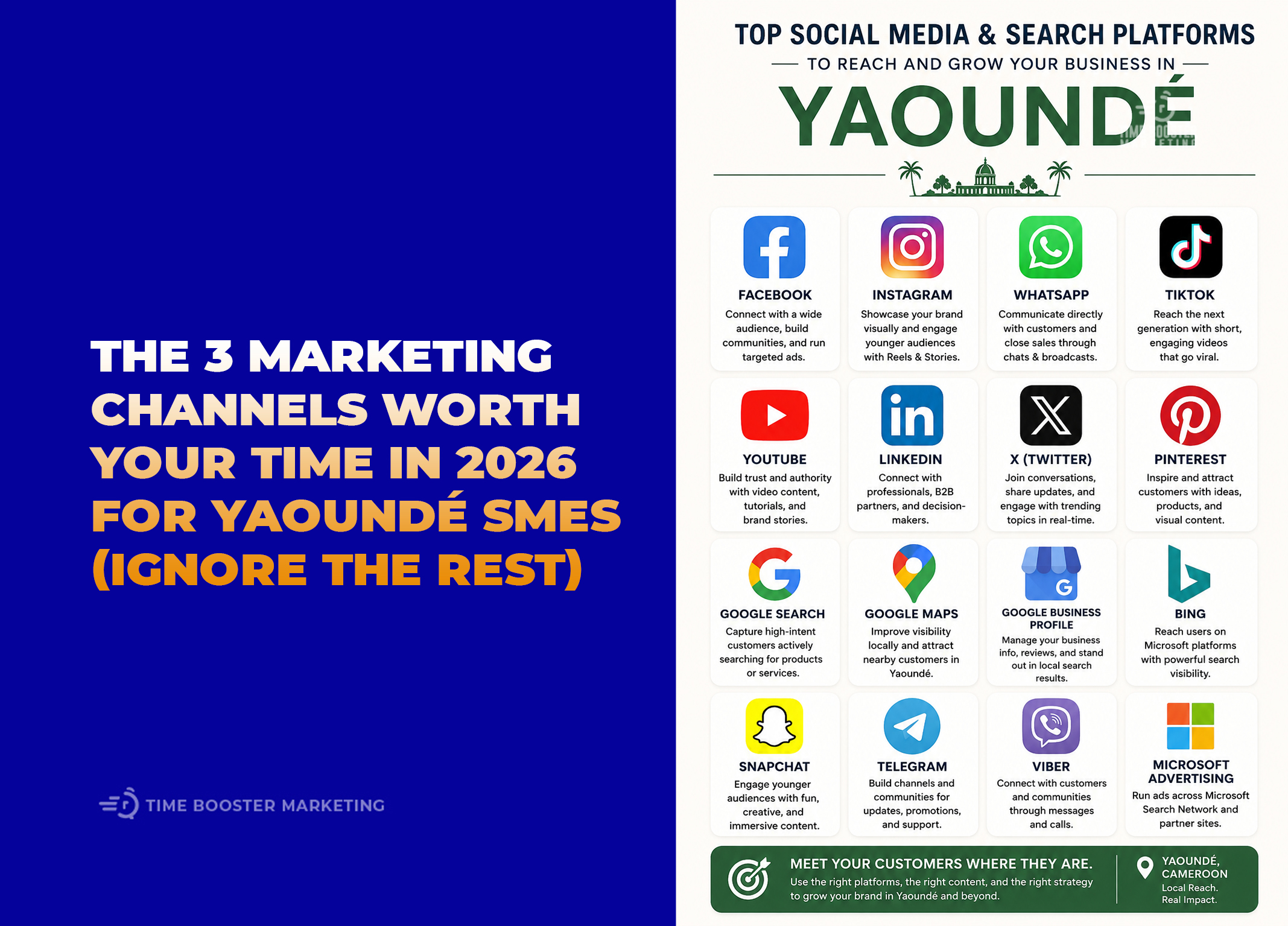
Which Marketing Channels Should Yaoundé SMEs Focus On in 2026?
Yaoundé SMEs do not have a shortage of marketing channels. They have too many channels competing for too little time, too little budget, and too little strategic attention. A small business owner can open Instagram in the morning, see competitors using Reels, check Facebook and notice community groups are active, hear that TikTok is driving discovery, listen to a consultant praise LinkedIn, then receive advice to start YouTube, email marketing, SEO, paid ads, influencer partnerships, WhatsApp broadcasts, and Google Business Profile all at once.
That is not strategy. That is pressure disguised as opportunity.

For most SMEs in Yaoundé, the real problem is not that they chose the “wrong” channel. The real problem is that they are spreading themselves across too many channels before any one of them has enough consistency to work. A restaurant posts twice on Instagram, forgets Facebook, updates WhatsApp Status only when sales are slow, never asks customers for reviews, and has no searchable website page. A consultant writes one LinkedIn post, starts a newsletter, abandons it, creates a TikTok account, then complains that digital marketing does not produce clients. A boutique posts new arrivals everywhere but has no email list, no structured catalog, no customer follow-up rhythm, and no repeat-purchase system.
The definitive answer for 2026 is simple: Yaoundé SMEs should focus on email, SEO, one social platform, and WhatsApp. Email gives you ownership. SEO gives you compounding discoverability. One social platform gives you focused attention. WhatsApp turns interest into conversation, follow-up, and sales. Cameroon’s digital environment is large enough for online marketing to matter, but not every buyer is equally reachable on every platform; DataReportal’s Digital 2026 Cameroon report notes millions of adult social media user identities in the country, which confirms the opportunity while also making focus more important than ever. (DataReportal – Global Digital Insights)
The Best 2026 Marketing Stack for Yaoundé SMEs
The winning stack for most Yaoundé SMEs in 2026 is not complicated. It is not “be everywhere.” It is not “post ten times a day.” It is not “run ads before your offer is clear.” The best stack is a focused system where every channel has a specific job and no channel is expected to do everything.
Your 2026 marketing stack should look like this:
- Email as the owned channel
- You use it to keep direct access to customers, leads, past buyers, and interested prospects.
- SEO as the compounding channel
- You use it to help buyers find your business when they search for services, products, answers, locations, comparisons, and pricing guidance.
- One social platform as the borrowed attention channel
- You use it to stay visible, build trust, show proof, educate buyers, and create regular touchpoints.
- WhatsApp as the conversion layer
- You use it to answer questions, qualify leads, confirm orders, send reminders, close sales, and maintain customer relationships.
This structure works because it respects how small businesses actually operate. Most Yaoundé SMEs do not have a full marketing department. They have a founder, a small team, maybe one assistant, maybe one designer, maybe a niece or cousin helping with posts, and a phone that handles customer service, sales, suppliers, family communication, and marketing all at once. A marketing system that ignores that reality will not survive beyond two motivated weeks.
The strongest channel strategy is not the one that looks impressive on a slide. It is the one you can repeat every week without exhausting yourself, confusing your audience, or wasting money.
1. Email: The Owned Channel Yaoundé SMEs Should Stop Ignoring
Email is easy to underestimate in Cameroon because WhatsApp feels more natural, faster, and more conversational. Many SMEs think email is only for corporations, NGOs, banks, schools, formal job applications, or foreign audiences. That assumption causes small businesses to miss one of the most important principles in modern marketing: the business that owns the customer relationship is less vulnerable to algorithm changes.
You do not own your Instagram followers. You do not own your Facebook reach. You do not own your TikTok views. You do not own LinkedIn impressions. You do not even fully own the attention of people watching your WhatsApp Status, because status visibility depends on saved contacts, attention habits, timing, and whether people are still watching your updates. Email is different because people intentionally give you a direct contact point that you can use for structured follow-up, education, announcements, launches, reminders, loyalty campaigns, and reactivation.
This does not mean email should replace WhatsApp. In Yaoundé, WhatsApp is still essential for sales conversations because many customers want to ask questions before paying, confirm details, negotiate, send screenshots, request delivery information, and feel that a real person is available. Email plays a different role. It helps you organize and retain attention over time, especially when the buyer is not ready today but may be ready next week, next month, or next season.
Litmus reports that email marketing can generate strong returns, with its ROI guide describing an average return of $36 for every dollar spent, while also making clear that results depend on list quality, permission practices, testing, content, and analytics. For Yaoundé SMEs, the practical lesson is not that email automatically creates sales; the lesson is that a permission-based list becomes a long-term asset when you use it consistently and professionally. (Litmus)
What Email Should Do for a Yaoundé SME
Email should not become another random channel where you send occasional promotions when business is slow. It should be the place where interested people receive useful reminders, helpful explanations, customer stories, new offers, and practical reasons to return. A restaurant can use email to send weekly corporate lunch menus, event catering reminders, and seasonal offers. A training center can use email to explain course dates, registration deadlines, outcomes, and student success stories. A consultant can use email to teach business owners how to solve specific problems before inviting them into a paid service.
Use email for:
- Customer education
- Explain how to choose, use, compare, prepare for, or benefit from your product or service.
- Lead nurturing
- Follow up with people who downloaded a guide, asked for information, attended an event, filled a form, or showed interest.
- Repeat sales
- Remind past customers when it is time to reorder, renew, book again, upgrade, or refer someone.
- Campaigns
- Promote launches, events, seasonal offers, limited slots, new arrivals, or service packages.
- Trust-building
- Share testimonials, behind-the-scenes updates, case studies, customer wins, and founder perspectives.
- Reactivation
- Bring back silent leads, old customers, and people who asked questions but never completed the buying process.
A Yaoundé SME does not need a complex email funnel at the beginning. Start with one signup method, one welcome email, and one useful email every week or every two weeks. The goal is not to impress people with automation. The goal is to stop losing warm prospects simply because you had no structured way to continue the relationship.
The Minimum Email System
Start with this simple setup:
- One clear reason to subscribe
- A guide, checklist, menu, catalog, discount, event invite, consultation request, quote form, or useful resource.
- One welcome email
- Explain who you help, what you offer, what makes your business different, and how people can contact you.
- One recurring email
- Send one useful message weekly or biweekly with education, proof, offers, or updates.
- One customer follow-up sequence
- After purchase, send a thank-you note, usage guidance, review request, referral prompt, or next-step offer.
- One monthly reactivation message
- Contact people who showed interest but never bought, or customers who have not purchased recently.
This is enough to start building ownership. You can make it more sophisticated later, but the first job is to stop depending completely on platforms you do not control.
2. SEO: The Compounding Channel That Makes You Findable
SEO is one of the most underused marketing channels for Yaoundé SMEs because many business owners think of it as technical, slow, expensive, or only useful for large companies. That is a mistake. SEO is not simply about ranking a blog post for a fancy keyword. It is about making your business visible when someone is actively searching for what you sell.
A person searching for “event planner Yaoundé,” “English training center Yaoundé,” “best restaurant Bastos,” “real estate agency Yaoundé,” “catering service Yaoundé,” “business consultant Cameroon,” “private school Yaoundé,” or “beauty salon Mvan” is not the same as someone casually scrolling Instagram. Search often captures intent. The buyer already has a problem, need, question, or comparison in mind. That makes SEO especially powerful for SMEs that sell services, location-based offers, professional expertise, education, hospitality, real estate, healthcare-adjacent services, and high-trust products.
Google’s SEO Starter Guide explains that SEO is about helping search engines understand your content and improving your presence in search, while Google’s people-first content guidance emphasizes that SEO should serve users first, not manipulate ranking systems. For Yaoundé SMEs, that means your website should answer real customer questions clearly, locally, and helpfully rather than stuffing pages with keywords. (Google for Developers)
Why SEO Is Better Than Random Posting for Long-Term Visibility
Social media can create fast attention, but it usually requires constant feeding. A post may perform for a few hours, a day, or a few days before disappearing into the feed. SEO works differently. A strong service page, product page, location page, or helpful article can keep attracting visitors over time because people continue searching for answers. This compounding effect matters for SMEs that cannot produce high-volume content every day.
That is why SEO should be treated as infrastructure, not decoration. A searchable website page that explains your service clearly, shows proof, answers objections, includes location relevance, and makes contact easy can become a digital salesperson. It may not replace referrals or social media, but it gives interested buyers a place to verify your credibility before they contact you.
For Yaoundé SMEs, SEO should begin with practical basics:
- Google Business Profile
- Keep your business name, category, location, service area, phone number, opening hours, photos, services, and reviews accurate.
- Core service pages
- Create one page for each major service or product category instead of forcing everything onto one vague homepage.
- Local search content
- Use location-specific pages or sections where relevant, such as “catering services in Yaoundé” or “corporate training in Yaoundé.”
- Helpful articles
- Answer questions customers already ask before buying.
- Review collection
- Ask satisfied customers for reviews and use their language to understand what future buyers care about.
Google’s Business Profile guidance says businesses can improve local ranking by keeping business information accurate and complete, including details that help customers find local results in Search and Maps. For location-based Yaoundé SMEs, this is not optional; if people cannot easily find, verify, or contact you, competitors with better local visibility will absorb demand you should have captured. (Google Help)
SEO Topics Yaoundé SMEs Should Create First
Do not begin SEO by writing random motivational blog posts. Start with buyer-intent topics that help people make decisions. A strong SEO strategy for an SME should reduce confusion, answer objections, and make the buying path easier.
Good first topics include:
- Service explanation pages
- “Corporate Catering Services in Yaoundé”
- “Digital Marketing Services for SMEs in Cameroon”
- “Professional Training Programs in Yaoundé”
- Comparison articles
- “How to Choose an Event Planner in Yaoundé”
- “Private School vs Training Center: What Parents Should Consider”
- “Instagram Ads vs SEO for Small Businesses in Cameroon”
- Pricing guidance
- “How Much Does Catering Cost in Yaoundé?”
- “What Affects the Cost of Branding for a Small Business?”
- “What Should SMEs Budget for Digital Marketing?”
- Trust-building content
- “Questions to Ask Before Hiring a Real Estate Agent in Yaoundé”
- “How to Know If a Consultant Is Right for Your Business”
- “What to Check Before Booking a Venue in Yaoundé”
These topics are not just for traffic. They help serious buyers understand what matters before they contact you, which makes the sales conversation warmer and more qualified.
3. One Social Platform: Borrow Attention Without Losing Focus
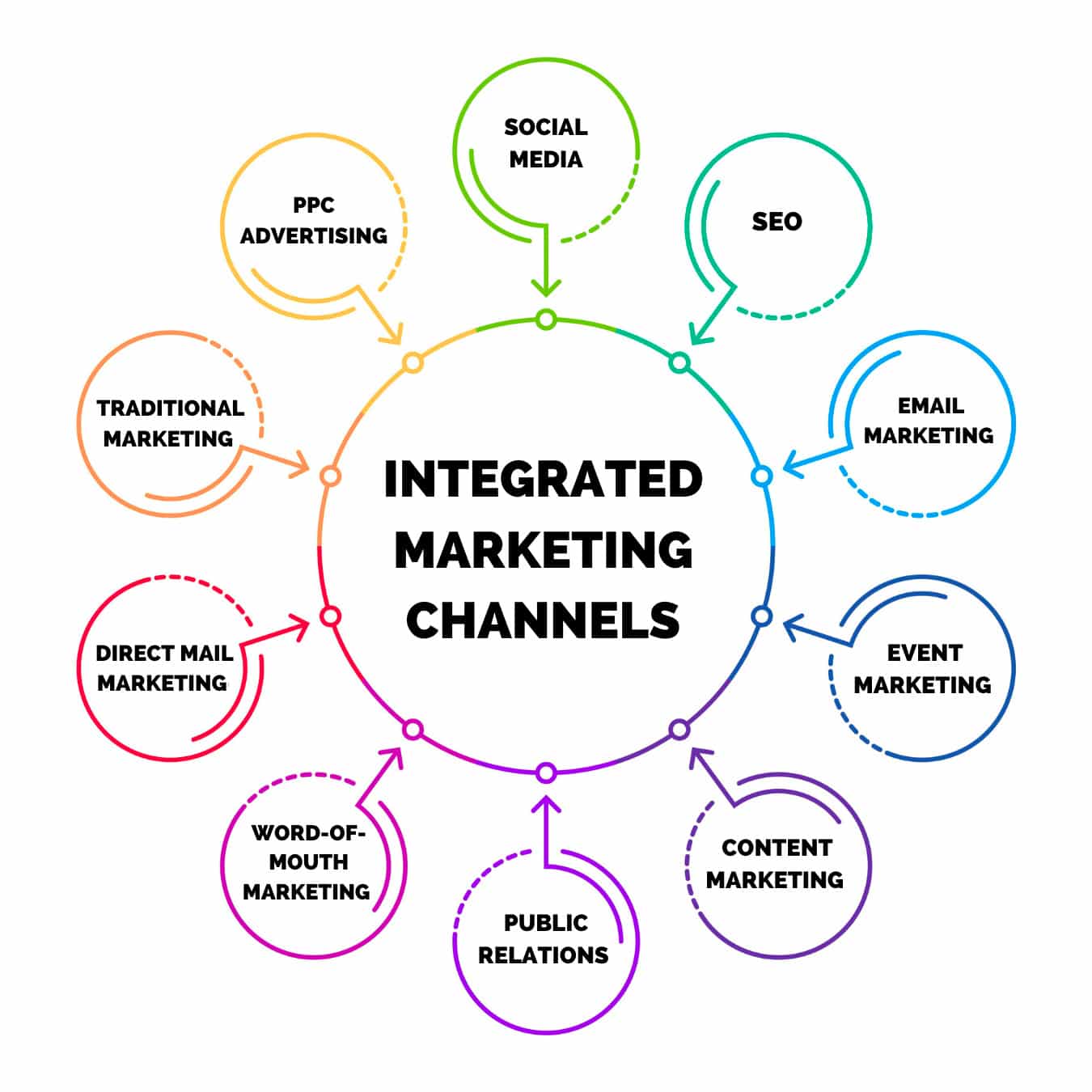
Social media is still important, but most Yaoundé SMEs are using it in the least efficient way possible. They try to be active on every platform at once, then end up inconsistent everywhere. One week they post on Facebook, the next week Instagram, then they try TikTok because someone says it is growing, then they create a LinkedIn post because they want professional clients, then they return to WhatsApp Status because it feels easier. After a few months, no platform has enough rhythm, content quality, audience learning, or community interaction to produce reliable results.
The better approach is to pick one primary social platform and become recognizably useful there. This does not mean you are banned from reposting content elsewhere. It means one platform gets the strategy, consistency, engagement, and performance review. Everything else is secondary.
Social platforms use ranking and recommendation systems that rely on interaction signals, content information, relevance, and user behavior. Instagram explains that ranking works differently across Feed, Stories, Explore, and Reels, while TikTok says user interactions help its recommender systems predict what people are more likely to find interesting. That means each platform has its own behavior patterns, and treating all platforms the same weakens your learning. (Instagram Creators)
Why Spreading Across 5 Channels Kills Momentum
Spreading across five channels looks productive, but it usually creates shallow execution. You are not only creating more posts; you are managing different content formats, audience expectations, captions, creative styles, analytics, comments, inboxes, algorithms, posting schedules, and follow-up systems. That is a heavy operational load for a small business.
The hidden cost is momentum. When you divide attention too early, you rarely publish enough content on any platform to understand what works. You cannot confidently say which message creates inquiries, which content format attracts serious buyers, which platform brings sales, or which audience segment is worth pursuing. Your data becomes scattered, and scattered data leads to emotional decisions.
Spreading across five channels often produces:
- Inconsistent visibility
- Customers do not see you often enough in one place to remember you.
- Weak audience learning
- You do not collect enough feedback from one platform to improve your content.
- Creative fatigue
- You spend more time adapting formats than improving the message.
- Poor follow-up
- Leads come from too many places, and some get missed.
- Weak brand association
- People see pieces of your business but do not develop a strong mental connection to what you sell.
- No clear winner
- Because every channel is underfed, every channel appears to “not work.”
This is why focus is not laziness. Focus is how a small business builds enough repetition to create trust.
How to Pick Your One Social Platform Based on Your Customer
Your one social platform should be selected based on customer behavior, not personal preference. The question is not “Which platform do I like?” The question is “Where does my ideal buyer already pay attention, evaluate options, ask questions, compare providers, and build trust?”
A Yaoundé bakery, a B2B consultant, a fashion boutique, a school, a real estate agent, and a corporate training provider should not automatically choose the same platform. Their buyers behave differently. Their proof needs are different. Their content formats are different. Their sales cycles are different. Their trust requirements are different.
Use this practical guide.
Choose Facebook If Your Buyer Is Community-Driven
Facebook remains useful for many local SMEs because it supports community behavior, local discovery, groups, referrals, event promotion, and broad age-range visibility. If your customers are families, parents, local residents, community groups, churches, associations, neighborhood buyers, or mixed-age audiences, Facebook may still be one of the most practical channels.
Facebook is a strong choice for:
- Food vendors
- Schools
- Local retail stores
- Event services
- Home services
- Real estate listings
- Community-based businesses
- Local professional services
- Restaurants and hospitality brands
- Businesses that benefit from groups and referrals
Use Facebook when your marketing depends on practical updates, community trust, customer recommendations, local visibility, group participation, and shareable offers. The platform is especially useful when people need to ask, comment, recommend, tag friends, or discuss purchases in a familiar environment.
Choose Instagram If Buyers Need to See Before They Trust
Instagram is strong for businesses where visual proof influences desire, trust, and perceived quality. If your customer wants to see style, presentation, transformation, atmosphere, packaging, results, product use, or behind-the-scenes care, Instagram should be considered seriously.
Instagram is a strong choice for:
- Fashion brands
- Beauty businesses
- Food brands
- Fitness studios
- Hotels and guesthouses
- Event decorators
- Photographers
- Lifestyle products
- Interior decor businesses
- Personal brands
- Premium consumer services
Instagram works best when your business can show proof visually. A salon can show transformations. A boutique can show styling ideas. A restaurant can show food presentation and customer experience. An event vendor can show setup quality. A hospitality business can show rooms, atmosphere, service, and guest moments. The key is not just beauty; it is visual trust.
Choose TikTok If Your Product Needs Demonstration and Discovery
TikTok can be powerful when your offer can be shown, explained, demonstrated, dramatized, or taught quickly. It is especially useful when your buyer responds to short video, personality, storytelling, trends, tutorials, and discovery-driven content.
TikTok is a strong choice for:
- Youth-focused brands
- Beauty businesses
- Food brands
- Fitness offers
- Fashion brands
- Creators
- Training programs
- Entertainment-linked businesses
- Product demos
- Student-facing businesses
- Businesses with strong founder personality
Choose TikTok if you can create video consistently and if your offer benefits from demonstration. Do not choose it only because people talk about going viral. Viral attention without a buying path can waste time. The platform works best when you can turn attention into education, proof, trust, and a clear next step.
Choose LinkedIn If Your Buyer Is Professional or Institutional
LinkedIn is the strongest social platform for many professional-service and B2B businesses because it supports authority, expertise, career identity, institutional trust, and business decision-making. If your buyers are executives, managers, consultants, HR teams, NGO professionals, corporate staff, founders, or institutional decision-makers, LinkedIn may be more valuable than Instagram or TikTok.
LinkedIn is a strong choice for:
- Consultants
- Trainers
- Accountants
- Lawyers
- HR firms
- Marketing agencies
- Technology providers
- B2B service providers
- Executive coaches
- Professional education businesses
- Corporate wellness providers
- Business strategy firms
LinkedIn works when your content shows judgment. You need opinions, frameworks, case studies, lessons, market observations, and practical advice. A LinkedIn audience does not only need to see what you sell; they need to understand how you think. HubSpot’s 2026 State of Marketing content emphasizes that brands need stronger points of view, distinctiveness, trust, and relevance as content volume rises, which supports the need for SMEs to sound specific rather than generic online. (HubSpot)
The Channel Decision Matrix for Yaoundé SMEs
Use this matrix as a practical starting point. It is not a permanent rule, but it helps you avoid choosing channels based on trends instead of buyer behavior.
| Business Type | Best Primary Social Platform | Why It Works | Supporting Channels |
|---|---|---|---|
| Beauty, fashion, food, lifestyle | Visual proof, desire, transformation, product presentation | WhatsApp, email | |
| Youth brands, creators, student-facing businesses | TikTok | Discovery, short video, demonstrations, personality | WhatsApp, email |
| B2B services, consulting, training, professional offers | Authority, expertise, professional trust, decision-maker visibility | SEO, email | |
| Local retail, schools, events, community services | Groups, referrals, local discovery, community trust | WhatsApp, Google Business Profile | |
| Location-based services | Facebook or Instagram | Local visibility, proof, customer sharing, referrals | Google Business Profile, WhatsApp |
| High-ticket services | LinkedIn or SEO-led content | Education, trust, longer decision journey | Email, WhatsApp |
| Hospitality and tourism-adjacent businesses | Instagram plus SEO | Visual desire and search-based discovery | Google Business Profile, email |
| Repeat-purchase product brands | Instagram or Facebook | Reminders, proof, customer stories, offers | Email, WhatsApp |
The right choice is the one that matches the buyer’s decision process. If people need visual confidence, choose a visual platform. If they need professional credibility, choose LinkedIn. If they rely on community discussion, choose Facebook. If they discover through demonstration and personality, choose TikTok.
Where WhatsApp Fits in the Strategy
WhatsApp is essential in Yaoundé, but it should not be treated as your entire marketing strategy. WhatsApp is where many sales conversations happen, but it is usually not where strangers first discover you at scale. It is the conversion and relationship layer, not the whole engine.
This distinction matters because many SMEs depend too heavily on WhatsApp Status. Status can help with reminders, proof, announcements, and customer warmth, but it mostly reaches people who already have your number and choose to watch your updates. That makes it useful for retention and warm selling, but weak as your only discovery system.
WhatsApp Business provides tools such as quick replies and catalog features that can help businesses respond faster, organize products or services, and reduce repeated manual explanations. For Yaoundé SMEs, these tools matter because speed, clarity, and professionalism in the conversation can determine whether a lead becomes a customer or disappears. (WhatsApp Help Center)
Your WhatsApp System Should Include
A strong WhatsApp setup should make buying easier, not more confusing. If your social media content creates interest but your WhatsApp experience is slow, disorganized, or unclear, you will lose sales at the final step.
Set up:
- A clear business profile
- Include business name, description, location or service area, opening hours, and website or catalog link.
- Saved replies
- Prepare answers for pricing, delivery, booking, payment, availability, FAQs, and next steps.
- Catalog or service menu
- Make products, packages, or services easy to browse where relevant.
- Labels
- Organize leads by status, such as new inquiry, quoted, paid, pending delivery, follow-up, or repeat customer.
- Fast response rhythm
- Decide when you check messages so leads do not go cold.
- Proof assets
- Keep testimonials, reviews, product photos, process photos, and customer stories ready to share.
- Follow-up messages
- Contact warm leads who asked questions but did not complete the purchase.
WhatsApp should feel like a professional sales desk, not a chaotic inbox.

What You Should Stop Prioritizing First
Some marketing channels are useful, but they should not be your first priority if your foundation is weak. Many SMEs waste money on advanced tactics before fixing basic problems such as unclear offers, weak proof, slow replies, poor follow-up, and no customer list.
Do Not Start With Paid Ads If Your Offer Is Unclear
Paid ads can be powerful, but they are not magic. Ads amplify what already exists. If your offer is confusing, ads spread confusion faster. If your page has no proof, ads attract skeptical buyers. If your WhatsApp response is slow, ads create inquiries that die before conversion. If your product positioning is weak, ads make the weakness more visible.
Before running ads, make sure you have:
- A clear offer
- A clear customer
- Proof
- Strong product or service explanation
- Simple buying process
- Fast WhatsApp response
- Working landing page or catalog
- Basic tracking
- Follow-up system
Ads should scale a working message. They should not be used to rescue a business that has not clarified why people should buy.
Do Not Start With Influencers If You Cannot Capture Demand
Influencer marketing can create attention, but attention is not the same as sales. If an influencer sends people to your page and they find unclear pricing, no proof, no stock, slow replies, poor photos, or a confusing order process, you will waste the opportunity.
Before paying influencers, prepare:
- Product availability
- Clear prices
- Delivery information
- Testimonial content
- Product page or catalog
- WhatsApp scripts
- Tracking code or referral link
- Campaign offer
- Follow-up sequence
Influencer marketing fails when businesses prepare for visibility but not conversion.
Do Not Start With YouTube Unless You Can Sustain Production
YouTube can build authority, especially for education, consulting, reviews, tutorials, and expert-led businesses. However, it requires topic planning, recording, editing, thumbnails, search optimization, and consistency. For many SMEs, it is better to first build authority through SEO articles, LinkedIn posts, Instagram Reels, TikTok videos, or shorter educational content before committing to YouTube as a primary channel.
Choose YouTube when you have:
- A clear content angle
- Enough topics for long-form videos
- A consistent production rhythm
- Editing support or simple editing skills
- Patience for long-term growth
- A product or service that benefits from deep education
If you cannot sustain it, do not make it your main channel yet.
The Weekly Channel Routine for a Busy Yaoundé SME
A small business does not need a complicated marketing department to build momentum. It needs a weekly rhythm that makes visibility and follow-up predictable.
Use this routine:
- Monday: Publish one educational post
- Teach your audience something useful about their problem, buying decision, mistake, or opportunity.
- Tuesday: Improve one SEO asset
- Update a service page, add FAQs, request a review, improve a product description, or write part of a helpful article.
- Wednesday: Send one email
- Share a tip, customer story, offer, reminder, or useful explanation.
- Thursday: Publish one proof post
- Share a testimonial, process, case study, behind-the-scenes moment, delivery example, or customer result.
- Friday: Publish one offer post
- Clearly explain what you sell, who it is for, why it matters, and how to take the next step.
- Saturday: Follow up
- Contact warm leads, reply to old inquiries, check pending conversations, and ask satisfied customers for reviews or referrals.
- Sunday: Review
- Look at what created inquiries, traffic, email signups, WhatsApp conversations, and sales.
This routine is simple enough for a one-person business but strong enough to build a real marketing system.
Final Take: Focus Beats Channel Overload
In 2026, Yaoundé SMEs should stop confusing more channels with better marketing. A business that posts weakly across five platforms will usually lose to a business that shows up consistently on one platform, captures leads through email, becomes discoverable through SEO, and handles WhatsApp conversations professionally.
The best channel mix is clear:
- Email for ownership
- SEO for compounding discovery
- One social platform for focused attention
- WhatsApp for conversion and customer relationships
This mix gives you balance. SEO helps new people find you. Social media helps them remember and trust you. Email helps you stay connected beyond the algorithm. WhatsApp helps you turn interest into a real conversation.
You do not need to market everywhere to grow in Yaoundé. You need to show up where your customers already are, answer the questions they actually have, collect their contact information, build proof consistently, and make the buying process easier than your competitors do. That is how focused SMEs will win in 2026.