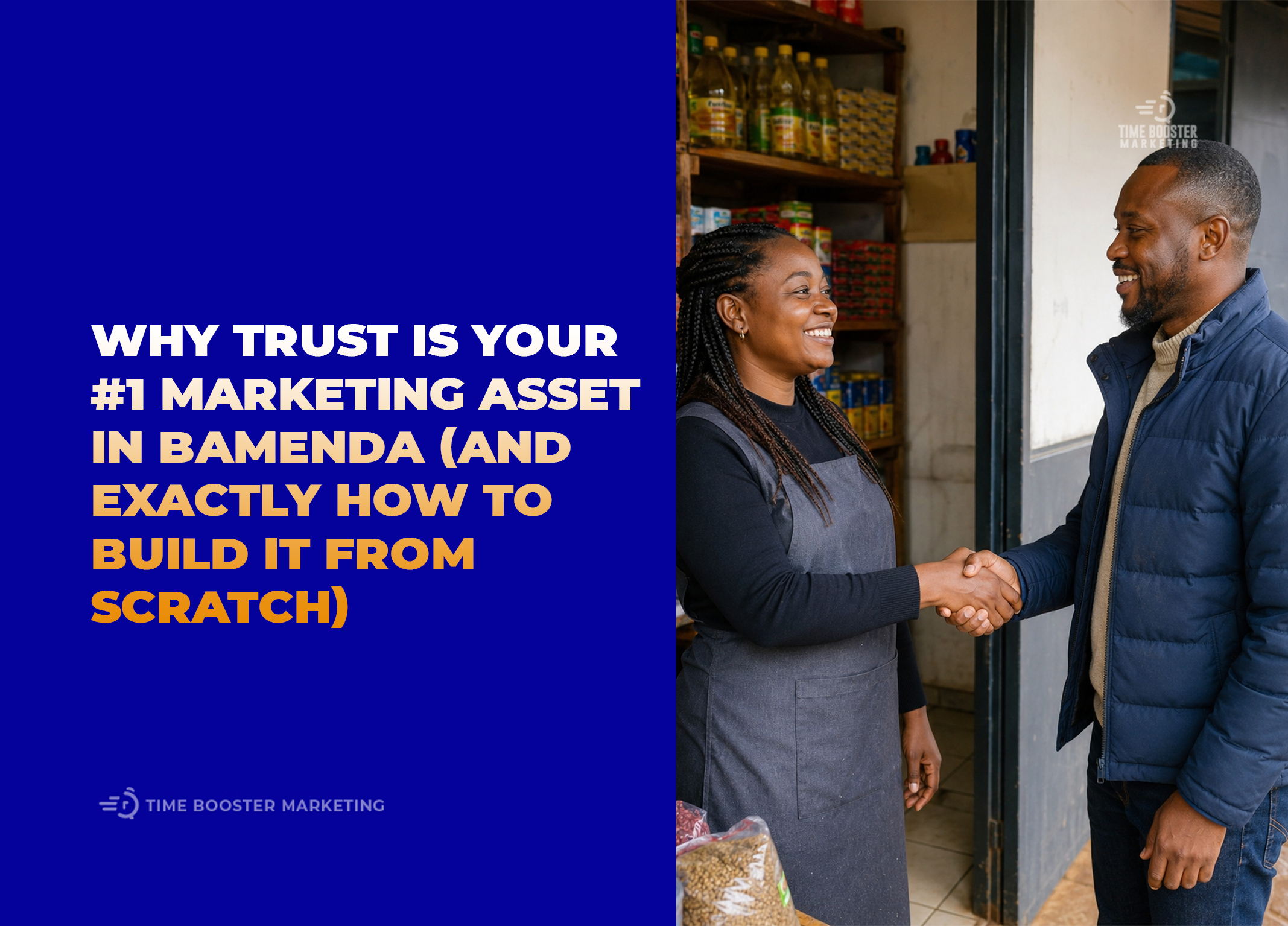
How Do Bamenda Customers Decide to Trust a New Business?
A Bamenda customer rarely buys from a new business just because the business says, “We are the best.”
They want to know: are you real? Can I trust you? Will you deliver what you promised? Will my money be safe? Will you answer when I call or message? Have other people used you before? Do you understand what customers here actually care about?
That is why building brand trust is the bridge between a stranger and a buyer.
Before someone becomes your customer, they are first a stranger. They may see your flyer, your WhatsApp Status, your Facebook post, your signboard, your Google Business Profile, your Instagram page, or your recommendation in a group chat. At that moment, they are not only judging your product or service. They are judging your credibility.
For Bamenda SMEs, this matters because many customers buy through familiarity, referrals, social proof, repeated exposure, and personal confidence. A customer may not know your business yet, but they may trust the person who recommended you. They may not have visited your shop yet, but they may trust your reviews. They may not understand your offer fully, but they may trust how clearly and professionally you explain it.
Building brand trust in Bamenda is not about pretending to be bigger than you are. It is about giving customers enough proof to feel safe choosing you.
Google also pays attention to trust-related signals. For local business visibility, Google says local results are influenced by relevance, distance, and prominence, with prominence connected to how well-known a business appears to be through information such as links, articles, directories, and reviews. (Google Help)
That means the same things that help customers trust you can also help you appear more credible online.
Why Trust Matters More When Your Business Is New

When your business is already popular, customers borrow trust from your reputation. They have heard your name before. Their friend has bought from you. They have seen your shop many times. Maybe your brand is already known in Mile 4, Commercial Avenue, Nkwen, Up Station, Food Market, Small Mankon, or around the university community.
But when your business is new, people do not have that memory yet.
So they look for clues.
They check your page. They read comments. They ask someone. They look at your photos. They observe your tone. They see whether your contact details are clear. They check if you respond quickly. They compare your price with your presentation. They watch whether you are consistent or only active when you need sales.
A new business has to work harder because the customer is carrying more risk.
If you run a salon, the customer risks bad hair and wasted money. If you run a food business, the customer risks poor hygiene, late delivery, or disappointing taste. If you sell clothes, they risk wrong sizing, low-quality fabric, or no exchange policy. If you provide professional services, they risk paying someone who disappears or does careless work.
Trust reduces that fear.
You do not need a huge budget to build trust. You need visible proof, consistent communication, and a customer experience that makes people feel, “This business is serious.”
The 3 Trust Signals Google and Customers Both Respond To
The best trust signals work in two directions. They help real people feel confident, and they help search platforms understand that your business is legitimate and useful.
For Bamenda SMEs, the three most important trust signals are consistency, proof, and reputation.
1. Consistency: Customers Trust What They Can Recognize Repeatedly
Consistency sounds simple, but many small businesses ignore it.
A customer sees one phone number on your flyer, another number on your Facebook page, and no number on your Google profile. Your opening hours say 8 a.m., but customers arrive at 9 a.m. and nobody is there. Your Instagram page says you offer delivery, but your WhatsApp reply says delivery is not available. Your price list changes depending on who asks.
That kind of confusion damages trust.
Customers may not say it directly, but they notice. In a market where people already fear being disappointed or cheated, inconsistency makes them cautious.
Google’s local ranking guidance also emphasizes relevance and accurate business information. A complete and accurate business profile helps Google understand what your business does and match it to relevant local searches. (Google Help)
For customers, consistency answers a basic question: “Can this business be relied on?”
What Consistency Looks Like for a Bamenda Business
Your business name should appear the same everywhere. Your phone number should be easy to find. Your location description should be clear, especially if your area does not have perfect street addressing. Your opening hours should be updated. Your services should be explained in the same way across WhatsApp, Facebook, Google, Instagram, signboards, and flyers.
This matters even more if your customers contact you through WhatsApp before buying. Many Bamenda customers will not complete the purchase from a website alone. They want to message, ask questions, negotiate, confirm availability, request photos, or verify delivery.
If your WhatsApp communication is slow, confusing, or careless, trust drops.
Consistency is not only visual branding. It is operational behavior.
2. Proof: Customers Trust What Other People Have Experienced
A new customer wants evidence that someone else has already taken the risk.
That is why reviews, testimonials, client photos, before-and-after images, screenshots, delivery confirmations, customer videos, and referrals are powerful.
Reviews matter because customers often use them to reduce uncertainty. BrightLocal’s 2025 Local Consumer Review Survey found that consumers still read reviews carefully, but they are becoming more cautious and objective about trusting them, meaning the details and authenticity of reviews matter more than simple star ratings. (BrightLocal)
For Bamenda SMEs, this is important. Fake-looking praise will not build deep trust. A vague review like “Best service ever” is nice, but a detailed review is stronger.
A better review says:
“I ordered a birthday cake for my daughter in Nkwen. The design was exactly what I requested, delivery came before 3 p.m., and the cake was fresh.”
That review gives proof of product quality, location, delivery reliability, and customer satisfaction.
What Proof Looks Like in Real Life
If you are a tailor, show finished outfits on real customers, with permission. If you run a restaurant, show clean food preparation, packaged orders, and customer feedback. If you are a real estate agent, show property walkthroughs, signed agreements where appropriate, and clear explanations of your process. If you are a consultant, show the problem you helped solve and what changed after your work.
Proof should be specific.
Do not only say, “Our customers are happy.” Show why they are happy.
3. Reputation: Customers Trust Businesses That Feel Known and Accountable
Reputation is not only fame. Reputation is the feeling that a business is visible enough to be accountable.
A customer trusts you more when they know where to find you, how to contact you, who is behind the business, and what other people say about you.
Google describes prominence as one of the factors that influences local results, and prominence can be shaped by information Google finds about a business across the web, including reviews and other references. (Google Help)
For a Bamenda SME, reputation can come from simple things:
Your Google Business Profile is active.
Your Facebook page has recent posts.
Your WhatsApp Business profile has a catalog.
Your customers tag you.
You reply to comments.
You show your location clearly.
Your business appears in local directories or community pages.
People mention your brand in recommendations.
You respond professionally to complaints.
Reputation grows when customers see that your business is not hiding.
A business that disappears after collecting money will not build trust. A business that is reachable, visible, and responsive feels safer.
How Bamenda Customers Actually Judge a New Business
Customers rarely use a formal checklist. They judge quickly, often based on small signals.
They may ask themselves:
“Does this business look serious?”
“Do I know anyone who has bought from them?”
“Are the photos real?”
“Do they reply well?”
“Is the price too cheap to be trusted?”
“Is the owner visible?”
“Can I visit the location?”
“Do they explain things clearly?”
“Will they embarrass me if I complain?”
“Do they understand what I actually need?”
This is why trust is emotional and practical at the same time.
A customer may like your product, but if your communication is poor, they hesitate. A customer may afford your price, but if you have no proof, they delay. A customer may want to support a local brand, but if your page looks abandoned, they choose someone else.
Trust is built before the sale, during the sale, and after the sale.
How to Build Brand Trust in Bamenda Without a Big Budget

Many SMEs think trust requires expensive branding, influencer campaigns, billboards, or large promotions.
Those things can help, but they are not the foundation.
The foundation is simple: be visible, be clear, be consistent, and prove what you claim.
Start With a Complete Google Business Profile
Even if most of your customers contact you through WhatsApp or referrals, your Google Business Profile still matters.
When someone hears about your business, they may search your name. When someone is looking for “salon near me,” “restaurant in Bamenda,” “printing service Bamenda,” “guest house Bamenda,” or “cake baker Nkwen,” your profile can help you appear more credible.
Your profile should include your correct business name, category, phone number, location, opening hours, photos, services, and regular updates. Google says complete and accurate business information helps businesses match relevant searches. (Google Help)
Do not leave your profile empty. An empty profile says, “We exist, but we are not serious online.”
A complete profile says, “You can check us, contact us, visit us, and review us.”
Use WhatsApp Business Properly
In Cameroon, mobile communication and mobile money are part of everyday business activity. Research on instant payments in Cameroon found that mobile money agents and USSD are among the commonly used digital channels, showing how important mobile-first behavior is in the local payment environment. (AfricaNenda Foundation)
For Bamenda SMEs, WhatsApp Business is not just a chat app. It is often your mini storefront.
Set up your business name, logo, location, business hours, catalog, welcome message, and quick replies. Use labels to organize customers. Save frequently asked answers. Show your payment options clearly. Confirm orders in writing. Send receipts or order summaries when possible.
Trust grows when customers feel the process is organized.
A customer who messages you and receives a clear, polite reply within a reasonable time is more likely to buy than one who waits two days for a vague answer.
Make Your Prices and Process Less Mysterious
Some businesses hide every detail because they fear competitors. But too much mystery can reduce trust.
You do not have to publish every price if your service is customized. But you should give customers enough information to understand how pricing works.
For example, instead of saying:
“DM for price.”
Say:
“Birthday cakes start from 15,000 FCFA depending on size, design, and flavor. Send your date, number of guests, and sample design for an exact quote.”
That small explanation builds confidence.
For services, explain your process:
Step 1: Consultation.
Step 2: Quote.
Step 3: Deposit.
Step 4: Delivery or service date.
Step 5: Follow-up.
Customers trust businesses that make buying feel simple.
Show Faces, Places, and Real Work
A faceless brand can work when it is already famous. For a new Bamenda business, hiding too much can create doubt.
Show your workspace. Show your team. Show your process. Show packaging. Show deliveries. Show behind-the-scenes clips. Show real products in real lighting. Show the owner explaining something useful.
Google’s helpful content guidance encourages content created for people, with clear evidence of experience and usefulness. (Google for Developers) For a local business, showing real experience is not only an SEO idea. It is a trust-building habit.
People want to know there is a real person behind the business.
This does not mean you must expose your private life. It means your business should feel human, reachable, and accountable.
How to Use Client Results Even Before You Have Many
Many new business owners say, “I cannot build trust because I do not have many clients yet.”
That is not completely true.
You may not have many testimonials, but you can still show evidence.
You just need to use early proof properly.
Start With Micro-Proof
Micro-proof is small evidence that shows competence.
It may include:
A sample product.
A trial project.
A before-and-after image.
A short customer message.
A first delivery.
A practice design.
A test batch.
A pilot service.
A process video.
A personal story showing relevant experience.
For example, if you are starting a cleaning service, you can show a before-and-after cleaning result from a trial job. If you are starting a catering business, you can show test meals prepared for a small group and collect honest feedback. If you are starting a design business, you can show sample redesigns or volunteer work, clearly labeled.
The key is not to pretend you have served hundreds of customers. The key is to show that you can deliver.
Use Detailed Testimonials, Not Just Praise
When you receive early feedback, ask better questions.
Do not only ask, “Did you like it?”
Ask:
“What problem made you choose us?”
“What were you worried about before buying?”
“What did you like about the process?”
“What changed after using our product or service?”
“Would you recommend us, and why?”
These questions create useful testimonials.
A testimonial that says, “Good service” is fine. But a testimonial that says, “I was worried the dress would not be ready before my event, but they delivered two days early and the fitting was perfect” is stronger.
It answers the exact fear future customers may have.
Turn One Good Result Into Three Trust Assets
If you have only one strong client result, do not waste it.
Turn it into three pieces of content.
First, create a short testimonial post.
Second, create a behind-the-scenes explanation of how you delivered the result.
Third, create a lesson post that teaches future customers what to look for.
For example, if you helped a small shop create better product displays, you can post:
The client feedback.
Before-and-after photos.
A short explanation: “Three display mistakes that make small shops look less trustworthy.”
Now one result builds proof, education, and authority.
Be Honest About Being New
Some businesses try too hard to look established. Customers can often sense it.
You can be new and still trustworthy.
Say:
“We are currently taking limited orders as we build our customer base.”
“We are offering introductory packages for our first 20 clients.”
“We are testing weekend delivery in Bamenda and collecting customer feedback.”
“We are new, but we are serious about quality, communication, and timely delivery.”
That honesty can work in your favor.
Newness is not the problem. Uncertainty is the problem. When you communicate clearly, customers feel safer.
The Authenticity Advantage Local Bamenda Brands Have
Big brands have recognition. Local brands have closeness.
That closeness is an advantage when you use it well.
A Bamenda SME can understand local customer behavior in a way a distant brand may not. You understand how people ask questions before buying. You understand the role of referrals. You understand that a customer may want to call before paying. You understand local delivery realities, event urgency, school calendars, church programs, family obligations, student budgets, professional expectations, and neighborhood trust networks.
That knowledge can become part of your brand strength.
Speak Like Your Customers Actually Speak
Authenticity does not mean being careless. It means sounding real and relatable while still being professional.
If your customers use English, Pidgin, or local expressions in everyday buying conversations, your marketing can reflect that naturally where appropriate. You do not need to sound like a corporate company in another country.
For example, a food vendor might say:
“Fresh achu available this Saturday. Limited bowls. Order early so we plan well.”
That sounds more natural than:
“We provide premium culinary solutions for all demographic segments.”
The first one feels local, clear, and believable.
Show That You Understand Local Buying Concerns
Customers in Bamenda may care about price, but they do not only care about price.
They also care about reliability, respect, communication, cleanliness, timing, quality, and whether you will disappoint them after collecting money.
Use your content to address those concerns.
If you run a delivery business, explain your delivery zones and timing. If you run a beauty business, explain hygiene standards. If you sell electronics, explain warranty or return conditions. If you sell clothes, explain sizing, exchange rules, and fabric details. If you offer professional services, explain your process and deliverables.
Authenticity becomes powerful when customers feel, “This business understands how we buy.”
Do Not Copy Big-Brand Marketing Blindly
A large brand can run vague awareness campaigns because people already know them.
A new Bamenda SME cannot afford that.
If you are not yet known, your marketing must be clearer. Do not only post nice designs with slogans like “Quality you can trust.” Show the quality. Explain the trust. Prove the promise.
Instead of saying:
“Your satisfaction is our priority.”
Say:
“We confirm every order on WhatsApp, send progress photos for custom work, and allow one correction before final delivery.”
That is more believable because it explains what trust looks like in action.
Trust Signals Small Businesses Can Add This Week
You do not need to rebrand everything before you start building trust.
You can improve trust this week with simple changes.
Add Clear Contact Details Everywhere
Every page, flyer, profile, and post should make it easy to contact you.
Include your phone number, WhatsApp link, location description, opening hours, and response expectations. If your business is appointment-only, say so. If you do delivery only, say so. If you do not work on Sundays, say so.
Clarity prevents frustration.
Pin Your Best Proof
On Facebook, Instagram, TikTok, or WhatsApp Business, make your best proof easy to find.
Pin a testimonial. Pin your service list. Pin your location. Pin your best before-and-after. Pin a post explaining how to order. Pin a customer result.
Do not make customers dig through old posts to understand whether you are credible.
Ask for Reviews Immediately After a Good Experience
The best time to ask for a review is when the customer is happy.
Send a polite message:
“Thank you for buying from us. We are building trust with new customers. Please send a short review about your experience, especially what you liked about the service, timing, or product quality.”
If you have a Google Business Profile, ask them to leave the review there. Reviews can influence both customer confidence and local business visibility. (Google Help)
Reply to Reviews and Comments Professionally
Do not ignore people who engage with your business.
Reply to positive comments with gratitude. Reply to questions clearly. Reply to complaints calmly. Even when a customer is difficult, other people are watching how you handle the situation.
Trust is not only built when things go well. It is also built when people see that you respond responsibly.
Use Real Photos Before Stock Images
Stock images may look polished, but they often feel distant.
Real photos build more trust, even if they are not perfect. A real photo of your food, shop, product, team, workspace, or delivery tells customers, “This is what you can expect.”
Use good lighting. Keep the background clean. Show details. Avoid heavy filters that make the product look different from reality.
Explain Your Guarantees, Policies, and Limits
Customers trust businesses that set expectations.
If you require a deposit, explain why. If deposits are non-refundable after work begins, say so clearly. If delivery depends on location, explain the conditions. If custom orders need three days, say so. If returns are only accepted for defects, say so before payment.
Clear policies prevent conflict and show professionalism.
How Different Bamenda Businesses Can Build Trust
Trust looks different depending on your industry.
For Restaurants and Food Vendors
Customers care about taste, hygiene, quantity, timing, and consistency.
Show food preparation, packaging, delivery, customer feedback, and daily availability. Use clear menus. Avoid posting food that is not actually available. Tell customers when orders close. Confirm delivery details.
A food business builds trust when customers know they will receive what they expected, when they expected it.
For Salons, Barbers, and Beauty Brands
Customers care about skill, cleanliness, product quality, and personal treatment.
Show before-and-after work. Explain your booking process. Show your tools and hygiene standards. Share maintenance tips. Ask clients for permission to post results. Display clear pricing ranges.
Beauty customers are trusting you with their appearance. Proof matters.
For Boutiques and Fashion Sellers
Customers care about fabric quality, sizing, fit, authenticity, and exchange rules.
Show videos, not only photos. Mention sizes clearly. Explain whether items are thrift, ready-to-wear, imported, locally made, or custom. Share customer try-ons where possible. State delivery and exchange terms.
A boutique builds trust by reducing the fear of “what I saw is not what I received.”
For Professional Services
Customers care about competence, confidentiality, process, and results.
Explain your qualifications, experience, service steps, timelines, and deliverables. Share educational content. Use case examples without exposing private client information. Show testimonials that describe the problem and outcome.
Professional trust is built through clarity and expertise.
For Real Estate and Property Businesses
Customers care about legitimacy, location accuracy, documentation, pricing, and safety.
Show real property videos. Avoid misleading photos. Explain fees clearly. State whether documents are available. Share location details honestly. Do not pressure customers with false urgency.
Real estate trust is fragile because the financial risk is high.
For Schools, Training Centers, and Tutors
Customers care about results, safety, discipline, teaching quality, and communication.
Show learning outcomes, parent feedback, class structure, teacher credibility, and student support. Explain fees and schedules clearly. Share educational tips to demonstrate expertise.
Parents and students trust institutions that communicate consistently.
Marketing Without a Big Budget: The Trust-First Content Plan
If your budget is small, your content must work harder.
Do not post randomly. Build trust through repeated proof.
Use this simple weekly rhythm.
Monday: Problem Education
Post about a problem your customer cares about.
Example:
“Three mistakes that make custom dresses arrive late.”
“Why your small business needs clear receipts.”
“How to know if a phone accessory is poor quality before buying.”
This shows expertise.
Wednesday: Proof or Process
Show work, results, delivery, packaging, testimonials, or behind-the-scenes.
Example:
“Today’s order packed for delivery to Nkwen.”
“Before and after: logo redesign for a local vendor.”
“How we prepare our workspace before clients arrive.”
This shows credibility.
Friday: Offer Clarity
Explain what you sell and how to buy.
Example:
“We are taking weekend orders for grilled fish plates. Orders close Friday at 6 p.m.”
“Our basic bookkeeping cleanup package is for small businesses that need organized records before tax season.”
This creates conversion.
Sunday: Human Connection
Share a founder note, customer appreciation post, local story, lesson learned, or community moment.
This builds familiarity.
The goal is not to entertain everyone. The goal is to make the right customer trust you enough to take the next step.
The Mistake That Breaks Trust Fast
The fastest way to lose trust is to overpromise and underdeliver.
Do not say delivery takes one hour if it usually takes three. Do not say “original quality” if the product is not original. Do not say “limited slots” every week if it is not true. Do not use fake testimonials. Do not post other people’s work as your own. Do not disappear after payment.
Trust takes time to build and seconds to damage.
A small business can survive slow growth. It may not survive a reputation for dishonesty.
How to Know Your Trust Is Growing
Trust is not always visible immediately, but there are signs.
Customers start asking better buying questions.
People refer others to you.
Past customers return.
People mention that they have been watching your page.
Customers pay deposits with less hesitation.
People tag your business in recommendation posts.
Your reviews become more detailed.
Your WhatsApp conversations become easier.
Customers stop asking only for discounts and start asking about value.
These are signs that your brand is moving from “unknown” to “considered.”
Final Thoughts: Trust Is the Real Marketing Currency
In Bamenda, a new business does not need to be famous before it can be trusted.
But it must be clear. It must be visible. It must be consistent. It must show proof. It must communicate like a serious business. It must understand the customer’s fear before asking for the customer’s money.
Trust is not built by shouting louder. It is built by making customers feel safer.
When people can see your work, understand your process, read real feedback, contact you easily, and recognize your local authenticity, they have fewer reasons to hesitate. That is when a stranger becomes a buyer. That is when a buyer becomes a repeat customer. That is when a repeat customer becomes the person who recommends you before you even enter the room.
For Bamenda SMEs, that kind of trust is not a small thing.
It is the foundation of sustainable growth.