
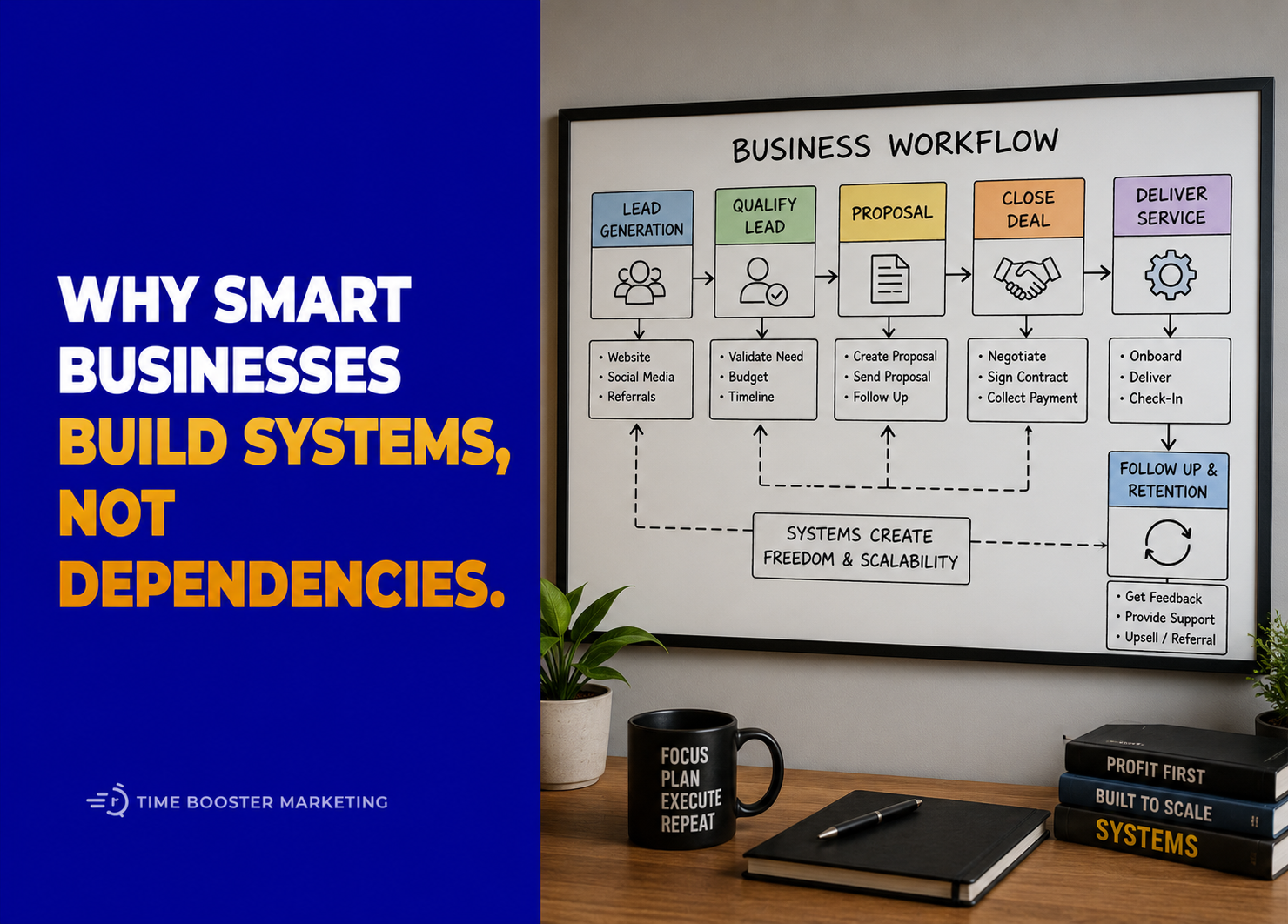
Why Your Business Needs a Marketing System in Cameroon, Not Just a Marketing Person
You hire someone to manage your social media.
For the first few weeks, posts appear regularly. Promotional flyers are designed, WhatsApp Status updates are published and customer messages receive faster responses.
Then the person becomes unavailable.
Suddenly, no one knows the content plan. The Canva files are stored in a personal account. The Facebook password cannot be found. Customer enquiries are buried inside WhatsApp conversations, and the business owner must personally approve every caption before anything moves forward.
The problem is not necessarily that you hired the wrong person.
The deeper problem is that you hired an individual without building a system around the work.
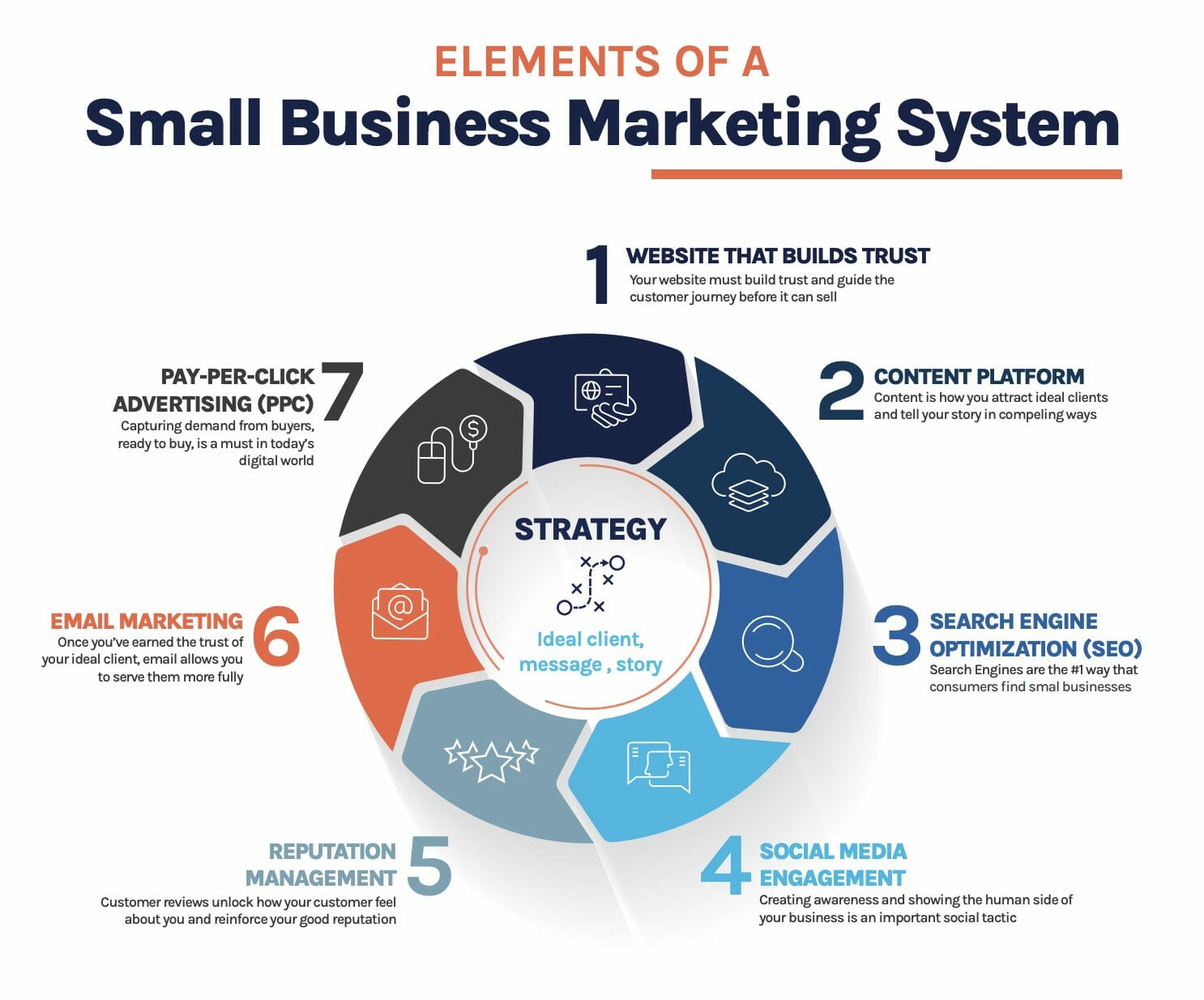
A marketing system in Cameroon should define how ideas become campaigns, how campaigns become content, how content receives approval, how enquiries are handed to sales and how results are measured. The person executes the system, but the business owns it.
A Marketing Person and a Marketing System Are Not the Same Thing
A marketing person brings skill, judgment and creative ability.
A marketing system provides structure.
Without structure, even a talented marketer must repeatedly ask:
- What are we promoting this month?
- Who needs to approve this design?
- Where are the product photographs?
- Which price is correct?
- Who responds to WhatsApp leads?
- How do we know which campaign generated sales?
When those answers depend on the owner’s memory, marketing slows down every time the owner becomes busy.
The International Organization for Standardization describes a management system as a clearly defined set of processes and responsibilities that helps a business operate as intended. Although your small business may not need formal certification, the principle applies directly to marketing: consistent results require documented processes, assigned responsibilities and regular improvement. (ISO)
Your marketer should bring expertise into the system, not become the system.
Why Person-Dependent Marketing Restricts Growth
Person-dependent marketing usually creates five operational weaknesses.
Knowledge Is Not Owned by the Business
The marketer knows how campaigns are set up, where files are stored and which customers need follow-up. None of this is documented.
When the person leaves, the business loses both labour and institutional knowledge.
Work Begins Through Informal Requests
The owner sends a late-night voice note asking for a flyer. Another manager requests a promotion through WhatsApp. A branch employee changes the offer verbally.
Because there is no standard campaign brief, the marketer receives incomplete or contradictory instructions.
Approvals Become Bottlenecks
Every caption, image and video waits for the owner’s personal approval. Feedback arrives through scattered voice notes instead of one clear review process.
Content misses deadlines, but the marketer is blamed for inconsistency.
Leads Fall Between Marketing and Sales
Marketing generates messages, but no one owns the next stage.
The marketer assumes the receptionist will respond. The receptionist assumes the salesperson has seen the conversation. The potential customer waits several hours, loses confidence and contacts another business.
Reporting Focuses on Activity
The marketer reports that 15 posts were published and the page gained 300 followers.
The owner still cannot see how many qualified enquiries, appointments, quotations or sales came from the work.
A system closes these gaps by defining how work moves from one stage to the next.
Build a Seven-Stage Marketing Workflow
Your workflow does not need expensive software. It can begin with a shared spreadsheet, a cloud folder and one project board.
What matters is that every campaign follows the same visible stages:
Request → Brief → Production → Review → Approval → Distribution → Reporting
Workflow tools formalize this idea by moving work through standardized stages. For example, Asana’s workflow guidance uses sequences such as submission, review, approval and completion to make ownership and status visible. (Asana Help Center)
Stage 1: Campaign Request
Every marketing request should enter through one channel.
Create a simple form or template asking:
- What are we promoting?
- Who is the intended customer?
- What problem does the offer solve?
- What is the price?
- When does the offer begin and end?
- Which location can fulfil it?
- What action should the customer take?
- Who approves the campaign?
This prevents incomplete instructions from becoming urgent design requests.
Stage 2: Campaign Brief
The marketer converts the request into a short execution brief.
The brief should contain the objective, audience, message, offer, channel, budget, required assets, deadline and success metric.
For example:
Generate 40 qualified WhatsApp enquiries for the Douala home-cleaning package during August at a maximum cost of CFA 3,000 per qualified enquiry.
That statement gives the team a commercial target. “Promote our cleaning services” does not.
Stage 3: Production
The marketer prepares the required content using agreed brand templates.
Each task should have:
- One owner
- One deadline
- One file location
- One current status
- One version for approval
Do not allow final artwork to live only inside personal phones or laptops. Store editable files, approved logos, photographs and copy in a company-controlled folder.
Stage 4: Review
The reviewer checks facts, not personal preferences.
The review should confirm:
- The price is accurate
- The offer can be fulfilled
- Contact details are correct
- The message reflects the intended customer
- Claims can be supported
- The next action is clear
“Make it more beautiful” is not useful feedback. “Replace the old price and make the WhatsApp booking instruction more visible” is actionable.
Stage 5: Approval
Set one approval deadline and one final approver.
A growing business should not require five people to approve an ordinary Facebook post. Use different approval levels based on risk.
Routine educational content may follow pre-approved templates. Promotional campaigns may require a department manager. Sensitive claims, major discounts or public announcements may require the owner.
Project-management systems can formalize decisions as approve, request changes or reject, preventing ambiguous feedback from keeping work open indefinitely. (Asana Help Center)
Stage 6: Distribution and Lead Handoff
Publishing is not the end of marketing.
Define who handles the customer after the post or advertisement generates interest.
Your handoff rules should answer:
- Who monitors incoming messages?
- How quickly should the first response be sent?
- What information qualifies a lead?
- When is the lead transferred to sales?
- Where is the conversation recorded?
- Who follows up when the customer does not respond?
A WhatsApp lead could move through these stages:
New enquiry → Qualified → Quotation sent → Follow-up → Won or lost
The marketer may generate demand, but the sales or customer-service team must own conversion.
Create Templates for Repetitive Work
Templates reduce the time spent rebuilding common materials.
Your system should include templates for:
- Monthly marketing plans
- Campaign briefs
- Social media captions
- Promotional flyers
- Customer testimonials
- WhatsApp replies
- Lead-tracking sheets
- Weekly reports
- Campaign review meetings
Templates should standardize the essential information without making every message sound identical.
A quotation-promotion template, for instance, could require a customer problem, service benefit, proof point, price condition and one call to action. The marketer can still write creatively within that structure.
Templates also make onboarding easier. A new employee does not need to guess how your business works.
Give People Access Without Losing Business Control
Company assets should remain under company ownership.
The business should control primary email addresses, social accounts, advertising accounts, websites, domains, analytics platforms and design-file repositories. Team members should receive the access needed to perform their roles rather than sharing one master password.
Meta allows businesses to assign Page task access for functions managed through tools such as Meta Business Suite and Ads Manager. Meta Business Suite also supports drafts and scheduled posts, allowing production and publishing to continue through an organized calendar. (Facebook)
Maintain an access register showing:
- Platform
- Business owner
- Administrator
- Current users
- Access level
- Recovery details
- Last review date
Review access immediately when an employee, freelancer or agency relationship ends.
Track Performance Through One Business Scorecard
Your report should connect marketing activity to commercial outcomes.
Track five levels:
Activity: Content published, campaigns launched and budget spent.
Attention: Reach, video views, profile visits or website sessions.
Response: Calls, WhatsApp conversations, forms or quotation requests.
Sales: Bookings, orders, signed contracts and revenue.
Efficiency: Cost per qualified lead, conversion rate and customer acquisition cost.
Do not allow each platform to use unrelated campaign names. Establish one naming system across your content calendar, advertising account, website links and sales sheet.
For website campaigns, Google Analytics campaign parameters can identify the source, medium and campaign associated with visits. Those values can then appear in traffic-acquisition reporting. (Google Help)
For WhatsApp-led sales, add a mandatory lead-source field to your tracking sheet. Record whether the enquiry came from Facebook, Instagram, Google, a referral, an event or another channel.
A 30-Day Marketing System Implementation Plan
During the first week, list every recurring marketing activity and identify where work currently gets delayed.
During the second week, document the seven-stage workflow, assign one owner to each stage and build your campaign brief, content and reporting templates.
During the third week, organize company files, correct platform access and introduce one lead-tracking process.
During the fourth week, run one real campaign through the complete system. Record where approvals stalled, information was missing or leads were lost. Then improve the workflow.
Do not attempt to automate a broken process. First make the steps clear. Automation can follow once the team understands what should happen, when it should happen and who is responsible.
Build Marketing That Survives Staff Changes
A strong marketer remains valuable.
The objective of a marketing system is not to remove human judgment or reduce people to task executors. It is to give skilled people the structure, information and authority required to perform consistently.
When your business owns the workflow, templates, accounts, customer data and reporting process, changing one employee does not force marketing to restart from zero.
Your marketer can take leave without campaigns disappearing. A new team member can understand how work moves. The owner can approve important decisions without becoming the bottleneck. Sales can see which leads require follow-up, and management can connect marketing spending to business results.
That is the difference between hiring someone to post for your business and building a marketing operation capable of supporting growth.