How Do Buea Businesses Build a Marketing System That Runs Weekly?
Most Buea entrepreneurs do not fail at marketing because they lack ideas. They fail because their marketing depends too much on mood, memory, pressure, and last-minute energy. When sales are slow, they post more. When customers come in, they disappear. When a launch is coming, they suddenly remember their email list, WhatsApp Status, Instagram page, Facebook group, or Google Business Profile. Then after a few days of effort, business gets busy again and marketing returns to silence.
That is the feast-or-famine cycle. It feels normal because many small businesses operate this way, but it is not harmless. When your marketing disappears during busy weeks, your future pipeline gets weaker. When you only post when you need sales, your audience starts to feel the urgency instead of the value. When you only follow up when cash is tight, warm leads go cold. When every week starts with “What should I post today?” marketing becomes emotionally expensive before you even create anything.
Buea businesses need a different approach because the local market rewards visibility, trust, referrals, WhatsApp conversations, student and professional networks, and consistent proof. Buea Council describes the municipality as located in Cameroon’s South West Region at the foot of Mount Cameroon, while the University of Buea describes itself as a hub for learning, innovation, problem-solving, and community building. That matters because many businesses in Buea operate inside a mixed market of students, young professionals, families, institutions, tech-adjacent founders, service providers, and community-driven buyers. A business that wants to grow here cannot rely on occasional noise; it needs a system that keeps it visible and trusted every week. (bueacouncil.cm)
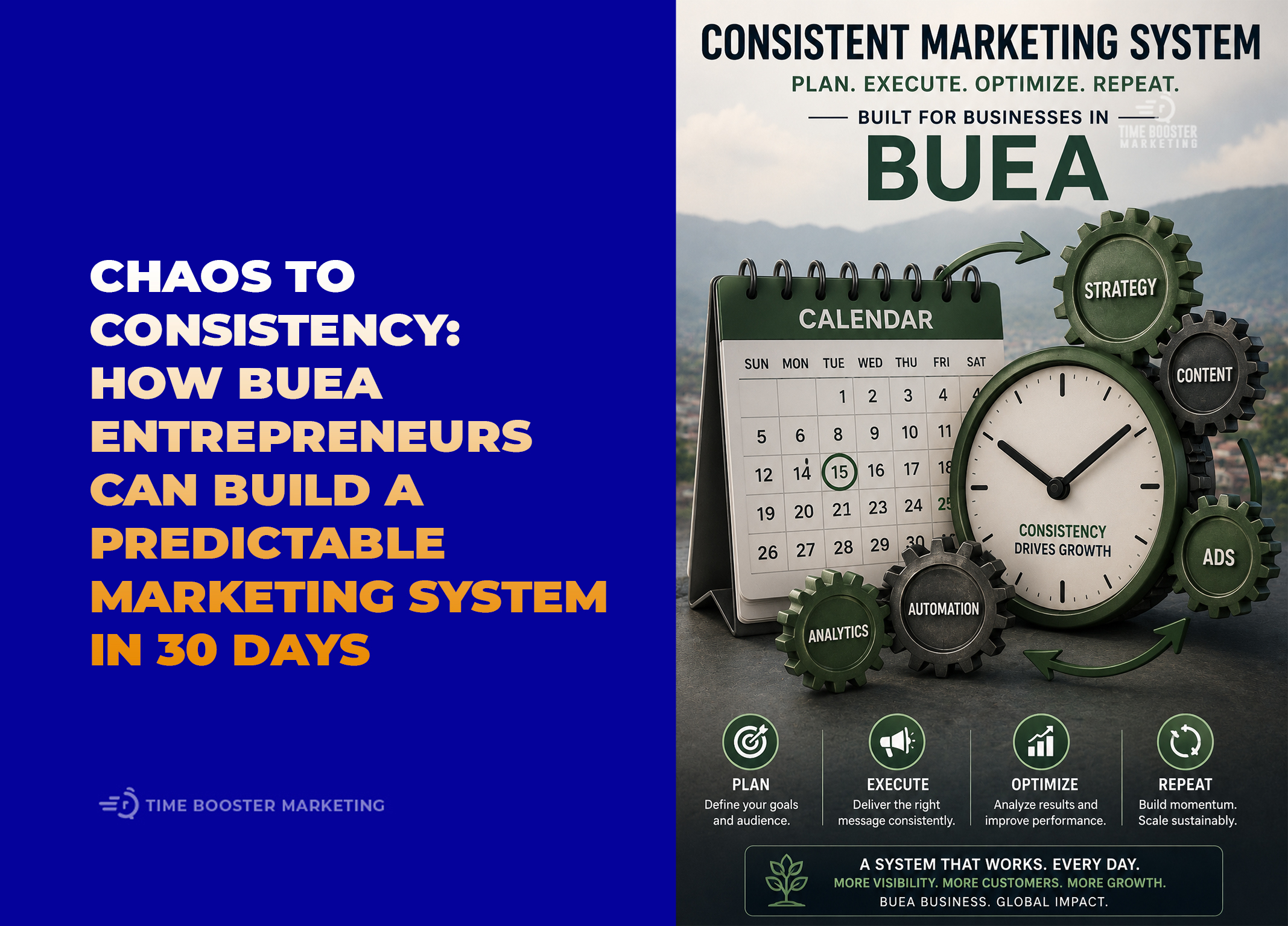
A predictable marketing system is not a complicated funnel with ten tools and a full-time marketing team. For most Buea SMEs, it is a simple weekly rhythm supported by a few reusable assets and light automation. The goal is not to remove the human side of the business. The goal is to stop rebuilding your marketing from scratch every Monday.

Why Buea SMEs Need Marketing Systems, Not More Motivation
A marketing system is a repeatable process that helps your business attract attention, build trust, follow up, and generate sales conversations every week. It is not just a content calendar. It is not just automation. It is not just posting three times per week. A real system connects visibility to inquiry, inquiry to follow-up, follow-up to sale, and sale to repeat business or referral.
This distinction matters because many small business owners try to solve system problems with emotional intensity. They promise themselves they will “be more consistent.” They save content ideas. They buy templates. They watch marketing videos. They post strongly for a few days, then life happens. Customers need delivery. Staff members disappoint. Internet connection becomes unstable. A family issue comes up. Cash flow gets tight. The owner becomes tired, and marketing stops again.
Motivation is not reliable enough to run a business. A system is better because it reduces the number of decisions you need to make each week. Instead of asking, “What should I post?” you follow your content pillars. Instead of asking, “Who should I follow up with?” your lead tracker tells you. Instead of rewriting the same WhatsApp response ten times, you use saved replies. Instead of waiting until customers forget you, your email or broadcast rhythm keeps the relationship warm.
Cameroon’s 2026 digital environment supports this mobile-first, system-first approach. DataReportal reports that Cameroon had 12.6 million internet users at the end of 2025, internet penetration of 41.9%, 29.0 million cellular mobile connections, and 5.90 million social media user identities in October 2025. Those numbers show that digital marketing matters, but they also show why Buea SMEs must be practical: not every buyer is online in the same way, and not every platform deserves equal effort. (DataReportal – Global Digital Insights)
The Weekly Marketing Rhythm: The 3 Hours Per Week Framework
A weekly marketing rhythm gives your business a minimum operating system for visibility, trust, and sales. The point is not to spend your whole week creating content. The point is to protect three focused hours so marketing keeps running even when business is busy.
For most Buea SMEs, three hours per week is realistic enough to sustain and strong enough to create momentum. It will not make you famous overnight, but fame is not the goal. The goal is to show up consistently enough that potential customers remember what you do, understand why it matters, see proof that you are credible, and know how to contact you when they are ready.
The three-hour framework has five parts:
- Attract
- Bring the right people into your world through useful content, local visibility, referrals, SEO, and social media.
- Engage
- Start conversations through comments, DMs, WhatsApp replies, polls, questions, and community interaction.
- Nurture
- Build trust through email, WhatsApp broadcasts, customer stories, educational content, and proof.
- Convert
- Make clear offers, follow up with warm leads, explain pricing, answer objections, and guide people to buy.
- Retain
- Stay connected with past customers through check-ins, reviews, repeat offers, referrals, and after-sales care.
The rhythm works because it prevents you from treating marketing as only posting. Posting is visible, but it is not the whole system. A business can post often and still lose sales if it does not follow up, explain the offer clearly, collect proof, or make buying simple.
Hour 1: Plan and Create the Week’s Core Content
The first hour should be used to create the week’s core marketing message. This is where many entrepreneurs go wrong because they try to create content one post at a time. That approach creates decision fatigue. Instead, pick one weekly theme and create several pieces of content around it.
For example, a Buea catering business might choose the theme “how to plan stress-free food for office meetings.” A beauty business might choose “how to choose the right treatment before spending money.” A boutique might choose “how students and young professionals can dress well on a realistic budget.” A consultant might choose “why small businesses lose leads after the first WhatsApp conversation.”
During this hour, create:
- One educational post
- Teach your audience something that helps them make a better buying decision.
- One proof post
- Show a testimonial, customer result, process photo, delivery example, before-and-after, or behind-the-scenes moment.
- One offer post
- Explain what you sell, who it is for, why it matters, and how to take the next step.
- One short-form reuse
- Turn the same idea into a WhatsApp Status, short video, carousel, or email paragraph.
This keeps your marketing focused. You are no longer searching for random ideas every day. You are repeating one commercially useful message from different angles until your audience understands it.
Hour 2: Publish, Engage, and Start Conversations
The second hour should be used for distribution and engagement. Many businesses publish content and leave immediately, then wonder why nothing happens. Social media is not a notice board. It is a conversation environment. If you want the platform and the audience to respond, you must participate.
Use this hour to:
- Publish or schedule your posts.
- Reply to comments.
- Answer DMs.
- Comment on relevant local posts.
- Respond to WhatsApp inquiries.
- Ask one useful question on your main platform.
- Share one proof item on WhatsApp Status.
- Reconnect with people who showed interest last week.
This hour matters because conversation is often where trust begins. A buyer may not purchase after one post, but they may ask a question. They may reply to your status. They may save the post. They may send it to a friend. They may check your profile quietly. Your job is to make the next step easy and human.
For Buea businesses, this is especially important because many sales are relationship-led. People often buy after seeing proof, asking around, receiving a recommendation, checking your communication style, and feeling that you will not disappear after payment. A consistent engagement rhythm turns passive visibility into active trust.
Hour 3: Follow Up, Review, and Improve the System
The third hour is where the money often hides. Many SMEs spend too much time trying to attract new people while ignoring people who already showed interest. A lead who asked for price last week is warmer than a stranger who has never heard of you. A past customer who liked your service is easier to sell to than someone seeing your brand for the first time. A referral partner who already trusts you can send better leads than a random viral post.
Use this hour to:
- Follow up with warm leads.
- Send a short email or WhatsApp broadcast.
- Ask one satisfied customer for a review.
- Update your lead tracker.
- Review which post created inquiries.
- Record common customer questions.
- Turn those questions into next week’s content.
- Check whether anyone needs a repeat offer, renewal, refill, appointment, or reminder.
This review habit is what turns marketing from guessing into learning. If people keep asking the same question, your content is not answering it clearly enough. If people ask for prices and disappear, your value explanation or proof may be weak. If people like your content but never inquire, your call to action may be unclear. If people inquire but do not pay, your buying process may have friction.
A predictable marketing system gets smarter every week because it captures feedback and uses it.
A Simple Weekly Schedule for Buea SMEs
A system becomes easier when each day has a role. You do not need to post every day, and you do not need to create complicated campaigns every week. You need a rhythm that your audience can recognize and your business can maintain.
A practical weekly schedule could look like this:
- Monday: Education
- Publish a post that teaches your audience how to solve a problem, avoid a mistake, compare options, or make a smarter decision.
- Tuesday: Engagement
- Ask a question, reply to comments, respond to DMs, and interact with potential customers or local community pages.
- Wednesday: Proof
- Share a testimonial, process photo, customer result, before-and-after, delivery example, or behind-the-scenes moment.
- Thursday: Nurture
- Send one email, WhatsApp broadcast, or customer update that gives value before making an offer.
- Friday: Offer
- Clearly explain your product, service, package, booking window, promotion, or consultation opportunity.
- Saturday: Follow-up
- Contact warm leads, check abandoned conversations, ask customers for reviews, and remind interested people of next steps.
- Sunday: Review
- Look at what worked, save customer questions, and choose next week’s theme.
This rhythm is simple, but it works because it covers the full marketing cycle. You are not only posting motivational quotes or random product photos. You are teaching, proving, nurturing, selling, and improving.
What to Automate First, Second, and Third
Marketing automation should not be used to make your business feel robotic. It should be used to protect consistency. The purpose of automation is to handle repetitive tasks so the business owner can spend more energy on judgment, customer care, relationship-building, and quality delivery.
The mistake many entrepreneurs make is trying to automate everything at once. They sign up for too many tools, create complicated workflows, and abandon the setup because it becomes confusing. A Buea SME should automate in stages: capture and follow-up first, nurturing second, and content distribution third.
First: Automate Lead Capture and First Response
The first thing to automate is the moment someone shows interest. This is where many small businesses leak opportunities. A person clicks your page, asks a question, fills out a form, sends a WhatsApp message, or requests information, but the response is slow, unclear, or inconsistent. By the time you reply properly, the buyer has cooled down or contacted someone else.
Start by automating:
- Website contact forms
- Email signup forms
- WhatsApp Business greeting messages
- Away messages
- Frequently used replies
- Lead tags or labels
- Inquiry confirmation messages
- Booking or order instructions
WhatsApp Business provides features such as away messages, quick replies, labels, and catalogs, which are especially useful for small businesses that receive repeated questions through chat. These tools do not replace personal selling, but they reduce delay and help customers get basic information faster. (WhatsApp for Business)
Your first-response system should answer:
- What do you offer?
- Who is it for?
- How much does it cost or how can someone get a quote?
- What information do you need from the customer?
- What happens next?
- When will you respond?
- How can they pay, book, order, or visit?
If a customer has to drag basic information out of you one message at a time, your marketing system is leaking trust.
Second: Automate Nurturing and Relationship Building
Once lead capture is working, automate nurturing. Nurturing is the process of staying useful and visible to people who are interested but not ready to buy immediately. This matters because not every buyer makes a decision the first day they see your offer. Some need to compare options. Some need to wait for salary. Some need to ask a partner. Some need proof. Some need to trust you for a few weeks before taking action.
Email tools can help here because they allow you to send structured follow-ups based on signups, purchases, clicks, or customer categories. Mailchimp describes marketing automation flows as workflows that can add tags, send targeted emails, and support different customer interactions. For Buea SMEs, the simple version could be a welcome email after signup, a useful explanation two days later, a proof email a few days after that, and an offer reminder at the end. (Mailchimp)
Automate nurturing through:
- Welcome emails
- New customer onboarding
- Appointment reminders
- Event reminders
- Course registration follow-ups
- Repeat purchase reminders
- Review requests
- Referral prompts
- Abandoned inquiry follow-ups
- Monthly customer education
This is where many businesses start to feel more stable. Instead of chasing every lead manually, the system keeps the relationship warm. You still show up personally where needed, but you are no longer depending only on memory.
Third: Automate Content Distribution and Reuse
Content distribution should be automated after your capture and nurture systems are working. Many entrepreneurs start here because scheduling posts feels productive, but scheduled content is not enough if inquiries are not captured and nurtured properly. Once the foundation is ready, scheduling becomes powerful because it protects consistency during busy weeks.
Automate content distribution by:
- Scheduling social posts in advance
- Repurposing one post into multiple formats
- Planning WhatsApp Status sequences
- Scheduling email newsletters
- Creating recurring content templates
- Reusing testimonials across platforms
- Updating Google Business Profile regularly
- Turning FAQs into posts and emails
Google’s local ranking guidance says businesses should keep Business Profile information complete and accurate so customers know what the business does, where it is, and when they can visit. For Buea businesses that depend on local discovery, regular profile updates, accurate hours, good photos, and customer reviews should be treated as part of the weekly marketing system, not something you fix once and forget. (Google Help)
The Four Assets That Run Your Marketing on Autopilot
A marketing system needs assets. Without assets, every week feels like starting from zero. With the right assets, your marketing becomes easier because you can reuse, repurpose, update, and automate pieces of the system instead of constantly inventing new material.
The four assets every Buea SME should build are:
- A landing page or website page
- An email list
- A content library
- A follow-up system
These four assets are not fancy. They are practical. Together, they help your business explain, capture, educate, prove, and convert.
Asset 1: A Landing Page or Website Page
A landing page is your always-on salesperson. It explains your offer even when you are sleeping, delivering orders, attending to customers, or handling operations. For many Buea SMEs, a simple but clear page is enough to outperform competitors who rely only on scattered social media posts.
Your landing page should include:
- Clear headline
- Who the offer is for
- Problem you solve
- What is included
- Benefits and outcomes
- Price or quote process
- Testimonials or proof
- FAQs
- Location or service area
- WhatsApp button
- Email signup or lead form
- Clear next step
This page matters because social media attention is unstable. A potential customer may see your post, click your bio, and want a clear explanation. If they land on a confusing profile with no proper offer page, you lose them. Your landing page gives structure to your marketing and makes your business easier to trust.
For local businesses, a landing page also supports search. A Buea salon, restaurant, training center, consultant, school, real estate service, or repair business should have at least one page that clearly tells Google and customers what it does and where it operates.
Asset 2: An Email List
Your email list is your owned audience. It is one of the few marketing assets that does not depend entirely on a platform’s algorithm. If Instagram reach drops, Facebook engagement slows, TikTok changes, or WhatsApp Status views become inconsistent, your email list still gives you a direct way to communicate with people who have shown interest.
Start collecting emails from:
- Customers
- Inquiries
- Event attendees
- Website visitors
- Downloaded guides
- Course applicants
- Consultation requests
- Repeat buyers
- Referral partners
- People who request catalogs or menus
The email list does not need to be large before it becomes useful. A small list of serious local buyers is more valuable than a large audience that never purchases. The goal is not to send spam. The goal is to build a permission-based relationship where people hear from you consistently with useful information, proof, and relevant offers.
Send emails such as:
- Weekly tips
- New arrivals
- Service explanations
- Customer stories
- Booking reminders
- Event updates
- Seasonal offers
- Case studies
- FAQs
- Reorder reminders
- Referral requests
An email list is what helps you stop depending only on people remembering to check your page.
Asset 3: A Content Library
A content library is a bank of reusable marketing materials. It helps you stop saying, “I do not know what to post.” Instead, you have stored ideas, testimonials, FAQs, photos, videos, captions, customer questions, product explanations, and proof assets that can be reused across platforms.
Your content library should include:
- Customer testimonials
- FAQs
- Product photos
- Service explanations
- Before-and-after examples
- Behind-the-scenes videos
- Founder stories
- Case studies
- Common mistakes
- Pricing explanations
- Comparison posts
- Educational tips
- Objection-handling posts
- Screenshots of customer feedback
- Process photos
- Delivery or event examples
The content library is especially useful for Buea entrepreneurs who serve a mix of students, professionals, institutions, families, and local communities. Different customer groups may need the same message explained in different ways. A content library lets you adapt without starting over.
For example, one customer question like “Why is your price higher?” can become:
- A WhatsApp saved reply
- An Instagram carousel
- A Facebook post
- A website FAQ
- An email
- A short video
- A sales page section
- A staff training note
That is how one insight becomes a system.
Asset 4: A Follow-Up System
A follow-up system is where many SMEs recover lost money. Most businesses do not lose sales only because people say no. They lose sales because interested people go silent and nobody follows up properly.
A follow-up system should track:
- New inquiries
- People who asked for prices
- People who requested a quote
- People who booked but did not pay
- People who bought once
- People who need repeat service
- People who referred others
- People who complained or needed support
- People who should receive a reminder
Your follow-up system can be simple. It can start in a notebook, Google Sheet, WhatsApp labels, or a basic CRM. The tool matters less than the habit.
Track these columns:
- Name
- Contact
- Source
- Interest
- Date of inquiry
- Last message
- Next follow-up date
- Status
- Notes
- Outcome
Follow-up should not feel like begging. It should feel like service. Many customers are busy. Some forget. Some need clarification. Some need reassurance. Some are waiting for payday. Some need a reminder that you still have availability. A respectful follow-up helps serious buyers complete the decision.
The Buea SME Marketing System in Practice
Imagine a Buea training center offering short professional courses. Without a system, the owner posts registration flyers randomly, answers WhatsApp questions manually, forgets to follow up with interested students, and only promotes heavily one week before classes start. The result is stress, uncertain enrollment, and repeated panic.
With a system, the same training center works differently. On Monday, it publishes an educational post about why a specific skill matters. On Wednesday, it shares proof from a past student or class session. On Thursday, it sends an email to interested leads explaining the next cohort. On Friday, it posts the offer clearly with registration steps. WhatsApp quick replies answer common questions about fees, schedules, certificates, and payment. Leads are tagged. Follow-ups go out every Saturday. The website page explains the course, outcomes, dates, and registration process.
The course may not sell out immediately, but the system creates steady momentum. People see the offer repeatedly. They understand it better. They receive reminders. Their questions are answered faster. Proof reduces doubt. Follow-up catches people who were interested but distracted.
That is how marketing becomes predictable.
The 30-Day Setup Plan for a Weekly Marketing System
A predictable system does not need to be built in one day. Start with 30 days.
Week 1: Clarify the Foundation
Use the first week to define what your marketing system is supposed to sell. Many entrepreneurs automate confusion because they never clarified the offer. Before tools and content, fix the message.
Clarify:
- Your best customer
- Your main offer
- The problem you solve
- Your strongest proof
- Your pricing logic
- Your buying process
- Your main platform
- Your follow-up method
- Your weekly marketing theme
By the end of Week 1, write this sentence:
- “We help [specific customer] solve [specific problem] through [specific offer] so they can [specific outcome].”
This sentence becomes the foundation for your posts, landing page, WhatsApp replies, email welcome message, and offer content.
Week 2: Build the Four Assets
Use the second week to create the basic assets that make the system work. Do not aim for perfection. Aim for usable.
Build:
- One landing page or clear offer page
- One email signup method
- One simple content library folder
- One lead tracker or follow-up sheet
Also prepare:
- Five saved WhatsApp replies
- Three testimonials or proof items
- One offer explanation
- One FAQ section
- One review request message
This week gives your marketing structure. Without these assets, you will keep improvising.
Week 3: Set Up Light Automation
Use the third week to automate the repetitive parts of the customer journey. The goal is not to create a complicated machine. The goal is to reduce delays and protect consistency.
Set up:
- WhatsApp greeting message
- WhatsApp away message
- Quick replies
- Labels
- Email welcome message
- Review request template
- Follow-up reminders
- Social post scheduling
- Google Business Profile update rhythm
At this stage, automation should make you more responsive, not less human. Keep your voice clear, respectful, and natural.
Week 4: Run the Weekly Rhythm
Use the fourth week to test the system. Do not judge it only by sales. Watch the whole journey.
Track:
- Profile visits
- Website clicks
- WhatsApp inquiries
- Email signups
- Replies
- Customer questions
- Objections
- Follow-up responses
- Reviews collected
- Sales
- Repeat purchases
- Referrals
At the end of the week, ask:
- What content created the most serious conversations?
- Where did buyers hesitate?
- Which questions repeated?
- Which follow-up message worked?
- Which asset needs improvement?
- What should we repeat next week?
This review turns your system into a learning engine.
Common Mistakes That Break Weekly Marketing Systems
A marketing system fails when the owner tries to make it too complex, too soon. The point is not to build a corporate funnel with many moving pieces. The point is to build a rhythm that can survive real life.
Avoid these mistakes:
- Trying to automate before clarifying the offer
- Automation cannot fix weak positioning. It only makes weak positioning travel faster.
- Using too many tools
- A small business should not need ten platforms before it can follow up with leads.
- Posting without follow-up
- Content creates attention, but follow-up turns attention into sales conversations.
- Depending only on WhatsApp Status
- Status is useful, but it mostly reaches people already in your network.
- Creating content from scratch every day
- This causes burnout. Use content pillars and a content library instead.
- Ignoring reviews
- Customer proof reduces doubt and should be collected weekly.
- Failing to review performance
- Without review, you keep repeating habits without knowing what actually works.
- Making automation sound cold
- Automated messages should still sound like your brand, not a robot.
- Stopping when business gets busy
- Busy weeks are exactly why the system exists. It protects future demand while you serve current customers.
A 3-Hour Weekly Checklist
Use this checklist every week.
Hour 1: Create
- Choose one weekly theme.
- Write one educational post.
- Create one proof post.
- Prepare one offer post.
- Draft one email or WhatsApp broadcast.
- Save one customer question for future content.
Hour 2: Publish and Engage
- Publish or schedule posts.
- Share one WhatsApp Status sequence.
- Reply to comments.
- Respond to DMs.
- Comment on relevant local posts.
- Start one useful conversation.
- Update your Google Business Profile if relevant.
Hour 3: Follow Up and Review
- Follow up with warm leads.
- Ask one customer for a review.
- Update your lead tracker.
- Send one email or broadcast.
- Check which content created interest.
- Note repeated objections.
- Choose next week’s improvement.
This checklist is simple enough to repeat and strong enough to create consistency.
Conclusion: Predictable Marketing Comes From Systems, Not Willpower
Buea businesses do not need to keep living inside the feast-or-famine cycle. You should not have to panic every time sales slow down, disappear every time operations get busy, or rebuild your marketing from zero every week. That approach is exhausting, and it makes growth feel more mysterious than it needs to be.
A predictable marketing system gives your business a weekly rhythm. It helps you attract the right people, stay visible, nurture trust, follow up with warm leads, and keep customers returning. It also protects your marketing from your mood, because the system keeps running even when you are tired, busy, or focused on delivery.
Start with three hours per week. Build the four assets. Automate the repetitive parts first. Keep the human touch where it matters most. Review what works and improve the system every week.
A good product or service is not enough if people forget you exist. A weekly marketing system makes sure they keep finding you, hearing from you, trusting you, and buying from you.