Storytelling in Marketing Cameroon: Why Human Stories Beat Corporate Language
Your salon may deliver excellent work and still struggle to communicate its value.
The problem is often not your service. It is the language used to market it.

Phrases such as “premium beauty solutions,” “exceptional customer satisfaction,” and “a commitment to excellence” sound professional, but they could describe almost any salon in Douala or Yaoundé. They do not show customers what makes your experience different. They do not reflect a recognizable situation. Most importantly, they do not create an emotional reason to contact you.
Storytelling changes that.
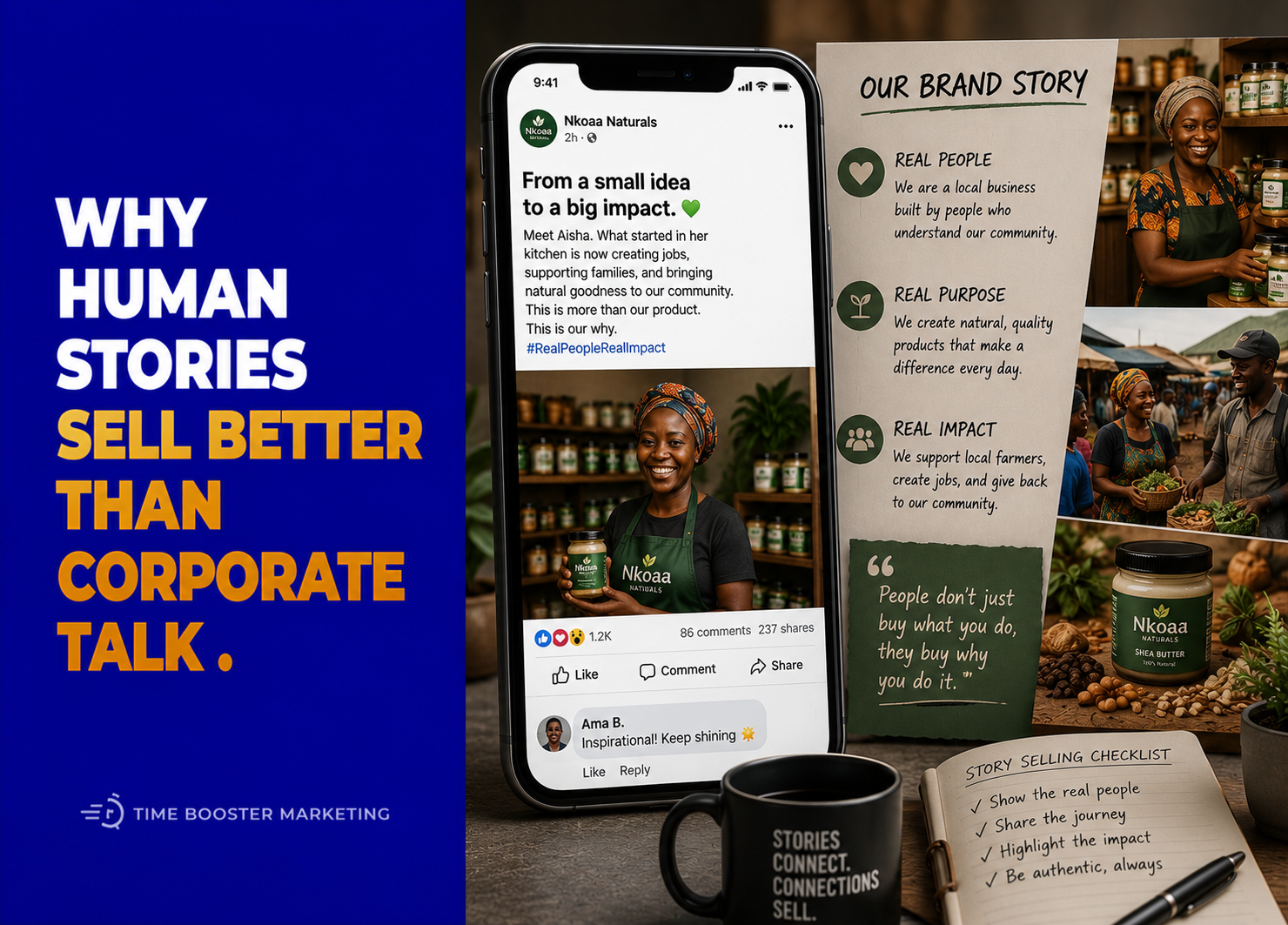
Instead of asking customers to believe a general claim, a story allows them to see a person, understand a problem, and imagine an outcome. That makes your marketing feel less like an announcement from a company and more like a useful conversation with someone who understands them.
Corporate Language Creates Distance
Corporate language usually begins with the business:
“We are a leading beauty establishment offering innovative services delivered by highly qualified professionals.”
A potential customer does not immediately see herself in that sentence. She must translate your claims into her own concerns:
- Can you handle my natural hair properly?
- Will my makeup last through an outdoor event?
- Will you respect my appointment time?
- Can I trust the result before an important ceremony?
- Will the final price suddenly change?
Corporate language forces the customer to perform this interpretation herself. Strong local messaging does the interpretation for her.
Consider this alternative:
“Clarisse had an 8 a.m. traditional wedding ceremony and needed her makeup finished before the family photographs began. We planned her appointment around the early start, selected products suited to the heat, and completed the look with time to spare.”
The second version still communicates professionalism. But it demonstrates professionalism through a specific situation rather than announcing it as an abstract quality.
That is the central advantage of storytelling: it turns your promise into visible evidence.
Why Stories Are More Persuasive Than Claims
Stories give information a human structure. They show who experienced the problem, what was at stake, what decision was made, and what changed afterward.
Research into “narrative transportation” examines what happens when people become mentally and emotionally absorbed in a story. A published meta-analysis of storytelling in digital communication found that narrative transportation has meaningful implications for persuasion and marketing communication. A story does not merely present information; it helps the audience mentally enter the situation being described. (ScienceDirect)
That matters because customers are naturally cautious about promotional claims. Saying “our salon provides reliable service” is easy. Showing how your team solved a real scheduling problem for a bride, professional, student, or new mother gives the claim context.
Stories also improve differentiation. Two salons may offer braiding, makeup, facials, and nail services. The difference becomes clearer when one salon consistently tells stories about the people it serves, the problems it solves, and the care behind its process.
Your services may be similar to a competitor’s. Your experiences, perspective, customers, and brand voice are not.
Cultural Relevance Makes the Story Feel Recognizable
Cameroon’s communication environment is multilingual. English and French operate alongside numerous mother languages and locally used forms of expression. UNESCO’s work on multilingual education in Cameroon emphasizes the continuing importance of preserving and promoting mother languages. (UNESCO)
For your marketing, this means that a single formal voice will not always connect equally with every audience.
A salon targeting young professionals in Bonamoussadi may need a different tone from one serving university students in Buea or families preparing for ceremonies in Yaoundé. The language should reflect how the intended customer naturally discusses the problem.
That does not mean forcing slang, inserting Pidgin into every sentence, or translating the same caption word for word. It means choosing expressions, examples, rhythms, and situations your audience recognizes.
For example, “Get event-ready with our comprehensive beauty package” communicates an offer.
But this communicates a situation:
“Your dress is ready. The photographer has confirmed. Your aunties are already asking when you will arrive. Let us handle your hair and makeup so you are not solving beauty emergencies on the morning of the event.”
The second version works because it reflects a familiar moment. The details create recognition without reducing the customer to a stereotype.
Local Language Must Serve Clarity
Using local expressions is not automatically authentic. A brand can still sound artificial when it uses slang that its customers would never expect from it.
Use language based on three questions:
- Who is receiving this message?
A corporate professional booking through WhatsApp may prefer concise English or French. A younger lifestyle audience may respond to a more conversational mixture. - Where will the message appear?
A storefront sign needs immediate clarity. An Instagram Reel can carry more personality. A WhatsApp status should be readable within seconds. - What action should the customer take?
Creative language should never hide the service, price, booking process, location, or deadline.
Authentic content sounds natural because it reflects the customer’s world. It does not perform “localness” for attention.
Use the Person–Moment–Problem–Change Framework
You do not need dramatic customer stories. Ordinary moments are often more persuasive because they are easier to recognize.
Use this four-part framework.
1. Introduce a Recognizable Person
Describe the customer specifically enough to create identification without exposing private information.
Weak:
“A customer visited our salon.”
Stronger:
“A bank employee preparing for her maternity photographs visited us after work.”
The second version helps similar customers recognize that the service may suit their schedule and needs.
2. Establish the Moment
Explain what was happening and why the service mattered.
“She wanted a soft makeup look that would photograph well without feeling heavy during the afternoon session.”
This gives the service a purpose. You are no longer selling makeup in isolation. You are helping someone prepare for an important memory.
3. Show the Problem or Concern
Useful stories contain tension, even when the tension is small.
“Her previous makeup experience had left her uncomfortable because the foundation did not match her complexion.”
This demonstrates that you understand a real objection.
4. Explain the Change
Show what you did and what improved.
“We tested the complexion products before application, adjusted the finish under natural light, and created a look she felt comfortable wearing throughout the session.”
Avoid turning every story into a miracle. Credible transformation is more persuasive than exaggerated transformation.
Apply the “So What?” Headline Test
Many beauty-business headlines describe a service without explaining why it matters.
Consider:
“Professional Bridal Makeup Services Available.”
Ask, “So what?”
A stronger headline answers that question:
“Bridal Makeup That Still Looks Fresh After the Photographs, Greetings, Heat, and Happy Tears.”
The new version translates the service into a customer benefit. It also introduces a miniature story: the customer can imagine moving through her wedding day.
Apply the same test to common salon claims:
Feature: Experienced hairstylists.
Benefit: You receive guidance on styles that suit your hair, schedule, and maintenance capacity.
Feature: Quality beauty products.
Benefit: Your makeup is selected for comfort, appearance, and the conditions in which you will wear it.
Feature: Convenient location.
Benefit: You can attend your appointment without losing an entire day in traffic and unnecessary waiting.
Do not remove features completely. Connect every feature to a consequence the customer values.
Rewrite Your Main Marketing Channels
Corporate version:
“Dear esteemed customers, we are pleased to announce the availability of our premium weekend beauty package.”
Story-led version:
“You have an event on Saturday, but your week is already full. Our weekend package combines hair, nails, and makeup in one planned appointment, so you do not have to visit three different places. Send ‘WEEKEND’ to check available times.”
The second message shows the problem, benefit, and next action.
Do not post only a finished hairstyle with “Another satisfied client.”
Explain the moment:
“She wanted knotless braids before travelling but did not want a style that would feel too heavy during the journey. We adjusted the length, section size, and finishing based on how long she planned to keep the style.”
This caption teaches, demonstrates expertise, and gives future customers useful decision-making information.
Flyers
Replace long paragraphs about your company with a customer-centered headline, three clear outcomes, and one booking instruction.
For example:
Three appointments before your event? Make it one.
Hair, nails, and makeup coordinated around your schedule.
Book through WhatsApp before Thursday.
Storefront Copy
“Beauty and excellence redefined” says little.
“Hair, makeup, and nails for workdays, celebrations, and the moments you cannot repeat” gives the customer recognizable reasons to enter.
Emotional Storytelling Must Remain Honest
Emotional marketing becomes fake when the emotion is manufactured.
Use real situations. Obtain permission before sharing identifiable customer details or photographs. Change names where necessary. Do not exaggerate insecurity, embarrassment, skin conditions, or personal problems to make the transformation look more dramatic.
Brand trust increasingly depends on personal relevance and believable communication. The 2025 Edelman Brand Trust report emphasizes that customers expect brands to connect with their personal realities rather than relying only on broad corporate positioning. (Edelman)
The strongest story is not necessarily the most emotional one. It is the one that feels true.
Build a Weekly Story Collection System
You should not wait until posting day to invent a story.
After each significant appointment, record four short notes:
- What was the customer preparing for?
- What concern did she mention?
- What choice or adjustment did your team make?
- What result mattered most to her?
Turn one appointment into several pieces of authentic content:
- A WhatsApp status explaining the customer’s concern
- An Instagram caption showing the process
- A short video answering a related question
- A testimonial request focused on the experience
- A flyer headline based on the benefit
Mobile communication continues to shape how African businesses and customers interact. GSMA’s Mobile Economy Africa 2026 describes the expanding economic role of mobile technologies across the continent. For a salon already using mobile channels to receive enquiries and bookings, short, recognizable stories are therefore not decorative content; they are practical sales tools. (GSMA)

Make Your Marketing Sound Like Someone Customers Can Trust
Professional marketing does not have to sound distant.
Your customers are not looking for the salon with the longest words. They are looking for signs that you understand their hair, complexion, schedule, event, budget, expectations, and concerns.
Corporate language tells people that your business is excellent. Storytelling shows them what your excellence looks like in a situation they recognize.
Start with one real customer moment. Remove confidential details. Explain the concern, the decision, and the outcome. Then write it in the language your intended customer would naturally understand.
That is how your brand voice becomes more human without becoming less professional, and how your marketing begins to sound like a business people can confidently contact.