


Meta CBO vs ABO Strategy: Architecting Campaigns That Can Actually Scale
The Meta CBO versus ABO debate is often framed as a choice between trusting the algorithm and maintaining manual control.
That framing misses the more important issue.
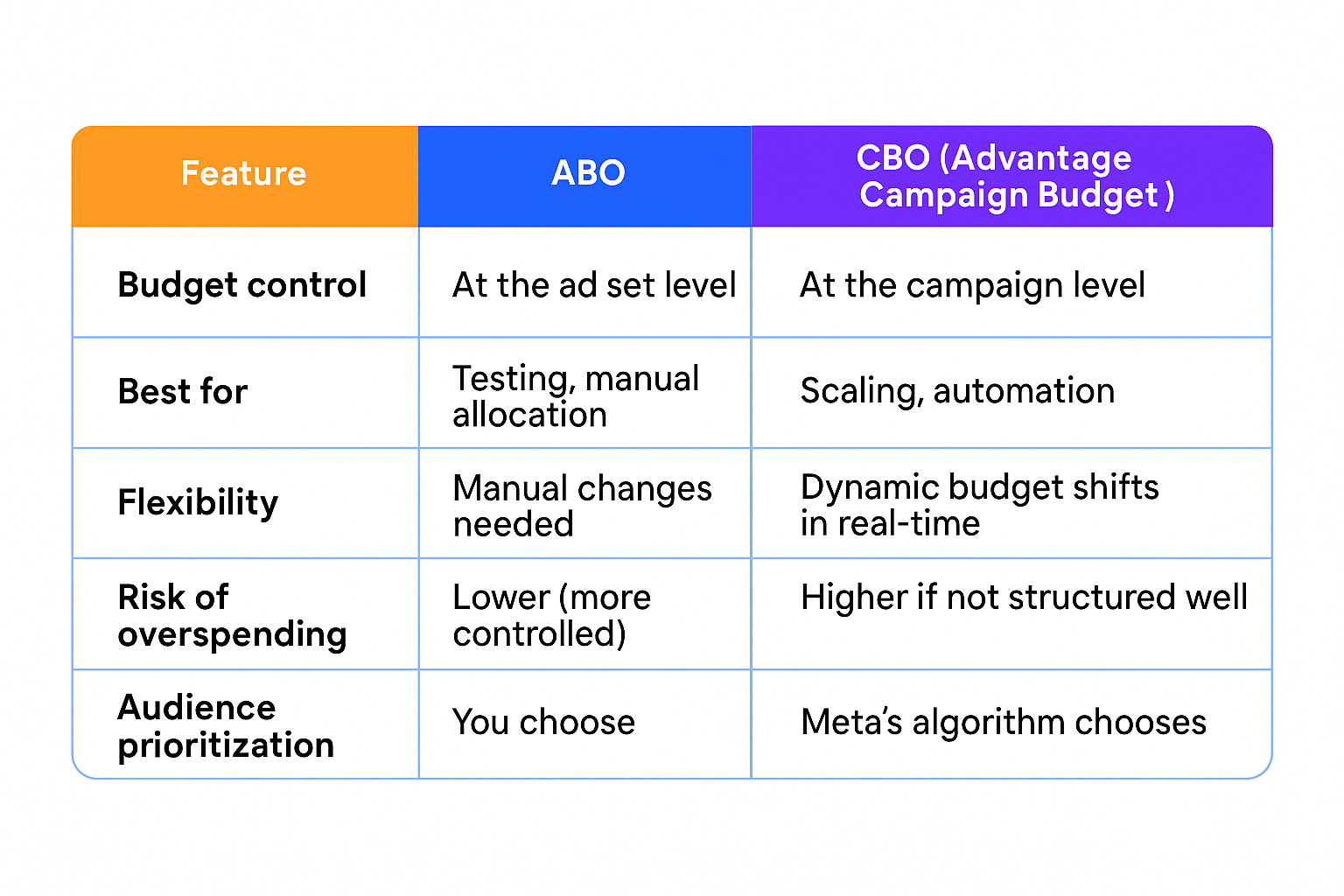
Campaign Budget Optimization and Ad Set Budget Optimization are not competing philosophies. They are budget-distribution systems designed for different stages of campaign development. ABO is most useful when you need controlled exposure to produce interpretable test data. CBO becomes valuable when you already have credible performance signals and want Meta to allocate more money toward the strongest opportunities.
Problems begin when you force both jobs into one campaign.
When unproven tests sit beside established winners inside a CBO campaign, Meta is not obligated to spend evenly. When proven ad sets remain trapped inside rigid ABO structures, you may prevent budget from moving toward the best available conversion opportunities.
A scale-ready account therefore separates discovery architecture from distribution architecture.
What Is the Difference Between CBO and ABO?
CBO is the traditional industry abbreviation for Campaign Budget Optimization. Meta currently presents this functionality as Advantage+ campaign budget.
With Advantage+ campaign budget, you establish one campaign-level budget. Meta then distributes that budget across eligible ad sets according to the conversion opportunities its delivery system identifies. Meta describes the system as continuously allocating budget toward ad sets with the strongest opportunities in real time. (Facebook)
ABO is common media-buyer shorthand for using separate budgets at the ad set level. Each ad set receives its own daily or lifetime budget, meaning you determine how much spending access each test receives rather than allowing unrestricted campaign-level redistribution. Meta officially distinguishes between campaign budgets and individual ad set budgets in its budgeting documentation. (Facebook)
The practical distinction is straightforward:
ABO controls exposure. CBO controls allocation.
You use ABO when fair or predetermined exposure matters more than immediate efficiency. You use CBO when maximizing campaign-level performance matters more than ensuring every ad set receives equal spend.
Why Mixing Testing and Scaling Breaks Budget Distribution
A test is designed to answer a question.
For example:
- Does a testimonial creative outperform a product-demonstration creative?
- Does a problem-aware angle produce more purchases than a discount-led angle?
- Can a broad prospecting audience outperform a customer lookalike?
To answer these questions, each meaningful variation needs sufficient delivery. That does not necessarily mean perfectly equal impressions, but it does require enough controlled exposure to avoid declaring a winner simply because one variation received most of the budget.
A scaling campaign has a different objective. Its job is not to treat every ad set fairly. Its job is to produce the highest possible volume within your profitability constraints.
When you place experimental and proven ad sets inside the same unrestricted CBO campaign, the system may concentrate spending on whichever ad set finds inexpensive early opportunities. That is rational from a delivery perspective, but it can invalidate your testing process. A potentially strong test may receive too little spend to demonstrate its value.
Conversely, keeping every winner in a separate ABO ad set can create excessive fragmentation. Meta warns that running similar ad sets simultaneously gives each ad set fewer opportunities to learn and recommends consolidating comparable structures where possible. (Facebook)
Your structure should therefore change as certainty increases.
When to Use ABO for Isolated Asset Testing

ABO is appropriate when your immediate goal is learning rather than scaling.
Use it when testing new creative concepts, offers, landing pages, geographic markets or materially different audience hypotheses. The separate ad set budgets create a controlled testing environment in which one variation cannot automatically consume the entire campaign budget.
Test One Strategic Variable at a Time
Do not create one ad set with a new audience, new offer, new creative angle and new landing page, then compare it with your control.
Even when performance improves, you will not know which change caused the improvement.
A cleaner creative test might use:
- The same objective and optimization event
- The same geographic market
- The same audience configuration
- The same placements
- The same offer and landing page
- One distinct creative concept per ad set
The purpose is not laboratory-level perfection. Meta’s auction environment is dynamic. The purpose is to reduce enough variables that your result can inform the next budget decision.
Calculate Test Budgets From the Business Outcome
Avoid selecting an arbitrary daily budget because it feels affordable.
Start with your target cost per acquisition and determine how much evidence you need before making a decision. A simple planning equation is:
Test budget per ad set = target CPA × desired number of evaluation events
Suppose an ecommerce brand can acquire customers profitably at $40 and you want at least three purchases before treating a result as directionally useful. Each ad set needs access to approximately $120 over the evaluation period.
This does not guarantee three purchases. It creates a budget aligned with the economic question you are trying to answer.
Meta recommends giving campaigns sufficient time and budget to learn instead of judging performance from extremely short delivery windows. Its budgeting guidance recommends planning around at least seven days where feasible. (Facebook)
Do Not Turn ABO Into Permanent Micromanagement
ABO should not become a collection of dozens of small ad sets that never generate enough conversion volume to produce stable decisions.
Once a test has failed, stop funding it. Once it has produced repeatable, economically acceptable results, graduate it into a scaling structure.
ABO is a proving ground, not a retirement home for every ad set you have ever launched.
When to Use Advantage+ Campaign Budget for Scaling
Move to CBO when your central question changes from “Does this work?” to “Where can Meta find more profitable volume?”
CBO performs best when the campaign contains ad sets that are all legitimate candidates for additional budget. You should already understand their offers, creatives, conversion paths and approximate economics.
Place Comparable Ad Sets in the Same Campaign
A scaling CBO should not resemble a storage folder containing unrelated tactics.
Keep ad sets aligned around:
- One campaign objective
- One optimization event
- The same funnel stage
- Compatible bid strategies
- Similar commercial economics
- Offers with comparable margins and customer value
Meta states that Advantage+ campaign budget eligibility requires ad sets to use the same budget type, bid strategy and standard delivery type. (Facebook)
Beyond technical eligibility, commercial comparability matters. A low-ticket introductory offer and a high-margin flagship product may generate very different acquisition costs. Allowing them to compete for the same budget can make campaign-level efficiency look healthy while starving the offer that creates more downstream profit.
Let CBO Optimize Proven Opportunities
Once ad sets have earned their position, avoid forcing equal distribution indefinitely.
CBO’s advantage is its ability to redirect budget as auction conditions change. One audience may perform better during a particular week. Another may find additional volume as creative engagement changes. Campaign-level budgeting allows the delivery system to respond without requiring constant manual reallocations.
That is the point at which passing control to Meta AI becomes strategically useful: not before you understand what is being scaled, but after you have reduced the number of unknowns.
How to Stop One Ad Set From Eating the Entire Budget
Automation does not require the complete removal of financial guardrails.
Meta allows advertisers using Advantage+ campaign budget to establish ad set minimum and maximum spend limits. These controls can restrict how aggressively the campaign budget moves between ad sets. (Facebook)
Use Maximum Limits as Temporary Risk Controls
A maximum spend limit can prevent one ad set from absorbing a dangerous share of the budget before you have enough evidence to trust the concentration.
For a campaign containing three comparable ad sets, you might initially prevent any single ad set from receiving more than approximately half of the campaign budget. This is a risk-management heuristic, not a universal Meta rule.
As performance becomes more stable, loosen or remove the restriction. A permanent cap that repeatedly blocks your strongest ad set defeats the purpose of campaign-level optimization.
Use Minimum Limits Only When Diagnostic Spend Is Necessary
A minimum spend limit can ensure a new or strategically important ad set receives some delivery.
Use minimums selectively. When every ad set receives a large guaranteed allocation, your CBO begins behaving like ABO with extra steps.
Minimums are most defensible when:
- A validated creative has just entered the scaling campaign
- A required geographic market needs baseline delivery
- A strategic product category must receive some exposure
- Early budget concentration would prevent meaningful evaluation
The guaranteed amount should be large enough to generate information but small enough to preserve Meta’s ability to optimize the remaining budget.
Apply Campaign Spending Limits for Financial Protection
Ad set limits control internal distribution. A campaign spending limit controls the total amount a campaign can spend.
Meta describes campaign spending limits as adjustable caps on overall campaign expenditure. They do not determine which ad set wins delivery, but they can protect the account from exceeding an approved test or launch budget. (Facebook)
This is especially useful for agencies operating under strict client authorizations or managing campaigns in currencies where a configuration mistake can quickly become expensive.
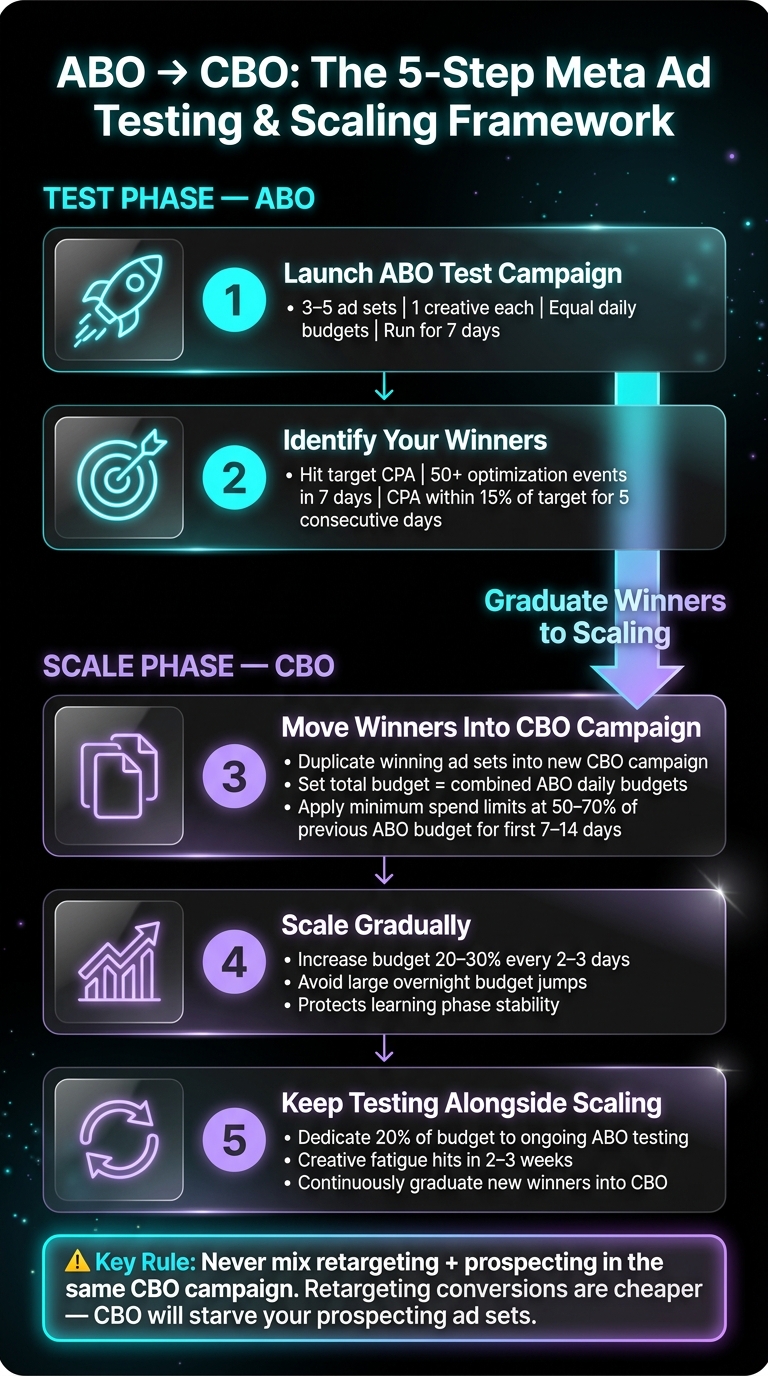
A Practical Test-to-Scale Campaign Framework
A reliable account can use two separate campaign systems.
Campaign One: ABO Testing
Create controlled ad sets for genuinely new hypotheses. Assign budgets based on target CPA and the amount of evidence required. Keep the optimization event, offer and major delivery settings consistent.
Evaluate tests against business metrics such as contribution margin, qualified lead rate or new-customer CPA—not merely click-through rate.
Campaign Two: CBO Scaling
Transfer validated winners into a consolidated Advantage+ campaign budget structure. Include only ad sets you would be comfortable funding more aggressively.
Begin with temporary maximum-spend safeguards when concentration risk is high. Remove restrictive controls when the campaign demonstrates that its budget allocation is producing profitable volume.
Continue introducing new winners from the testing campaign, but do not turn the scaling campaign itself into an uncontrolled experiment.
Build Separate Systems for Learning and Growth
The strongest Meta CBO versus ABO strategy is not choosing one structure for the entire account.
It is assigning each structure a precise responsibility.
ABO buys controlled information. CBO buys efficient distribution.
When you isolate testing, you can determine which creatives, offers and audience hypotheses deserve further investment. When you consolidate validated opportunities under Advantage+ campaign budget, Meta can shift spend toward the places where additional conversions are most likely.
That separation creates an account you can diagnose, defend and scale. You stop asking one campaign to discover winners and maximize them simultaneously—and your budget decisions become considerably more deliberate.


