


Ad Frequency Optimization on Meta: Fix Creative Fatigue Before Performance Drops
When you advertise inside a national audience containing millions of eligible users, Meta has room to keep finding new conversion opportunities.

A local campaign behaves differently.
A restaurant targeting customers within a delivery radius, a gym advertising within commuting distance or a real estate business focused on one city may exhaust its practical audience much faster. As Meta returns to the same high-probability prospects, frequency rises, familiar creative loses attention and acquisition costs begin to climb.
The mistake is waiting for cost per lead or cost per purchase to collapse before responding.
Effective ad frequency optimization on Meta requires you to detect creative decay while the campaign is still producing acceptable results. That means monitoring frequency as part of a wider pattern, eliminating unnecessary audience fragmentation and maintaining a creative pipeline capable of introducing genuine novelty.
What Creative Fatigue Actually Looks Like
Meta defines frequency as the estimated average number of times each person saw your ad. It is useful, but frequency alone does not prove that an audience is fatigued. (Facebook)
A frequency of three could be damaging in a small cold-prospecting campaign with one repetitive image. The same frequency could be commercially reasonable in a short retargeting campaign where customers need several reminders before purchasing.
Creative fatigue is better understood as a relationship between repeated exposure and weakening response.
Meta describes creative fatigue as a condition in which an audience has seen the same image or video too many times and becomes less likely to engage with it. Ads Manager may also display a Creative fatigue delivery status when Meta detects serious deterioration. (Facebook)
Your diagnosis should therefore combine frequency with performance direction.
The Five-Metric Fatigue Signal
Monitor these metrics over comparable rolling periods:
- Frequency
- Reach and new-reach growth
- Outbound click-through rate
- Conversion rate
- Cost per result
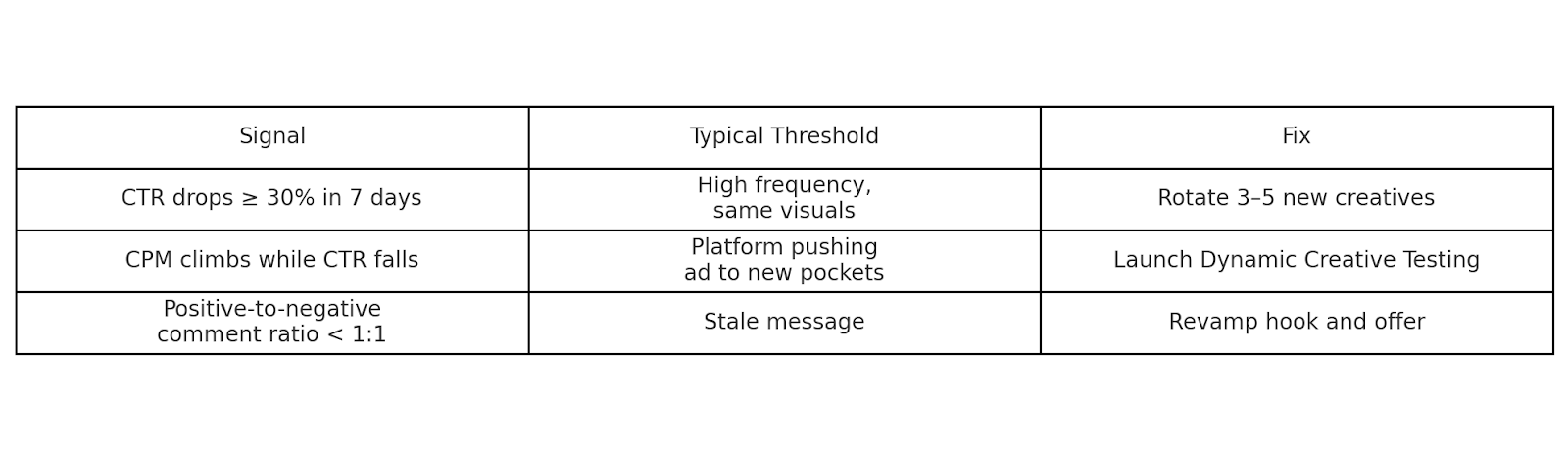
Creative decay becomes increasingly likely when frequency rises while reach expansion slows, click-through rate declines and cost per result increases.
For example, suppose a local salon’s campaign moves from a seven-day frequency of 1.8 to 2.7. That increase is not automatically a problem. However, when outbound click-through rate falls by 18%, landing-page conversion rate weakens and appointment cost rises by 25% during the same period, you have a meaningful fatigue pattern.
Do not wait for every metric to fail. The purpose of monitoring is to intervene while the account still has momentum.
Build Frequency Thresholds Around Your Local Market
There is no universal Meta frequency at which every ad becomes fatigued.
A sustainable level depends on audience size, campaign objective, offer urgency, creative quality, buying cycle and the time window being examined. A seven-day frequency of four means something different from a 90-day lifetime frequency of four.
You need thresholds based on your own localized consumer footprint.
Start With Practical Monitoring Zones
For a local cold-audience acquisition campaign, you can use the following ranges as initial operational guardrails—not universal Meta benchmarks:
- Stable zone: Seven-day frequency below approximately 2, with steady click-through rate and acquisition cost.
- Watch zone: Frequency around 2–3, accompanied by slowing reach growth or declining engagement.
- Action zone: Frequency above approximately 3, with sustained deterioration in click-through rate, conversion rate or cost per result.
Warm retargeting audiences can often tolerate more repetition because the users have already demonstrated intent. For those campaigns, a frequency of 3–5 may be a monitoring zone rather than an immediate shutdown signal.
The business context also matters. A two-week event promotion may require concentrated exposure. An always-on dental campaign showing the same testimonial for three months requires a lower tolerance for repeated impressions.
Create a Local Fatigue Baseline
Use your previous four to eight stable weeks to calculate a working baseline for each funnel stage.
Record:
- Median seven-day frequency
- Median outbound click-through rate
- Median conversion rate
- Median cost per result
- Weekly unique reach
- Percentage of spend assigned to each creative
Then define a fatigue alert relative to that baseline.
A practical internal rule could be:
Investigate when seven-day frequency increases by at least 25% while outbound click-through rate falls by 15% or cost per acquisition rises by 20%.
Those percentages are operating rules, not platform guarantees. Their value comes from forcing your team to investigate before severe deterioration becomes visible in monthly reporting.
Separate Creative Fatigue From Other Performance Problems
A tired advertisement is not the only reason acquisition costs rise.
Before replacing creative, check whether:
- CPM increased because auction competition changed
- The landing page became slower or unavailable
- The offer expired or lost relevance
- Conversion tracking stopped recording accurately
- Sales follow-up speed declined
- Budget changes disrupted delivery
- Seasonality changed customer intent
Meta’s delivery system enters a learning period while exploring which audiences and placements can produce the selected optimization event. Significant edits can cause further delivery instability, so repeated reactive changes may make diagnosis harder rather than easier. (Facebook)
Compare funnel stages before blaming the advertisement.
When click-through rate remains stable but landing-page conversion falls, your creative may still be doing its job. When click-through rate weakens while the landing page continues converting visitors normally, fatigue becomes a stronger explanation.
Consolidate Overlapping Ad Sets Before Duplicating Anything
Ad set duplication is frequently presented as a quick fix for declining performance.
It can also reproduce the original problem.
Duplicating an ad set with the same geography, audience logic and creative does not create new demand. It creates another delivery structure trying to reach many of the same people.
Meta calls this auction overlap: multiple ads from the same Page may become eligible for the same auction. Meta also notes that overlapping audiences can contribute to poor delivery. (Facebook)
This does not mean you literally pay twice for one impression. The larger operational problem is fragmentation. Similar ad sets divide conversion signals, budgets and learning opportunities across structures that are pursuing substantially the same prospects.
Use the Overlap Test
Before duplicating an ad set, ask:
- Is the new audience materially different?
- Does it represent another funnel stage?
- Does it require a separate budget or commercial objective?
- Does it use a genuinely different offer?
- Would exclusions prevent the two ad sets from pursuing the same users?
When the answers are no, consolidation is usually more defensible than duplication.
Meta recommends combining similar ad sets because running them simultaneously can give each ad set fewer opportunities to learn and generate results. (Facebook)
Build a Cleaner Local Structure
A local acquisition account often needs fewer ad sets than the advertiser assumes.
Instead of creating separate ad sets for numerous closely related interests, consolidate them into a broader prospecting structure. Keep retargeting separate when it has a distinct message, budget and level of intent. Use customer and recent-converter exclusions where commercially appropriate.
A simplified structure could contain:
- One broad local prospecting ad set
- One strategically distinct prospecting test
- One warm retargeting ad set
- One existing-customer campaign when retention is a separate objective
The objective is not minimalism for its own sake. It is to give each ad set enough budget, audience space and conversion data to perform a clear role.
Deploy Creative Breadth, Not Cosmetic Variations
Changing a button colour or moving a logo rarely provides enough novelty to reverse genuine fatigue.
You need new reasons for the audience to pay attention.
Build creative variations across several dimensions:
Change the Opening Hook
A familiar offer can feel new when introduced through a different customer problem, objection or desired outcome.
A gym could rotate between:
- “Struggling to stay consistent after work?”
- “Need guided training without an overcrowded gym?”
- “Want measurable progress before your next milestone?”
Each hook enters the customer’s decision from a different psychological angle.
Change the Proof Mechanism
Rotate demonstrations, customer stories, founder explanations, before-and-after processes, reviews, product close-ups and behind-the-scenes footage.
The purpose is not to manufacture endless advertisements. It is to show the same value proposition through different forms of evidence.
Change the Format
Develop static images, short-form video, carousels, customer-generated clips and vertical Stories or Reels assets. Meta recommends creative diversification across formats and placements rather than relying on one repeated execution. (Facebook)
Meta’s Advantage+ creative tools can also generate or optimize asset variations, resize media, test text options and adapt creative for different placements. These tools expand delivery options, but they should support—not replace—strong concepts. (Facebook)
Five automated crops of the same tired visual are not five new ideas.
Use Broad Delivery to Reduce Repetitive Exposure
Extremely narrow interest stacks can accelerate audience saturation in localized markets.
When your essential geographic, age, language and exclusion controls are established, broader targeting can give Meta more room to locate relevant prospects. Advantage+ audience can treat many audience inputs as suggestions while respecting strict controls such as location, minimum age, language and custom-audience exclusions. (Facebook)
Advantage+ placements can also distribute advertisements across Facebook, Instagram, Messenger and Audience Network placements, increasing the available inventory rather than repeatedly forcing delivery into one narrow placement. (Facebook)
Broad delivery will not rescue weak creative. It can, however, slow unnecessary saturation by expanding the number of eligible people, contexts and placements available to the system.
Your Proactive Creative-Fatigue Checklist
Review high-spend campaigns weekly and smaller local campaigns at least twice per week.
Check whether:
- Seven-day frequency is rising faster than unique reach
- Outbound click-through rate is falling
- Conversion rate is weakening
- Cost per acquisition is moving beyond its normal range
- One creative is receiving most of the spend
- Ads Manager shows Creative limited or Creative fatigue
- Multiple ad sets target substantially the same people
- The campaign relies on one hook, format or proof mechanism
- New creative is available before the current winner fails
When fatigue is confirmed, do not rebuild the entire account immediately.
Introduce new creative into the existing strategic structure, reduce or pause the decaying asset, consolidate redundant ad sets and preserve useful conversion history where possible. Expand targeting or placements only when doing so remains commercially relevant.
Treat Creative Renewal as Campaign Maintenance
Audience fatigue is not an unexpected platform malfunction. In a finite local market, it is a predictable consequence of repeated exposure.
The solution is not a frantic cycle of ad set duplication, daily edits and complete campaign relaunches. It is a monitoring system that connects frequency with reach, response quality and acquisition economics.
Establish a localized baseline. Consolidate structures pursuing the same customers. Give Meta sufficient audience and placement flexibility. Most importantly, maintain a pipeline of genuinely different hooks, formats and proof assets.
When you make creative renewal part of routine campaign operations, you can replace decaying ads before the market forces you to—and protect acquisition performance without constantly destabilizing the account.


