Which Brand Positioning Strategy Fits Your Business?
Your business is not struggling because your products are bad.
It is struggling because customers cannot clearly tell why they should choose your business over another.

A food vendor looks like every other food vendor. A beauty brand sounds like every other beauty brand. A fashion business posts the same style of photos as its competitors. A tech service provider says it is “reliable and affordable,” just like everyone else. A coaching brand promises “transformation,” but does not explain what kind, for whom, or why its approach is different.
When customers cannot see a clear difference, they compare the easiest thing to compare: price.
That is how many Buea businesses end up trapped in discount competition. One person reduces their price, another person adds a free delivery offer, another person gives a “promo,” and suddenly everyone is working harder for less profit.
But price is not the only way to compete.
In fact, for many small businesses, price is the weakest place to compete because there will almost always be someone willing to charge less. Someone has lower costs. Someone is desperate for quick cash. Someone is new and wants visibility. Someone does not fully understand their margins. Someone is willing to underprice just to get attention.
If your only reason for customers to choose you is that you are cheaper, your brand is vulnerable.
Brand positioning gives you a stronger advantage.
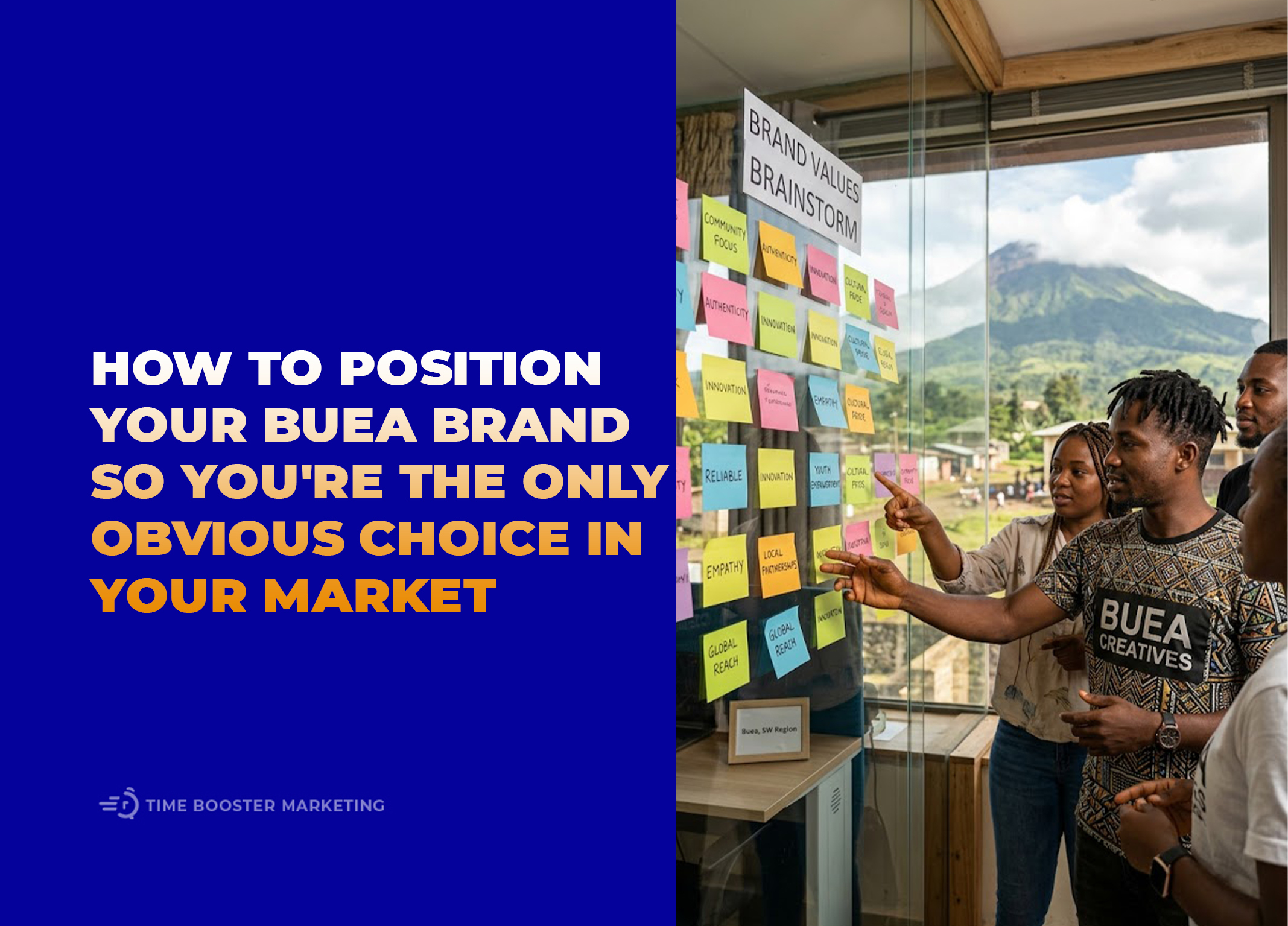
Positioning is the space your business owns in the customer’s mind. It is the clear reason people remember you, trust you, talk about you, and choose you over similar options. It is not just your logo, colors, slogan, or Instagram feed. Those things can support positioning, but they are not the positioning itself.
Your positioning answers a deeper question:
Why should the right customer choose you instead of every other available option?
For a Buea business, that answer must be practical, believable, and locally relevant. It must make sense to students, workers, families, entrepreneurs, professionals, visitors, and community networks depending on who you serve. It must reflect how people actually buy: through trust, referrals, WhatsApp conversations, social proof, convenience, familiarity, quality signals, and perceived value.
The strongest positioning strategy is not always the loudest. It is the clearest.
Why Brand Positioning Matters More in a Crowded Buea Market

Buea is a market where many businesses operate close to each other, both physically and digitally.
Customers may compare options in Molyko, Mile 17, Great Soppo, Bonduma, Clerks Quarters, Sandpit, and online through Instagram, Facebook, TikTok, WhatsApp statuses, and referrals. A student can ask five friends for recommendations before buying. A parent can compare several schools, tutors, vendors, or service providers. A bride can check multiple makeup artists and fashion designers before booking. A startup founder can compare web designers, photographers, consultants, and branding services before choosing one.
In this kind of environment, being “good” is not enough.
Many businesses are good. Many are affordable. Many are available. Many can deliver. Many can claim quality.
The real question is whether your brand gives customers a specific reason to remember you.
If your message sounds like everyone else’s, customers will place you in the same mental category as everyone else. Once that happens, you lose control of the comparison. The customer decides based on convenience, price, popularity, or whoever responds fastest.
Positioning helps you shape the comparison before the customer makes a decision.
Instead of being “one of many,” you become the obvious choice for a specific type of customer, need, situation, value, or experience.
The Problem With Competing Only on Price
Price competition feels easy because it creates quick movement.
If sales are slow, you reduce the price. If people hesitate, you offer a discount. If a competitor charges less, you match them. If customers complain, you add something extra for free.
At first, this may work. People respond. Orders come in. Engagement increases. But over time, price-based competition can weaken your business.
It can reduce your profit margin. It can attract customers who only buy when there is a discount. It can make your offer feel less valuable. It can train your audience to wait for promos. It can make it harder to raise prices later. It can force you to serve more customers just to make the same amount of money.
Most importantly, it prevents you from building a stronger identity.
When a business depends too much on price, it often avoids answering the harder strategic questions:
Who exactly are we for?
What do we want to be known for?
What do we do differently?
What experience do customers associate with us?
What problem do we solve better than others?
What kind of customer should choose us immediately?
What kind of customer are we not trying to attract?
These questions are uncomfortable, but they are where positioning begins.
What Brand Positioning Really Means
Brand positioning is not about pretending to be unique.
It is about making your real difference clear, relevant, and valuable to the right customer.
A business does not need to be completely original to be well positioned. A restaurant does not need to invent a new cuisine. A beauty studio does not need to create a new service category. A boutique does not need to sell clothes nobody has ever seen. A consultant does not need a revolutionary method.
Positioning is about choosing the angle that makes your business easier to understand and harder to replace.
For example, two food businesses may both sell lunch. But one can position around fast, affordable student meals near campus. Another can position around clean, premium office lunch packs for professionals. Another can position around healthy local meals for people who want convenience without heavy food. Another can position around event catering with reliable timing and presentation.
Same broad category. Different position.
Two beauty businesses may both offer makeup. But one can position around bridal elegance. Another can position around soft everyday glam for working women. Another can position around student-friendly beauty on a budget. Another can position around premium skin-prep and long-wear makeup for events.
Same service. Different customer perception.
This is why positioning is powerful. It does not always require a new product. Sometimes it requires a sharper choice.
The Positioning Matrix for Buea Businesses
A positioning matrix helps you decide how your business should stand out.
Instead of guessing, you evaluate your brand across two important questions:
Are you competing mainly on price or value?
Are you trying to serve everyone or a specific audience?
This creates four positioning zones.
Zone 1: Low Price + Broad Audience
This is the “cheap for everyone” position.
Many businesses fall into this zone by default. They try to serve anybody who can pay, and they use low prices to attract attention.
This can work if you have volume, operational efficiency, low costs, and a product people buy frequently. For example, a simple snack vendor near a busy student area may succeed with affordability and convenience if the business can handle high daily volume.
But for many small businesses, this position is risky.
If you do not have enough volume, low prices can damage your cash flow. If your offer requires skill, time, customization, delivery, or personal service, underpricing can quickly become exhausting. You may attract many customers but still struggle to make profit.
This position is not wrong, but it must be intentional. If you are low-price and broad-audience by accident, you may be building a busy but fragile business.
Best fit for:
High-volume products
Fast-moving daily purchases
Student-heavy offers
Simple, standardized products
Businesses with low delivery complexity
Offers where convenience matters more than deep differentiation
Risk:
You become replaceable if someone cheaper appears.
Zone 2: Low Price + Specific Audience
This is the “affordable for a clear group” position.
This is stronger than being cheap for everyone because the business still has focus. You are not simply saying, “We are affordable.” You are saying, “We are affordable for this specific customer with this specific need.”
For example, a printing business can position around affordable, fast academic printing for students. A food vendor can position around budget-friendly meal plans for university students. A hair service can position around simple, neat, affordable styles for students and young workers who need to look good without overspending.
This position works when the audience is price-sensitive but still values reliability, convenience, and relevance.
The key is to avoid looking low-quality. Affordable should not mean careless. In Buea, where word-of-mouth travels quickly, a low-price brand can still build trust if it is consistent, respectful, and clear.
Best fit for:
Student-facing businesses
Entry-level service offers
Budget-conscious customer groups
Businesses that can standardize delivery
Brands that want volume from a defined audience
Risk:
If costs rise or customers demand too much customization, margins can become weak.
Zone 3: High Value + Broad Audience
This is the “quality brand for many people” position.
Businesses in this zone do not compete primarily on being cheap. They compete on better quality, better experience, better reliability, better presentation, or better outcomes. However, they still serve a relatively broad audience.
For example, a restaurant may position as a clean, reliable, well-presented place for casual dining, meetings, and family outings. A logistics service may position around dependable delivery across Buea. A supermarket, pharmacy, or hospitality business may position around trust, consistency, and convenience for many types of customers.
This position can work well, but it requires strong operational discipline. If you promise quality to a broad market, you must deliver consistently. Customers will expect your service, environment, communication, and product quality to match the positioning.
Best fit for:
Hospitality businesses
Restaurants and cafés
Pharmacies and retail shops
Logistics and delivery services
Professional services with broad demand
Businesses with strong systems and service standards
Risk:
The brand can become too general if it does not define what “quality” specifically means.
Zone 4: High Value + Specific Audience
This is often the strongest positioning zone for expert-led and premium small businesses.
Here, you are not trying to serve everyone. You are choosing a specific customer and offering a clear, higher-value solution for them.
For example, a branding consultant can position around helping Buea startups and SMEs build credible brands before launching. A beauty studio can position around premium bridal makeup for brides who want a calm, reliable wedding-day experience. A fitness coach can position around structured programs for busy professionals who want accountability. A web designer can position around conversion-focused websites for service businesses that need leads, not just a pretty page.
This position allows you to charge based on value, not just time or materials.
It also makes your marketing easier because you know exactly who you are speaking to. Your content, testimonials, offers, pricing, and customer experience can all align around one clear audience.
Best fit for:
Consultants
Coaches
Creative professionals
Beauty and fashion specialists
Premium service providers
Tech and digital service businesses
Businesses with expertise, process, or customization
Risk:
You must be willing to say no to customers outside your focus. If you keep trying to serve everyone, the positioning becomes weak.
How to Choose Your Positioning Zone
Do not choose a positioning zone based only on what sounds attractive.
Choose based on your business model, capacity, audience, offer, and profit needs.
Ask yourself:
Can I profitably serve many people at a low price?
Do I have the systems to deliver high volume?
Is my audience highly price-sensitive?
Do I have expertise that justifies premium pricing?
Do customers need trust and guidance before buying?
Is my offer simple or customized?
Do I want more transactions or better-fit customers?
Do I have proof that supports a higher-value position?
Can I communicate clearly to a specific audience?
If your business requires deep personal attention, customization, expert knowledge, or high-quality delivery, competing mainly on low price may not fit. If your business sells simple daily products to students, a premium niche strategy may not be necessary. If your market is crowded and your service is skill-based, a high-value specific-audience position may give you the strongest advantage.
The goal is not to choose the most impressive position. The goal is to choose the position your business can actually deliver.
Three Positioning Archetypes That Win in Saturated Markets
A saturated market is not always a bad market.
A saturated market means demand exists. People are already buying. The problem is that many businesses are competing for the same attention with similar messages.
In Buea, saturated categories may include food, fashion, beauty, phone accessories, photography, event services, tutoring, tech services, real estate support, coaching, and digital marketing. The way to win is not always to shout louder. It is to become more specific, more trusted, or more meaningful.
Here are three positioning archetypes that can help.
Archetype 1: The Specialist
The Specialist wins by becoming known for one clear audience, problem, or outcome.
Instead of saying, “We do everything,” the Specialist says, “We are the best choice for this specific thing.”
This is powerful because customers often trust specialists more than generalists when the decision matters. If someone needs bridal makeup, they may prefer a makeup artist known specifically for brides. If a startup needs a website that generates inquiries, they may prefer a web designer known for service-business websites. If a parent needs exam preparation for a child, they may prefer a tutor known for that exact exam level.
The Specialist does not need to serve everyone because clarity attracts the right people.
Examples for Buea Businesses
A fashion designer can become the go-to brand for modest, elegant office wear for young professional women in Buea.
A food business can specialize in clean, well-packaged lunch bowls for office workers and entrepreneurs.
A photographer can specialize in graduation shoots, personal branding portraits, or small business product photography.
A tech business can specialize in websites and digital systems for local service providers.
A beauty brand can specialize in natural hair care for women who want healthy hair without complicated routines.
Why the Specialist Works
The Specialist reduces confusion.
Customers immediately understand what the business is known for. This makes referrals easier. Instead of saying, “She does makeup,” people can say, “She is the person to call for calm, reliable bridal makeup.” Instead of saying, “He does websites,” people can say, “He builds websites for small businesses that need clients.”
That level of specificity makes the brand easier to remember and recommend.
When to Choose This Archetype
Choose the Specialist archetype if:
You have a clear skill advantage
You serve a specific customer better than others
Your market is crowded with generalists
Your offer requires trust or expertise
You want to charge based on value
You want referrals to become more precise
What to Avoid
Do not claim specialization if your content, offers, and proof are still scattered.
If your page says you specialize in premium bridal makeup but your content is mostly random trends, birthday glam, skincare memes, and unrelated lifestyle posts, the positioning becomes weak. A Specialist must repeat the same message consistently until the market remembers it.
Archetype 2: The Local Insider
The Local Insider wins by understanding the local customer better than outside or generic competitors.
This archetype is especially useful in Buea because local context matters. Customers do not only buy based on abstract brand promises. They consider location, convenience, trust, language, timing, delivery, community reputation, student budgets, professional schedules, weather, events, campus life, and referral networks.
The Local Insider says, “We understand how people here actually live, buy, move, decide, and communicate.”
This is not about using local references superficially. It is about designing the business around local reality.
Examples for Buea Businesses
A food vendor can position around reliable student and office lunch delivery that understands class schedules, work breaks, and local delivery points.
A real estate support business can position around helping newcomers, students, and young professionals find safe, realistic housing options without confusion.
A digital marketing service can position around helping Buea SMEs turn WhatsApp, referrals, and social media into a practical customer journey.
A fitness brand can position around programs that fit Buea’s student and professional lifestyle, not imported routines that assume different schedules and budgets.
A hospitality business can position around being the trusted place for visitors, business travelers, and families who want comfort, location clarity, and reliable service.
Why the Local Insider Works
The Local Insider builds trust through relevance.
Customers feel understood. The brand does not sound like it copied a foreign template and pasted “Buea” into the caption. It speaks to real buying situations. It knows the objections. It understands the informal decision-making process. It makes the customer feel, “This business gets me.”
That feeling can become a competitive advantage.
When to Choose This Archetype
Choose the Local Insider archetype if:
Local knowledge affects the buying decision
Customers need guidance or reassurance
Your business serves students, newcomers, families, or local professionals
Convenience and trust matter
Referrals are important
You can communicate with cultural and market awareness
What to Avoid
Do not confuse local positioning with being casual or unprofessional.
A Local Insider still needs quality, consistency, and clear systems. Local relevance should make your brand more trusted, not less serious.
Archetype 3: The Premium Experience
The Premium Experience wins by making customers feel the difference before, during, and after the purchase.
This archetype is not only about high prices. It is about higher perceived value. Customers pay more because the experience feels more reliable, thoughtful, comfortable, organized, beautiful, professional, or emotionally satisfying.
In crowded markets, many businesses sell similar products. Experience becomes the differentiator.
A customer may choose one salon over another because the booking process is smoother. One food vendor because the packaging is cleaner. One consultant because the process is clearer. One photographer because the client experience feels calmer. One event vendor because communication is more professional.
The product matters, but the experience shapes trust.
Examples for Buea Businesses
A beauty studio can position around calm, appointment-based service for women who value privacy, hygiene, and punctuality.
A café can position around a clean, quiet environment for meetings, study sessions, and remote work.
A boutique can position around personal styling support instead of simply selling clothes.
A photographer can position around guided, confidence-building shoots for clients who feel awkward in front of the camera.
A consulting business can position around structured strategy sessions with clear deliverables and follow-up.
Why the Premium Experience Works
Many customers are tired of stress.
They are tired of late responses, unclear pricing, poor packaging, missed deadlines, unreliable delivery, uncomfortable environments, and businesses that act as if the customer is disturbing them.
A premium experience stands out because it removes anxiety.
The customer is not only paying for the product. They are paying for confidence, ease, respect, clarity, and consistency.
When to Choose This Archetype
Choose the Premium Experience archetype if:
Your customers value comfort, trust, or professionalism
You can deliver consistently
Your offer involves appointments, service, customization, or emotional moments
You want to attract customers who care about quality, not just price
Your category is crowded with informal or inconsistent competitors
What to Avoid
Do not call yourself premium if the customer experience does not support it.
Premium is not just a higher price, gold logo, or elegant Instagram template. Premium must show up in response time, packaging, communication, environment, delivery, follow-up, and problem-solving.
Which Archetype Fits Your Buea Business?
To choose the right archetype, start with your strongest unfair advantage.
Your unfair advantage is not always something dramatic. It may be something you already have but have not clearly positioned.
Maybe you understand students better than your competitors. Maybe your process is more organized. Maybe your taste level is stronger. Maybe you are better at explaining complex things simply. Maybe your delivery is more reliable. Maybe your customer service is warmer. Maybe you are deeply connected in a specific community. Maybe you have technical expertise. Maybe your work is more consistent. Maybe your customers trust your honesty.
Positioning turns that advantage into a message the market can understand.
If Your Strength Is Expertise, Choose The Specialist
If customers come to you because you know your craft deeply, choose a Specialist position.
This works well for consultants, coaches, tutors, photographers, designers, developers, makeup artists, skincare professionals, fitness trainers, and technical service providers.
Your message should emphasize the specific problem you solve and the specific customer you serve.
For example:
“We help Buea startups build credible brand identities before they launch.”
That is stronger than:
“We offer branding services.”
The first statement gives the customer a clear reason to pay attention.
If Your Strength Is Local Understanding, Choose The Local Insider
If customers trust you because you understand the environment, choose a Local Insider position.
This works well for food vendors, housing support businesses, delivery services, student services, hospitality businesses, event vendors, community-based brands, and practical service providers.
Your message should emphasize how your business fits real local needs.
For example:
“We provide reliable lunch delivery for Buea students and office workers who need clean, affordable meals without wasting time.”
That is stronger than:
“We sell food.”
The first statement connects to a real customer situation.
If Your Strength Is Service Quality, Choose The Premium Experience
If customers choose you because the experience feels smoother, safer, more beautiful, more organized, or more professional, choose a Premium Experience position.
This works well for beauty studios, boutiques, cafés, photographers, event services, hospitality brands, consultants, and high-touch service businesses.
Your message should emphasize the emotional and practical experience customers receive.
For example:
“We create calm, polished bridal beauty experiences for Buea brides who want to feel confident and cared for on their wedding day.”
That is stronger than:
“We do makeup.”
The first statement sells trust, not just service.
The One-Sentence Brand Position Formula
A clear brand position should be simple enough for customers, staff, partners, and referrers to repeat.
Use this formula:
For [specific audience] in [market/location], we help [main problem or desire] by providing [specific offer or experience] so they can [clear outcome or benefit].
This formula forces you to make choices.
You cannot serve everyone. You cannot list every service. You cannot hide behind vague words like “quality,” “affordable,” or “best.” You must define who you serve, what they need, what you provide, and why it matters.
How to Use the Formula
Start with the audience.
Who exactly is your best customer?
Not “everyone in Buea.” Be more specific.
Examples:
University students who need affordable daily meals
Young professional women who need polished office wear
Brides who want reliable beauty services
SMEs that need credible branding
New residents looking for housing guidance
Parents looking for exam preparation support
Entrepreneurs who need websites that generate inquiries
Visitors who need comfortable short-stay accommodation
Then define the problem or desire.
What do they want solved?
Examples:
They want convenience without poor quality
They want to look professional without stress
They want to avoid unreliable vendors
They want to attract customers online
They want to find safe housing without confusion
They want their children to perform better academically
They want a website that supports sales
They want a clean, calm place to stay
Then define your offer or experience.
What do you provide?
Examples:
Packaged lunch delivery
Personal styling and ready-to-wear pieces
Bridal makeup and beauty preparation
Brand identity and messaging strategy
Housing search support
Exam-focused tutoring
Conversion-focused website design
Short-stay hospitality
Then define the outcome.
What changes for the customer?
Examples:
They save time and eat well
They dress confidently for work
They feel calm and beautiful on their wedding day
They launch with a clearer, more credible brand
They find housing with less risk
They prepare with structure and confidence
They turn website visitors into inquiries
They enjoy a comfortable stay without uncertainty
Examples of Strong One-Sentence Brand Positions

Here are examples across different Buea business types.
Food Business
For Buea students and office workers, we provide clean, affordable lunch packs delivered on time so they can eat well during busy days without wasting time searching for food.
This position is clear because it defines the audience, the offer, the situation, and the benefit.
Beauty Studio
For brides and event guests in Buea, we provide calm, appointment-based makeup services with skin prep and long-wear finishing so they can feel confident throughout their special day.
This position moves beyond “we do makeup” and focuses on trust, experience, and outcome.
Fashion Brand
For young professional women in Buea, we create elegant ready-to-wear outfits that balance comfort, modesty, and style so they can show up confidently at work, church, and social events.
This position is stronger than simply selling clothes because it connects fashion to identity and lifestyle.
Tech Service Provider
For Buea service businesses, we build clear, mobile-friendly websites that explain their offers and generate inquiries so they can turn online attention into real leads.
This position avoids vague “web design” language and focuses on business results.
Tutoring Business
For secondary school students preparing for major exams in Buea, we provide structured subject coaching and progress tracking so they can study with clarity, confidence, and accountability.
This position speaks directly to parents and students who want more than random lessons.
Hospitality Business
For visitors, business travelers, and families coming to Buea, we provide clean, well-located short-stay accommodation with responsive support so they can feel comfortable and settled from arrival.
This position emphasizes peace of mind, not just rooms.
How to Know If Your Current Positioning Is Weak
Weak positioning usually shows up in the same ways.
You attract many price shoppers. People constantly ask for discounts. Customers do not understand what makes you different. Your content sounds similar to competitors. Your referrals are vague. Your bio or business description could apply to almost anyone. You feel pressure to copy trends because you do not have a clear message. You offer too many unrelated services because you are afraid to focus.
If customers regularly say, “But someone else is cheaper,” that may be a sign that your value is not clear enough.
It does not always mean your price is too high. It may mean your positioning is too weak.
When customers understand why your offer is different, price is still important, but it is not the only factor. They can compare based on trust, quality, fit, convenience, experience, expertise, speed, outcome, and reputation.
That is where better positioning gives you leverage.
The Difference Between a Slogan and a Position
Many businesses confuse slogans with positioning.
A slogan is a short phrase.
A position is a strategic meaning.
For example, “Quality you can trust” is a slogan-style statement. It sounds positive, but it is not specific. Almost any business can say it.
A stronger position would be:
“We help Buea SMEs create credible brand identities and marketing messages before they spend money on ads.”
That statement tells you who the business serves, what it helps with, and why it matters.
A slogan may make your brand sound nice. A position makes your brand easier to choose.
Before you worry about catchy wording, clarify the strategic idea.
How to Bring Your Positioning Into Your Marketing
Positioning only works if customers can see it repeatedly.
It should show up across your marketing, sales conversations, customer experience, and referrals.
Your Bio or Business Description
Your social media bio should quickly answer what you do, who you serve, and how to take the next step.
A weak bio says:
“Beauty | Lifestyle | Makeup | Bookings open”
A stronger bio says:
“Calm bridal and event makeup in Buea. Skin prep, long-wear finish, appointment-based service. WhatsApp to book your date.”
The stronger version gives the customer more useful information.
Your Content
Your content should reinforce your position.
If you are the Specialist, create content that shows expertise. Teach, explain, compare, diagnose, and demonstrate your process.
If you are the Local Insider, create content that reflects local customer situations. Talk about common buying mistakes, practical needs, local delivery realities, student schedules, event planning issues, or customer questions.
If you are the Premium Experience, create content that shows process, environment, packaging, service standards, behind-the-scenes care, testimonials, and customer comfort.
Your content should not feel random. It should make your position more believable.
Your Offers
Your offers should match your positioning.
If you claim to serve busy professionals, your booking and delivery process should be convenient. If you claim to be premium, your packages should be clear and your service should feel organized. If you claim to be student-friendly, your pricing, timing, and communication should reflect that reality.
Positioning fails when the promise and the experience do not match.
Your WhatsApp Conversations
In Cameroon, many sales conversations happen on WhatsApp. That means your positioning must continue after someone messages you.
Your greeting, response speed, catalog, package explanation, pricing clarity, proof, and follow-up should all reinforce the position.
For example, a Premium Experience brand should not respond with confusing one-word answers. A Specialist should not sound unsure about the problem they solve. A Local Insider should not ignore practical questions about location, timing, and delivery.
WhatsApp is not separate from branding. It is often where your brand becomes real.
Your Customer Experience
The strongest positioning is proven through experience.
If you position around reliability, deliver on time. If you position around calm service, reduce customer stress. If you position around expertise, explain clearly. If you position around affordability, keep the process simple and transparent. If you position around premium quality, make every touchpoint feel intentional.
Customers believe what they experience more than what you claim.
Common Positioning Mistakes Buea Businesses Should Avoid
Mistake 1: Trying to Appeal to Everyone
When you try to speak to everyone, your message becomes too general.
You end up saying things like “we serve all your needs,” “best quality at affordable prices,” or “your satisfaction is our priority.” These phrases are common because they feel safe, but they do not create strong differentiation.
Specificity feels risky because it means choosing. But choosing is what makes your brand easier to remember.
Mistake 2: Using “Affordable” as the Main Identity
Affordability can be part of your position, but it should not be the whole identity unless your business model is built for volume.
If you lead only with affordability, you attract people who are primarily comparing price. That can make it difficult to build loyalty or increase margins.
A stronger approach is to connect affordability to a specific audience and value.
For example:
“Affordable meal plans for students who need reliable lunch during busy class weeks.”
That is more strategic than:
“Cheap food available.”
Mistake 3: Copying Competitors’ Content Style
Many brands look similar because they copy what seems to be working for others.
They use the same captions, same poses, same design templates, same promotional language, and same content trends. This may create short-term familiarity, but it weakens differentiation.
Your content should come from your position, not only from trends.
If your brand is built around expertise, your content should educate. If it is built around experience, your content should show process and feeling. If it is built around local relevance, your content should speak to real local situations.
Mistake 4: Making Claims Without Proof
It is easy to say you are reliable, premium, professional, or customer-focused.
It is harder to prove it.
Your positioning needs evidence. That evidence can include testimonials, before-and-after results, process videos, customer stories, delivery proof, case examples, certifications, experience, product quality details, or transparent explanations.
Without proof, positioning becomes decoration.
Mistake 5: Changing Your Message Too Often
Some businesses change their message every time a new trend appears.
One month they are premium. The next month they are budget-friendly. One week they target students. The next week they target corporate clients. One post says luxury. Another post says cheapest in town.
This confuses the market.
Positioning requires repetition. People need to hear the same core idea many times before they associate it with your brand. You can create different types of content, but the underlying message should remain consistent.
A Practical Positioning Exercise for Your Buea Business
Use this exercise to clarify your position.
Step 1: List Your Top Three Customer Types
Write down the three groups most likely to buy from you.
For example:
University students
Young professionals
Parents
Brides
SMEs
Visitors
Event planners
Startup founders
Working women
New residents
Then identify which group is most profitable, easiest to serve, most aligned with your strengths, and most likely to refer others.
Your best positioning usually starts with your best-fit customer, not the broadest audience.
Step 2: Identify Their Real Buying Problem
Do not stop at the surface need.
A customer buying makeup may not only want makeup. She may want to feel confident, avoid embarrassment, look good in photos, and trust that the artist will not disappoint her on an important day.
A customer buying food may not only want food. They may want convenience, hygiene, predictable delivery, and something that fits their budget.
A customer buying a website may not only want a website. They may want credibility, leads, and a way to explain their business clearly.
Positioning becomes stronger when you understand the deeper reason behind the purchase.
Step 3: Define What You Do Better or Differently
Be honest.
Your difference does not need to be dramatic, but it must be real.
Do you respond faster? Are you more organized? Do you explain better? Is your packaging cleaner? Do you specialize in a specific style? Do you understand a certain audience better? Do you offer better follow-up? Do you provide more guidance? Do you have stronger taste? Do you deliver more consistently?
Choose a difference you can prove.
Step 4: Choose Your Archetype
Based on your strengths, choose one primary archetype:
The Specialist
The Local Insider
The Premium Experience
You can have elements of more than one, but one should lead.
If you try to position equally around everything, the message becomes diluted.
Step 5: Write Your One-Sentence Position
Use the formula:
For [specific audience] in [market/location], we help [main problem or desire] by providing [specific offer or experience] so they can [clear outcome or benefit].
Then simplify it until it sounds natural.
Your position should be clear enough that a customer can understand it quickly and repeat it to someone else.
Step 6: Align Your Marketing With the Position
Once your position is clear, update your:
Social media bio
WhatsApp catalog
Website or landing page
Content themes
Testimonials
Offer names
Pricing structure
Sales script
Referral message
Customer onboarding process
Positioning is not only a sentence. It is a system of signals.
Every touchpoint should help the customer understand why your business is the right choice.
How Positioning Helps You Charge Better Prices
Strong positioning does not automatically mean you can charge anything you want. But it does make pricing easier to defend.
When customers understand your value, they are less likely to compare you only on price.
For example, if you are a generic makeup artist, customers may ask why you charge more than another artist. But if you are positioned around calm, reliable bridal makeup with skin prep, schedule planning, and long-wear finishing, the comparison changes. You are no longer selling only makeup. You are selling confidence on an important day.
If you are a generic web designer, customers may compare you to someone who charges less. But if you are positioned around websites for Buea service businesses that need inquiries, your value becomes clearer. You are not just building pages. You are helping the business explain its offer and generate leads.
If you are a generic food vendor, customers may compare plate prices. But if you are positioned around clean, reliable office lunch packs delivered on schedule, you are selling convenience and trust, not just food.
Positioning helps customers understand what they are really paying for.
How Positioning Improves Referrals
Referrals become stronger when people know how to describe you.
If your positioning is vague, referrals sound vague:
“She does business stuff.”
“He sells clothes.”
“They do food.”
“She does makeup.”
These referrals may still help, but they are not powerful.
Strong positioning creates sharper referrals:
“She helps small businesses in Buea create clear brand messages before they start advertising.”
“He designs office wear for young professional women.”
“They deliver clean lunch packs for students and office workers.”
“She does calm, reliable bridal makeup for brides who do not want stress.”
The more specific the referral, the easier it is for the right customer to recognize themselves.
That is why positioning is not only a marketing tool. It is a word-of-mouth tool.
How to Test Whether Your Positioning Is Working
Positioning is working when the market starts repeating your message back to you.
You will notice signs like:
Customers describe your business using the words you want to own
Referrals become more specific
Fewer people ask only about price
Better-fit customers start reaching out
Your content feels easier to create
Your offers become easier to explain
Customers understand your value faster
You attract inquiries that match your strengths
You feel less pressure to copy competitors
Your business becomes known for something clear
You can also test positioning directly.
Ask recent customers:
“Why did you choose us?”
“What made us feel different?”
“What problem were you trying to solve?”
“What would you tell someone else about us?”
“What nearly stopped you from buying?”
Their answers will show whether your intended position matches actual customer perception.
If customers mention things you did not expect, pay attention. Sometimes the market sees your strongest advantage before you do.
A Simple Positioning Checklist
Before you finalize your brand positioning strategy, check these points:
Can I explain my business in one clear sentence?
Is my target customer specific?
Is my difference real and provable?
Does my position matter to customers?
Can I deliver the promise consistently?
Does my content reinforce the position?
Does my WhatsApp or sales process support the position?
Do my testimonials prove the position?
Can customers refer me easily?
Does my position reduce price-only comparison?
Does it fit my capacity and business model?
Does it give me room to grow?
If your answer is yes to most of these, your positioning is likely strong enough to guide your marketing.
If not, the issue may not be your logo, colors, or posting schedule. The issue may be that your brand has not chosen a clear place in the market.
Final Thoughts: Positioning Is the Advantage You Already Own
Many Buea businesses are closer to strong positioning than they realize.
You may already have loyal customers. You may already have a way of serving people that feels different. You may already understand a specific audience better than your competitors. You may already have proof, experience, taste, systems, or local trust that others do not have.
The problem is that you may not have turned that advantage into a clear market position.
When you do not define your position, customers define it for you. They may place you in the “affordable option” category, the “one of many” category, the “nice but unclear” category, or the “maybe later” category.
But when you position intentionally, you shape how people understand your value.
You stop competing only on price.
You stop trying to appeal to everyone.
You stop copying competitors who may not even have a strategy.
You start building a brand that stands for something specific in the mind of the right customer.
That is the real power of brand positioning. It does not require you to become someone else. It requires you to identify the advantage you already own, sharpen it, prove it, and repeat it until the market remembers.
For a Buea business in a crowded market, that clarity can become your unfair advantage.