


OpenAI has officially launched its new OpenAI self-serve Ads Manager for ChatGPT, marking a major shift in the evolution of AI-powered advertising. The platform introduces self-serve campaign management, CPC bidding, and expanded advertiser access, signaling that ChatGPT is moving beyond experimentation into becoming a full advertising ecosystem.

Previously, ChatGPT advertising was limited to select advertisers and agency partnerships. With this new rollout, businesses in the United States can now directly create and manage campaigns through OpenAI’s own Ads Manager platform.
What’s New in the OpenAI Self-Serve Ads Manager for ChatGPT?
The biggest update is direct advertiser access.
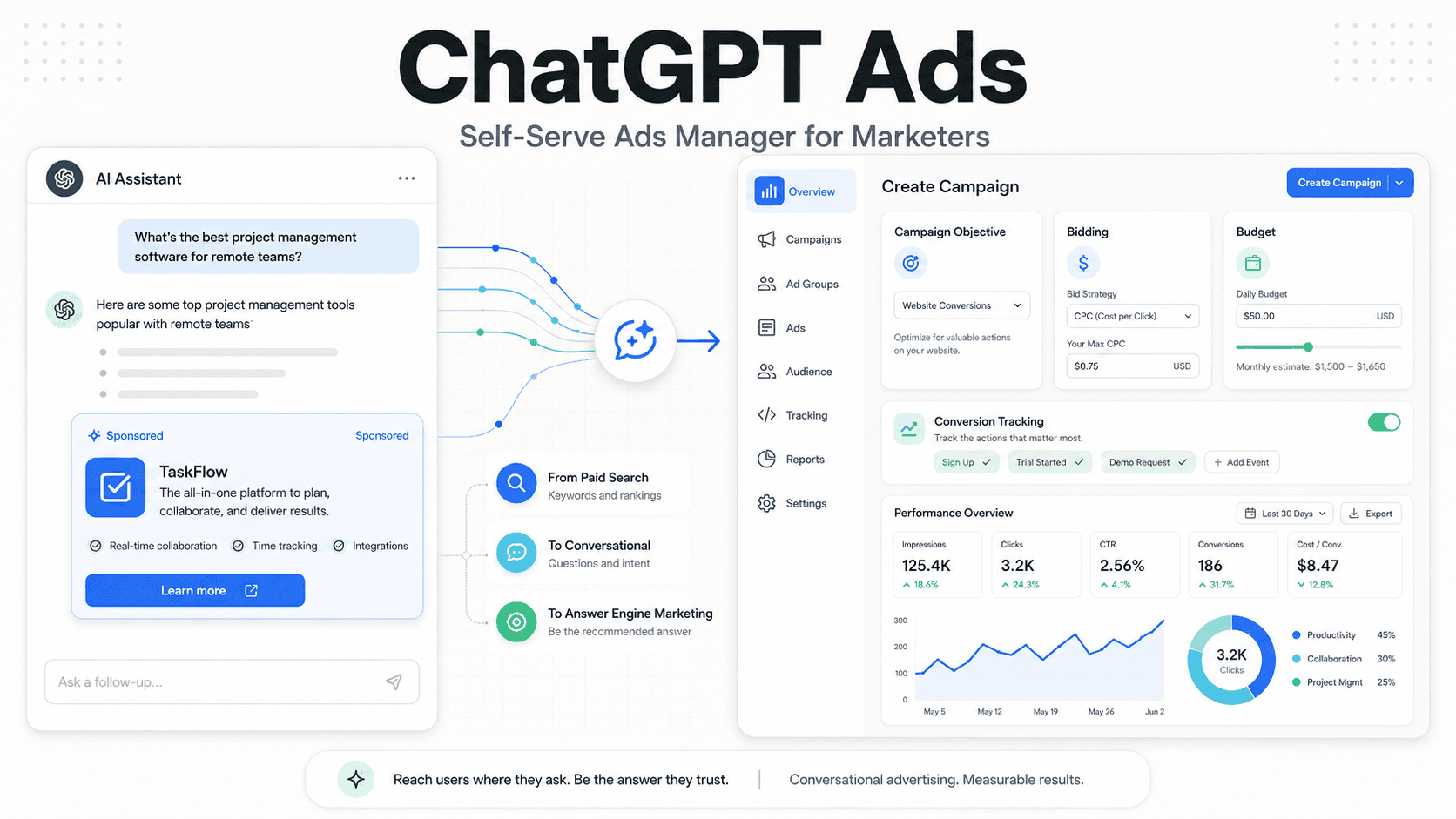
Businesses can now:
- Create campaigns directly inside ChatGPT
- Upload ad creatives
- Set budgets and pacing
- Manage bidding strategies
- Track campaign performance
This removes the need for relying solely on large agency partnerships or managed-service access.
OpenAI also confirmed partnerships with major agency groups including Dentsu, Omnicom, Publicis, and WPP, alongside technology partners such as Adobe, Criteo, Pacvue, and StackAdapt.
CPC Bidding Comes to ChatGPT Ads
One of the most important additions to the platform is CPC (cost-per-click) bidding.
Previously, advertisers primarily purchased ChatGPT ads using CPM-based pricing. OpenAI says CPC bidding gives businesses more flexibility by allowing them to pay based on user actions rather than impressions alone.
This is especially significant because ChatGPT users are often in “decision-making mode,” actively researching products, comparing options, and seeking solutions. OpenAI believes clicks in these conversations may signal higher intent compared to traditional browsing behavior.
Expanded Measurement and Conversion Tracking
OpenAI is also expanding measurement tools for advertisers.
The platform now supports:
- Conversion tracking
- Campaign performance reporting
- Measurement improvements for advertisers
Industry analysts see this as a necessary step if ChatGPT advertising wants to compete with established digital advertising ecosystems like Google and Meta.
Reports also suggest OpenAI is exploring additional capabilities such as CPA bidding and third-party measurement integrations in the future.
Why This Matters for Marketers
The launch of the OpenAI self-serve Ads Manager for ChatGPT signals a broader industry shift toward conversational advertising.
Unlike traditional social media platforms where users scroll passively, ChatGPT users actively ask questions and seek solutions. This creates a potentially high-intent advertising environment.
For marketers, this means:
- Ads may appear in more contextual environments
- User intent could become more valuable than impressions
- AI-driven search advertising is becoming more mainstream
The platform is still in beta, but many marketers already view this as the beginning of a major transformation in digital advertising.
What Businesses Should Watch Closely
While excitement around ChatGPT ads is growing, questions still remain around:
- Ad performance benchmarks
- User trust and ad transparency
- Inventory scale
- Measurement reliability
Industry experts say OpenAI will need to prove that ChatGPT ads can consistently deliver measurable ROI before the platform becomes a major advertising channel.
The launch of the OpenAI self-serve Ads Manager for ChatGPT is one of the clearest signs yet that AI-powered advertising is entering a new phase.
By introducing self-serve buying, CPC bidding, and conversion tracking, OpenAI is positioning ChatGPT as more than just an AI assistant, it is becoming an emerging advertising platform.
For marketers and businesses, the message is clear:
Conversational AI advertising is no longer experimental.
It is becoming part of the future of digital marketing.


