


If you work in marketing, content, media, or digital growth, these updates matter. Let’s walk through them carefully.
Google Veo 3.1 Pushes AI Video Generation Forward
Google’s Veo 3.1 update represents one of the most practical jumps forward in AI video generation so far.
This release focuses less on novelty and more on control.
Key Improvements in Veo 3.1
Native vertical video support
Creators can now generate videos natively optimized for vertical formats. This matters for Shorts, Reels, TikTok, and mobile-first storytelling.
4K upscaling
Veo 3.1 introduces improved resolution handling, allowing creators to upscale outputs to 4K with significantly better clarity and detail preservation.
Enhanced character consistency
One of the biggest pain points in AI video has been character drift. Veo 3.1 improves identity consistency across scenes, angles, and cuts, making longer narratives far more usable.
Improved prompt adherence
The system responds more accurately to scene descriptions, movement instructions, and visual constraints.
This is not just an upgrade for filmmakers. It’s a signal that Google is preparing AI video for professional workflows, not just demos.
(TechNow)
Google Launches Improved Veo AI Video Tools

Beyond the core model improvements, Google is also expanding how Veo fits into creator and brand pipelines.
The updated Veo tools emphasize:
- Faster iteration cycles
- More predictable outputs
- Better alignment with real production needs
This positions Veo less as an experimental AI toy and more as a scalable video engine for marketing teams, agencies, and content studios.
In short, Google is betting on AI video becoming infrastructure, not novelty.
(Google AI Studio)
Google Expands Budget Allocation Options for Ad Campaigns
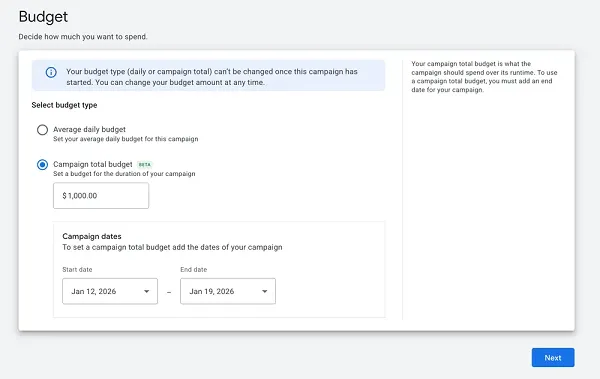
Advertising updates rarely get attention. Until they affect spending control.
Google’s new budget allocation expansion allows advertisers to distribute budgets more intelligently across campaigns, formats, and objectives.
What Changed
More flexible budget distribution
Advertisers can now allocate budgets dynamically across multiple campaigns without hard limits that restrict performance.
Improved automation signals
The system uses more granular performance data to shift spend toward what actually converts, not just what spends fastest.
Better alignment with business goals
Campaigns focused on awareness, leads, or conversions can coexist more efficiently within the same budget structure.
This update signals a deeper move toward outcome-based advertising rather than rigid campaign silos.
(TechNow)
Google Introduces New Platforms and Supporting Tools
Google continues to roll out AI-first platforms designed to integrate communication, content, and intelligence more tightly.
These platforms emphasize:
- Real-time AI processing
- Multimodal inputs
- Deeper integration with existing Google tools
The direction is clear. Google wants AI to live inside workflows, not outside them.
(blog.google)
AllSVGIcons Simplifies Asset Access for Designers and Developers
While not a Google product, AllSVGIcons fills a quiet but important gap in the ecosystem.
It provides a centralized library of SVG icons that are:
- Lightweight
- Scalable
- Developer-friendly
- Easy to integrate into websites and apps
As design systems grow more modular, tools like this reduce friction and speed up production across teams.
https://allsvgicons.com/
ChatGPT Begins Testing Ads in the United States

One of the most closely watched updates is OpenAI’s move to begin testing ads inside ChatGPT in the U.S.
This marks a shift in how conversational AI may be monetized at scale.
What This Means
- Ads may appear contextually within responses
- User experience is being tested carefully
- Monetization is moving closer to search-style economics
For marketers, this opens new territory. Conversational intent is often stronger than traditional search intent.
But it also raises questions.
How intrusive is too intrusive?
How do ads coexist with trust?
Those answers are still forming.
(TechNow)
What All These Updates Have in Common
When you step back and look at all these updates together, a clear pattern starts to form. Not hype. Not speed. Control.
Control over creative outputs means creators and teams are no longer guessing how AI will behave. Tools like improved video generation and better consistency features reduce randomness. You can plan, revise, and build with intention instead of hoping the output lands close enough. That changes AI from something you experiment with into something you actually rely on.
Control over ad spend efficiency shows up in how platforms are tightening the link between goals and budgets. Less waste. Fewer blunt settings. More room to let performance guide decisions without fully handing over the wheel. This matters for businesses that cannot afford to burn money just to learn.
And control over how AI integrates into real work may be the biggest shift of all. These tools are no longer sitting on the side as optional extras. They are being designed to fit into workflows, timelines, and systems people already use. That is the difference between technology that excites and technology that lasts.
This is what it looks like when AI moves from experimental to operational. Fewer demos. More responsibility. And yes, higher expectations.
Final Thoughts
None of these updates are loud. They do not need countdowns or dramatic promises. They are not trying to impress you in five minutes.
Instead, they quietly change how content gets produced, how advertising decisions are made, and how AI becomes part of everyday business judgment. You may not notice the shift immediately. But over time, the difference becomes obvious in who moves faster, who wastes less, and who stays adaptable when things change again.
If you are building for visibility, growth, or scale, this is not the moment to sit back. It is the moment to pay attention, test thoughtfully, and understand what is becoming stable. Not later. Now.
The tools are settling into place.
And the advantage, as usual, goes to the people who notice early and act with intention rather than noise.


