


This article looks at six important 2026 updates that impact how marketers measure performance, how websites talk to AI, how search visibility works, how people discover information on social, how back-end JavaScript runs, and how editors assemble video. It covers Meta’s ad metric changes, Yoast SEO’s new Schema Aggregator, a sharp drop in top-ranking pages cited in Google AI Overviews, Adobe’s findings on TikTok as a search engine, the Node.js 25 release with speed and security gains, and Adobe Firefly Quick Cut feature for AI-powered video rough cuts.
Meta Updates Ad Metrics to Align With Other Platforms
Meta has announced changes to its ad attribution metrics to make its reporting easier to compare with third-party tools like Google Analytics and other ad platforms. Historically, Meta attributed “clicks” broadly, counting actions like likes, shares, and saves alongside actual website link clicks, which inflated click numbers versus tools that only measured link clicks.
Now, Meta is simplifying the link click metric so it only counts genuine website link clicks, bringing its definition closer to what advertisers typically see in external analytics systems. This should reduce misalignment between Ads Manager and third-party dashboards, giving marketers a cleaner view of true click-through performance across channels.
Meta is also shifting non-link click interactions, such as shares and saves, into its Engaged View category, which is being renamed to engage-through attribution. The company is encouraging advertisers to rely on this metric to understand the full impact of high-value social interactions that may not involve a click but still contribute to conversions down the line.
Finally, Meta is redefining what counts as an engaged view for video ads, shortening the threshold from 10 seconds to 5 seconds. Internal data shows that nearly half of Reels-driven purchase conversions happen within the first two seconds of attention, so a shorter engaged-view window better reflects real user behavior and provides a more accurate indicator of meaningful engagement.
Yoast SEO’s Schema Aggregator: Cleaner Entity Signals for AI
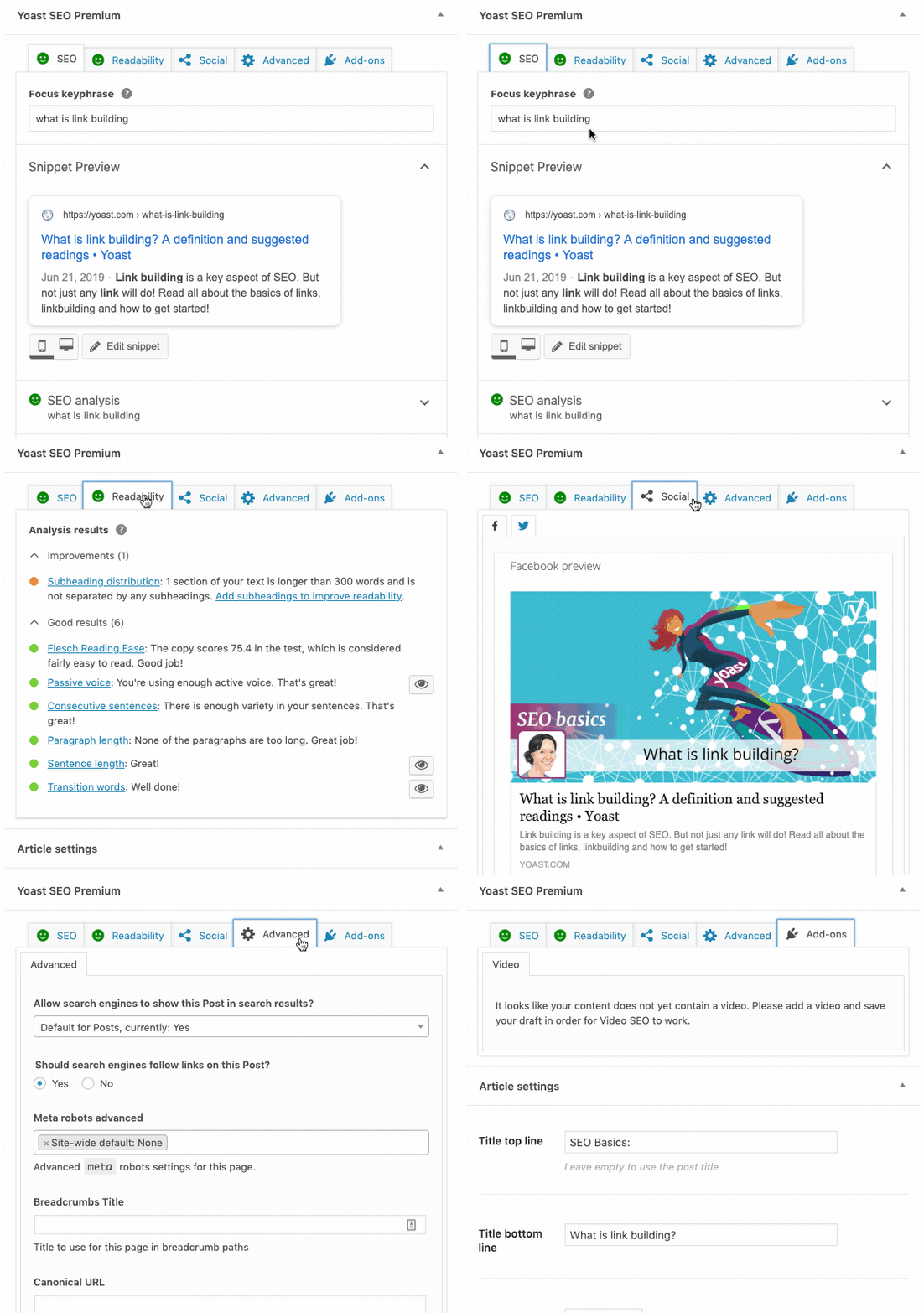
Yoast SEO has introduced a Schema Aggregator feature that consolidates a website’s structured data into a single “schema-map” endpoint. Instead of forcing search engines and AI agents to crawl individual pages and reconstruct relationships, the new endpoint provides a unified, deduplicated graph of entities, authors, articles, products, organizations, and how they relate.
This approach improves entity disambiguation, making it easier for AI systems to distinguish between similar entities and understand which content belongs to which author or brand. The schema-map includes all indexable content, removes navigation clutter, merges duplicate entities, and respects existing privacy and indexing settings, with responses designed to be cacheable and fast.
For sites that already extend Yoast’s schema (for example via WooCommerce SEO or partner plugins for events and recipes), those entities are automatically pulled into the same map, offering a more complete picture of the site’s semantic structure. As AI-driven search and conversational agents become more influential, Yoast positions this feature as future-proofing, making websites more machine-readable, contextually connected, and ready for the emerging “agentic web.”
Google AI Overview Citations Drift Away From Top Rankings
![Google AI Overview Citations Drop: Top-10 Pages Fall From 76% to 38% [2026 Data]](https://almcorp.com/wp-content/uploads/2026/03/Google-AI-Overview-Citations-From-Top-10-Pages-Dropped-From-76.webp "Industry News: Firefly Quick Cut, Node.js 25, Meta Ad Metrics, and Yoast Schema Aggregator 2")
New analysis shows that Google AI Overview citations are now significantly less tied to page-one organic rankings than they were a year ago. An Ahrefs study of 863,000 keywords and 4 million AI Overview URLs found that only 38 percent of cited pages also appeared in the top 10 results for the same query, down from 76 percent in a previous 2024 study.
The remaining citations are split almost evenly between pages ranking in positions 11–100 (31.2 percent) and pages beyond the top 100 (31.0 percent), indicating that many AI Overview sources come from content that doesn’t surface prominently in traditional organic listings. When focusing purely on organic listings (excluding ads, featured snippets, and other SERP features), results are similar, with 37 percent of cited pages in the top 10 and 36 percent outside the top 100.
Ahrefs suggests that Google’s query fan-out process plays a larger role in source selection. When an AI Overview is triggered, Google can break the original query into multiple related sub-queries and then choose sources that show up consistently across those sub-queries, even if they don’t rank highly for the initial keyword.
YouTube has also emerged as a notable citation source: among pages cited in AI Overviews that didn’t rank in Google’s top 100 for the same keyword, 18.2 percent were YouTube URLs, and YouTube accounted for 5.6 percent of all AI Overview citations in the dataset. For SEOs, this means that ranking for a single keyword is no longer a strong guarantee of AI Overview visibility; covering a topic comprehensively across related angles and formats, including video, appears increasingly important.
TikTok Becomes a Search Engine for Almost Half of U.S. Consumers
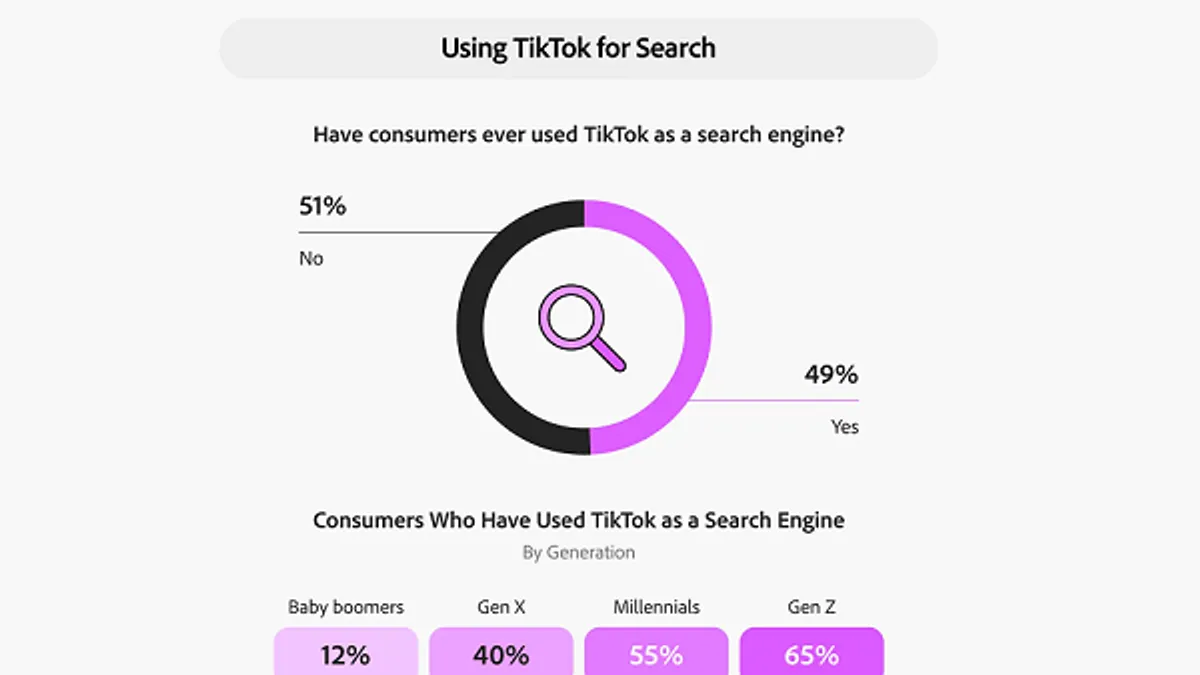
A recent Adobe study cited by Social Media Today found that nearly half of U.S. consumers now use TikTok as a search engine, underscoring its growing role as a discovery tool. The research, based on survey data from 807 consumers and 200 small business owners across the United States, examined how people use TikTok search to find relevant and valuable information.
Users turn to TikTok for recommendations, tutorials, product research, and trend discovery, particularly in lifestyle, fashion, beauty, food, and travel categories. For small businesses, the platform is increasingly seen as a way to get discovered organically by audiences who search directly within TikTok instead of, or in addition to, traditional search engines.
For marketers, this confirms that search behavior is fragmenting: optimizing content only for Google is no longer enough. Brands need a TikTok search strategy that considers keywords in captions, on-screen text, and spoken audio, as well as engaging visual formats that match how people browse and evaluate information on the app.
Node.js 25: Faster, Safer, and Closer to the Browser

Node.js 25, released in October 2025 with version 25.7.0 landing in February 2026, brings a series of performance and compatibility improvements aimed at modern JavaScript development. The release ships with V8 14.1, offering a faster JavaScript engine for better runtime performance and improved handling of modern language features.
Node 25 also enhances JSON processing, adds built-in Web Storage APIs (such as localStorage-style interfaces), and introduces a stronger permissions model that allows developers to explicitly grant capabilities like network access via flags such as --allow-net. These features make it easier to write secure applications that only expose necessary resources and bring Node closer to browser-like APIs, improving consistency across front-end and back-end JavaScript.
Overall, Node.js 25 focuses on making the runtime faster, more secure, and more aligned with modern web standards, which is particularly attractive for full-stack developers who want the same mental model across client and server code.
Adobe Firefly Quick Cut: AI-Powered Rough Cuts in Seconds
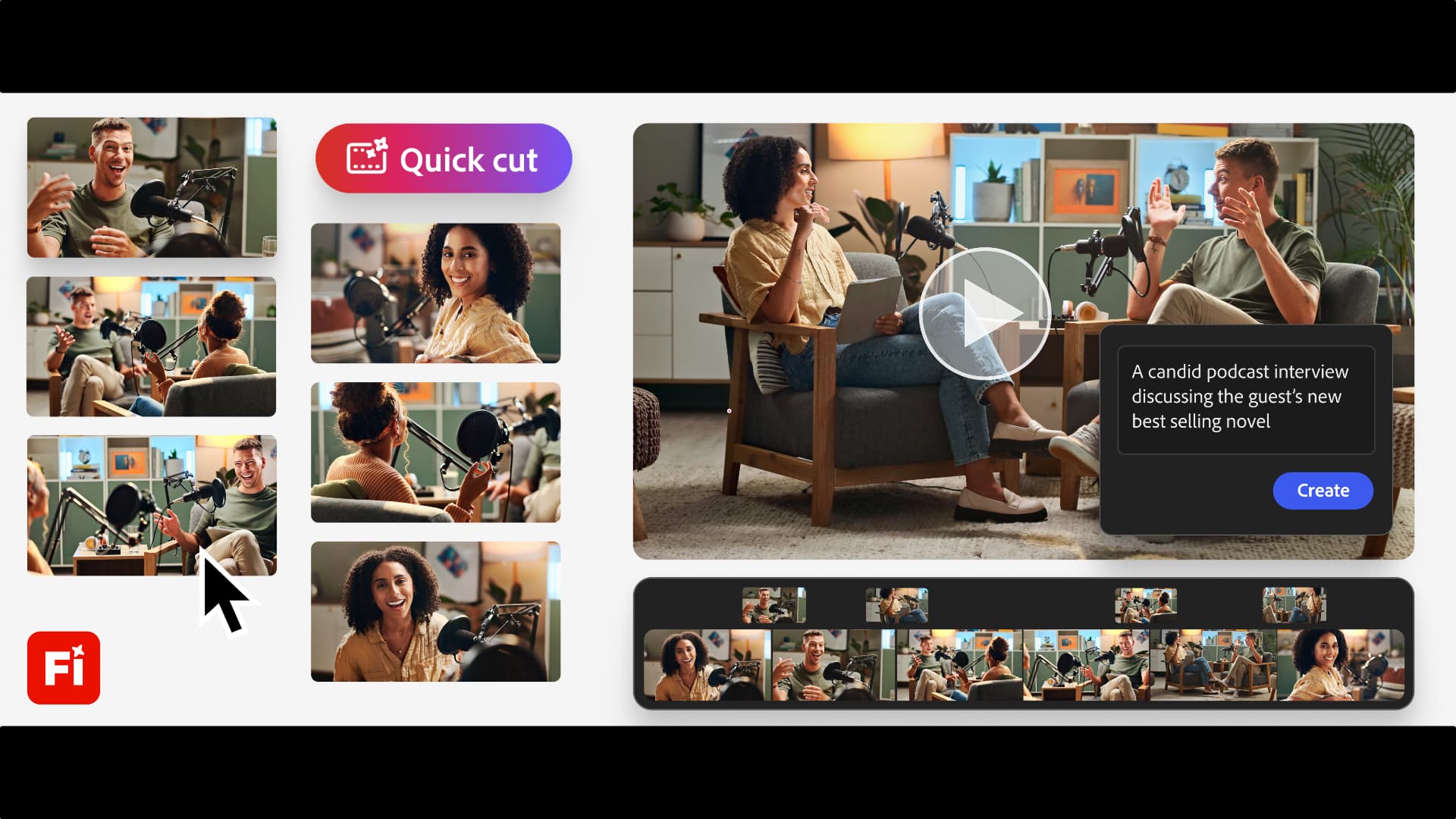
Adobe has launched Quick Cut, a new feature inside Adobe Firefly that uses AI to automatically generate a first draft of a video. Users can upload raw footage and then use text prompts to instruct the system on structure, pacing, and key moments, allowing Firefly to assemble a structured rough cut within seconds.
Quick Cut is designed to solve the “blank timeline” problem in video editing, where starting from scratch can be time-consuming and intimidating. By producing an initial cut that editors can then refine manually, it aims to reduce editing time and help creators move faster from concept to draft while preserving full creative control over the final version.
For content creators, agencies, and in-house marketing teams, Quick Cut represents another step toward AI-assisted post-production, where AI handles repetitive assembly work and humans focus on storytelling, polish, and brand consistency.
In combination, these updates show how measurement, semantics, AI search, social discovery, runtime engines, and creative tools are all evolving in parallel in 2026, forcing marketers and developers to rethink how they measure, model, and ship digital experiences.


