


AI Agents Reshape Marketing and Creative Workflows in 2026
The most important artificial intelligence story of 2026 is no longer simply whether a model can generate an image, write advertising copy or summarize a document.
The bigger shift is happening inside the workflow.
Meta is connecting advertising performance with creative generation. Adobe is placing an agent across multiple Creative Cloud applications. Anthropic is turning Claude into a visible participant in Slack conversations. Microsoft is bringing development, debugging and deployment closer together in Visual Studio Code. Google is building agentic systems for search and media production, while OpenAI is adding licensed professional imagery to ChatGPT’s discovery experiences.
Taken together, these developments suggest that technology companies are competing to become the operating layer through which creative and business work gets planned, produced, reviewed, distributed and measured. (Adobe Newsroom)
AI Is Moving From Content Generation to Workflow Management
The first generation of business AI tools focused heavily on individual outputs: generate an image, rewrite a paragraph, remove a background or create a video clip.
The emerging generation is designed to manage a sequence of actions.
Instead of producing one advertisement, an agent can study previous campaign results, propose new creative directions, generate variations and prepare them for testing. Instead of editing one file, it can organize assets, apply brand rules and resize a campaign for multiple platforms. Instead of answering one employee privately, it can join a shared workplace conversation and retain project context.
This distinction matters because businesses rarely struggle with only one isolated task. They struggle with handoffs, inconsistent branding, repetitive approvals, scattered data and the time lost moving between platforms.
The new products are attempting to reduce that friction.
Meta Rebuilds Its Creator and Advertising Workflow
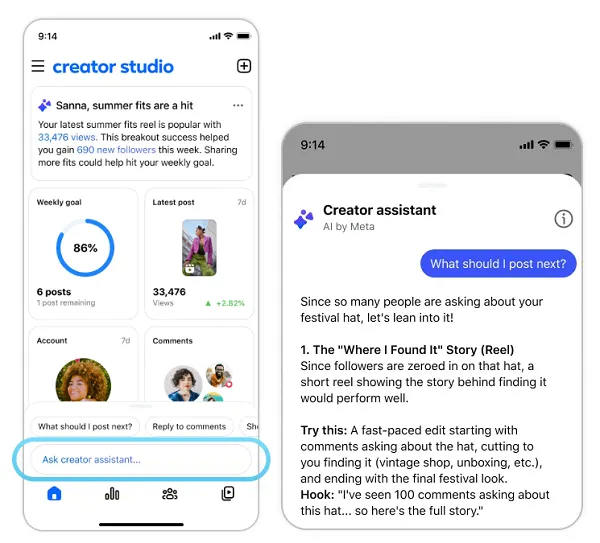
Meta’s decision to bring back Facebook Creator Studio is a strong example of this transition.
The original Creator Studio was discontinued in 2023 as Meta directed users toward Business Suite. The revived version is positioned differently: as an AI-powered companion for creators rather than merely another publishing dashboard.
The platform includes an AI Creator Assistant, personalized performance guidance, progress tracking and recommendations based on what is working across Meta’s applications. It can also prioritize engagement opportunities and generate suggested replies to comments. (Social Media Today)
For creators managing active communities, generated replies could reduce the time required to process large numbers of comments. However, this feature also highlights one of the central risks of workflow automation: efficiency can come at the expense of authentic interaction.
Community engagement is not simply an administrative task. For many creators and small businesses, it is part of the product. Automated responses therefore need careful review rather than automatic publication.
Advertising Data Moves Directly Into Creative Production
Meta is also testing an end-to-end advertising workflow that connects campaign performance with creative development.
Within a dedicated workspace, advertisers will be able to review results, generate new concepts based on those results and test creative variations. A “brand memory” function is intended to learn from previous advertisements, tone, identity and creative style so that generated materials remain closer to established guidelines. (The Keyword)
Meta is also expanding generated text and translation features inside Ads Manager. The tools can place generated text within image creatives and support additional languages for image copy and AI-generated video voiceovers. Meta is separately testing an integrated approval workflow so teams can review and approve changes without moving to another platform. (The Keyword)
The implications are significant for agencies and SMEs. Campaign reporting has traditionally happened after creative production. Meta is attempting to turn performance data into an input for the next creative cycle.
That could make experimentation faster, but it could also encourage marketers to optimize only for what produced an immediate measurable response. Brand strategy, originality and long-term positioning cannot always be reduced to the performance of a previous advertisement.
Creator Partnerships Become Part of the Same System
Meta plans to combine Creator Marketplace and Partnership Ads Hub into a Meta Creator Marketing Hub later in 2026. Facebook creators are also expected to join the marketplace, allowing brands to search across Facebook and Instagram from one destination.
The planned hub will bring creator discovery, partnership management, permissions, content selection, paid promotion and performance reporting closer together. (The Keyword)
This reinforces Meta’s larger strategy: keep as much of the marketing process as possible inside its own environment.
Adobe Turns Creative Cloud Into an Agentic Production System
Adobe’s Creative Agent expansion applies the same principle to professional content production.
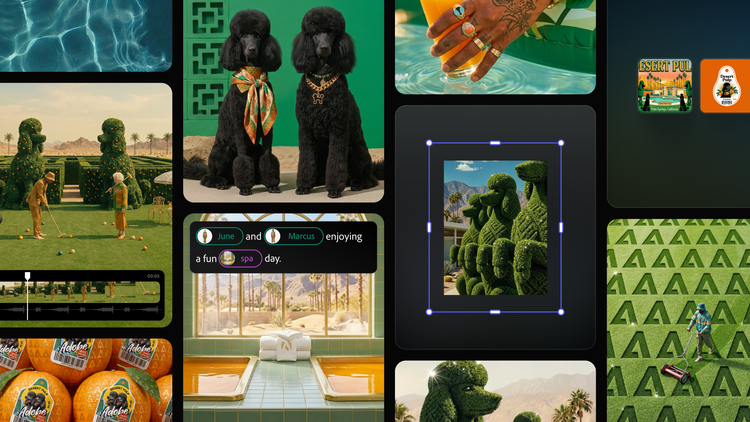
The company is rolling out AI Assistants across Premiere, Photoshop, Illustrator, InDesign and Frame.io. Instead of requiring users to execute every step manually, the assistants can interpret a desired outcome and coordinate a series of editable actions. (Adobe Newsroom)
In Premiere, the assistant can organize assets, rename clips, identify interview questions, add markers and assemble a working starting point. In Photoshop, it can manage tasks such as changing backgrounds, resizing assets and organizing layers. Illustrator users can request versioned files or preflight checks, while InDesign’s assistant can apply brand and layout changes across documents. (Adobe Newsroom)
Firefly is also gaining tools for creating brand kits, turning product photographs into short videos, assembling quick cuts and moving from storyboards to generated video.
The commercial value is clear. A small company could describe its brand, colors and style, generate an initial visual identity, produce product content and prepare social assets without coordinating several disconnected tools.
The risk is equally clear: when production becomes easier, businesses can generate more material than they can meaningfully review.
Adobe’s own research reflects that tension. In a survey of more than 16,000 creators, 75% described creative AI as integrated into or essential to their work, while 85% said the final creative decision should remain with the creator. (Adobe Newsroom)
That principle, automation with an editable, human-controlled outcome, is likely to become a key dividing line between professional creative systems and one-click content generators.
OpenAI and Getty Images Put Licensing Into AI Discovery
The OpenAI–Getty Images agreement adds another dimension to the competition: access to licensed, professionally produced content.
Under a multi-year display agreement, Getty Images’ licensed libraries will appear in search and discovery experiences within ChatGPT. The objective is to make visual responses richer while providing access to recognizable, rights-managed imagery. (Getty Images Newsroom – Getty Images)
For publishers, marketers and researchers, this is different from asking an image model to invent a photorealistic scene. News, history, sport, entertainment and public events frequently require authentic photographs rather than synthetic approximations.
The partnership indicates that licensed archives may become an important competitive advantage for AI search platforms. As generated images become more realistic, the ability to distinguish between an invented visual and a documented photograph becomes more, not less, valuable.
Businesses should therefore expect image sourcing, attribution, usage rights and provenance to become more important components of AI-assisted content production.
Anthropic Brings the AI Agent Into the Team Conversation

Anthropic’s Claude Tag moves AI from a private chat window into shared workplace communication.
Available in beta for Claude Enterprise and Claude Team customers using Slack, Claude Tag can be summoned in a thread with “@Claude.” It can read the permitted conversation, break work into tasks, retain context and proactively identify relevant organizational updates. Administrators can control the channels, information and tools available to the agent. (Reuters)
The interface change is more important than it may initially appear.
When an AI assistant operates privately, its reasoning and recommendations are usually visible to one person. When it operates in a shared channel, colleagues can see the request, review the result and challenge the response.
That could make workplace AI more collaborative and accountable. It could also create new governance questions around permissions, confidential discussions, incorrect summaries and responsibility for actions initiated by an agent.
Organizations adopting shared agents will need explicit rules covering what the agent can access, which tasks it may perform and when a human must approve the result.
Microsoft Tightens the Development Loop in Visual Studio Code
Agentic workflows are also changing how software is built.
Microsoft’s Aspire 13.4 extension brings more of the development, debugging, monitoring and deployment process directly into Visual Studio Code. Developers can create or initialize Aspire projects, run and debug applications involving multiple languages and inspect resource health without constantly switching tools. (Microsoft for Developers)
The extension supports debugging across C#, TypeScript and JavaScript, Python and Go resources. Aspire 13.4 also adds first-party Go hosting support, live resource information in the editor, typed command inputs and direct access to logs, endpoints and dashboard functions. TypeScript AppHost support has reached general availability. (Microsoft for Developers)
Microsoft’s update is not primarily a content-generation announcement, but it follows the same industry direction: reduce the distance between intention, execution and feedback.
For companies building their own AI applications, the developer environment is becoming part of the agent ecosystem. Coding assistants may generate code, but businesses also need reliable systems for running, inspecting, debugging and deploying the services those assistants help create.
Google Pushes Agents Into Search and Media Production
Google’s search strategy is also becoming increasingly agentic.

The company has introduced a redesigned AI-powered search box that accepts text, images, files, videos and browser tabs as inputs. Google is also developing information agents that can monitor changing information and deliver synthesized updates, along with agentic booking, shopping and service-related capabilities. (blog.google)
For marketers, this means visibility will depend on more than ranking for a short keyword phrase. Content must be understandable within longer, conversational and multimodal requests. It must also provide enough evidence, structure and specificity to be useful to an agent assembling an answer or completing a task.
Media Archives Become Active Business Assets
Google Cloud is applying similar technology to media and entertainment production.
Its partner ecosystem includes tools that use natural-language and multimodal search to help production teams locate specific footage, add searchable metadata, localize content and extract value from large archives. Google Cloud presents the industry as moving from AI experimentation toward production-scale deployment. (Google Cloud)
For broadcasters, studios and media companies, an archive is no longer just storage. When every frame can be searched and understood, historical content can be repackaged for new programming, advertising, localization and audience experiences.
Smaller companies can apply the same principle on a reduced scale. Product photographs, customer interviews, webinars and previous campaigns should be organized as reusable assets rather than forgotten after publication.
Lightroom Shows Why Practical Improvements Still Matter
Not every meaningful AI update needs to introduce a completely new agent.
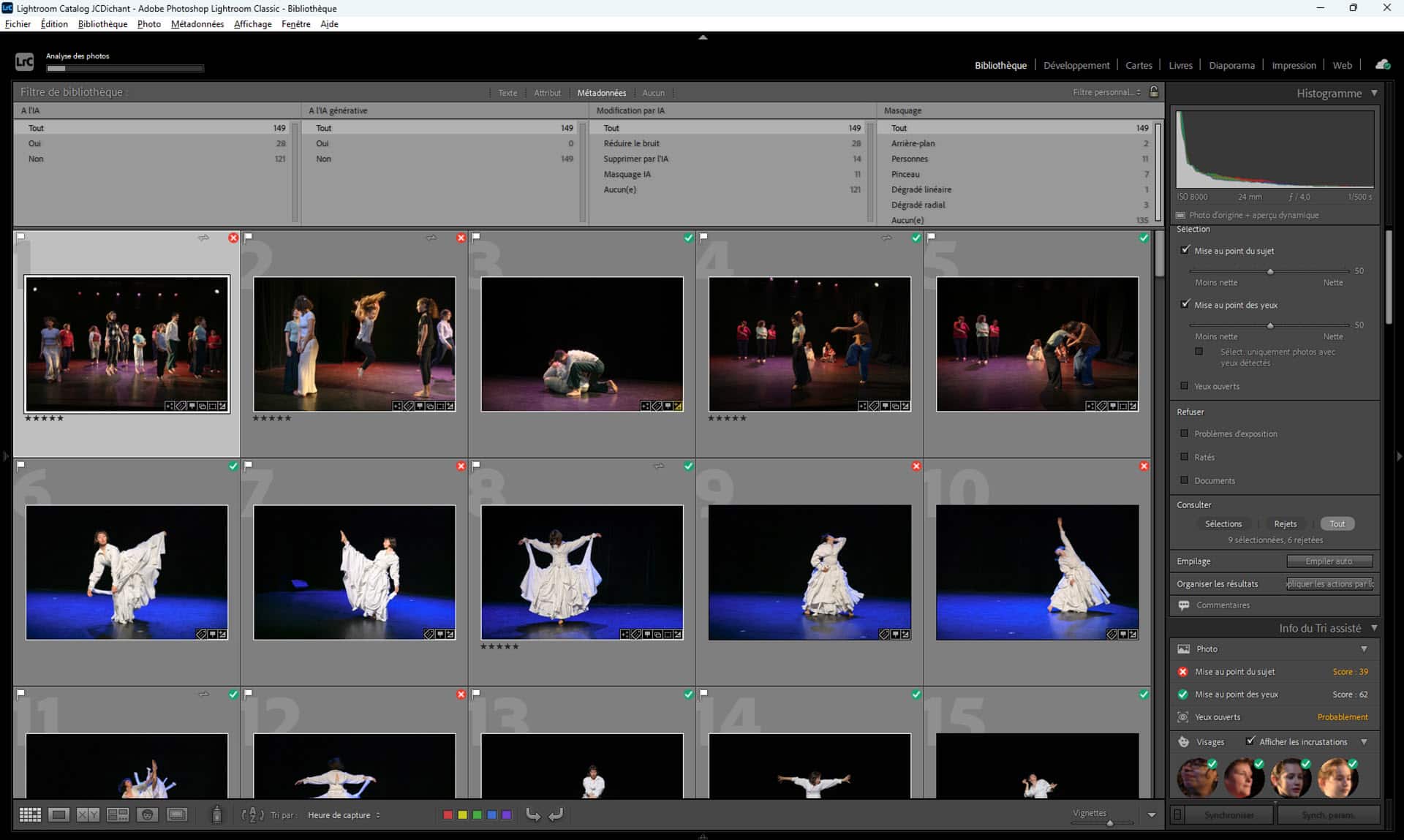
Lightroom Classic 15.4 demonstrates the value of focused workflow improvements. The release improves Select Object masking, adds duplicate detection for image catalogs and reduces AI denoising processing time by about 50% on Apple silicon Macs. (Fstoppers)
These changes address ordinary but expensive problems: inaccurate masks, cluttered libraries and time spent waiting for processing.
For photographers and content teams, that may produce more immediate value than a highly ambitious feature that is difficult to integrate into daily work. The lesson for technology buyers is to evaluate AI according to measurable workflow improvement, not the size of the announcement.
What These Updates Mean for Marketers and SMEs
1. Businesses Should Redesign Processes, Not Just Add Prompts
Buying an AI subscription without changing the underlying workflow usually produces limited benefits.
Organizations should map how an idea moves through research, creation, approval, publication and measurement. The best automation opportunities are often found in the delays and repetitive handoffs between those stages.
2. Brand Governance Will Become More Important
Meta’s brand memory and Adobe’s reusable assets show that platforms recognize the problem of maintaining consistency at scale.
Businesses should document approved language, visual rules, product facts, prohibited claims and review responsibilities before increasing AI-generated output. Without that foundation, automation can scale inconsistency as quickly as it scales production.
3. Human Review Must Be Assigned, Not Assumed
AI-generated replies, advertisements, translations and summaries can appear complete even when they contain errors.
Every automated workflow needs a named owner responsible for final review. That is especially important for advertising claims, product information, customer communication and culturally sensitive localization.
For SMEs operating across multilingual African markets, expanded French and Arabic capabilities may reduce production barriers, but local review remains necessary. A technically correct translation may still miss regional tone, consumer expectations or cultural context. (The Keyword)
4. Content Rights and Provenance Are Strategic Issues
The Getty Images agreement shows that access to licensed content can improve the usefulness and trustworthiness of AI discovery.
Businesses need to know where their images, text and training materials originated, what rights they hold and how those assets may be used by connected systems. Provenance should be treated as part of content operations rather than a final legal check.
5. The Competitive Advantage Is Moving Toward Judgment
As more platforms automate basic production, the ability to generate another image, caption or video variation will become less distinctive.
Competitive advantage will increasingly come from choosing the right problem, understanding the audience, setting meaningful constraints and recognizing which output is worth publishing.
The Next Phase of AI Will Be Defined by Integration
The common thread connecting Meta Creator Studio, Adobe Creative Agent, Claude Tag, Microsoft Aspire, Google’s agentic infrastructure and the OpenAI–Getty Images partnership is integration.
AI is being embedded where work already happens.
The most successful organizations will not be those that automate the highest number of tasks. They will be those that combine automation with clear objectives, reliable data, brand discipline, appropriate permissions and human judgment.
The transition from AI tools to AI-managed workflows is already underway. For marketers, creators, developers and business owners, the priority is no longer simply learning how to prompt a model. It is deciding how much of the workflow the model should control, and where people must remain firmly in charge.


