


Scaling Paid Ad Budget: How to Increase Spend Without Breaking Meta Delivery
A campaign generates leads at an acceptable cost for seven days. The client gets excited. The media buyer doubles the daily budget overnight.
Two days later, cost per lead rises sharply, lead quality becomes unstable, and the team wonders what happened.

The issue is not that scaling failed. The issue is that the account treated scaling like a budget decision instead of a delivery-system decision.
Meta’s ad delivery system learns from conversion signals, audience response, auction conditions, creative engagement, and budget constraints. When you change the budget aggressively, you change the conditions under which the campaign was previously working.
Meta’s official guide to the learning phase explains that ad sets are still exploring the best way to deliver, and it includes a “Last significant edit” column to show changes that may affect learning. This is why budget scaling should be gradual, structured, and measured rather than impulsive.
Why Sudden Budget Jumps Break Performance
A daily budget is not just a spending limit. It influences how aggressively Meta enters auctions, how widely it searches for conversions, and how quickly it exhausts the easiest opportunities inside an audience.
When you suddenly double or triple spend, the system may need to find additional conversions beyond the segment that was already responding. That can push delivery into less responsive users, more competitive auctions, or weaker placements.
The result is usually visible in three places:
- CPM increases because the campaign is entering more expensive auction opportunities.
- CTR drops because delivery expands into colder or less relevant users.
- CPL or CPA rises because the extra spend does not convert at the same rate as the original spend.
Scaling should therefore begin with one question:
Can this campaign maintain conversion efficiency at a slightly higher spend level?
Not:
How fast can we force the budget upward?
1. Use Vertical Scaling With Incremental Budget Increases
Vertical scaling means increasing the budget on an existing campaign or ad set that is already performing.
This is the cleanest scaling method when the campaign has stable delivery, enough conversion volume, and acceptable lead or purchase quality.
A practical rule is to increase budget by 15 to 20 percent at a time, then observe performance before making another increase. This percentage is a conservative operating guideline, not a universal Meta rule. The logic is simple: smaller changes give the delivery system room to adjust without dramatically changing the auction conditions overnight.
For example:
- Day 1 budget: $100
- Next increase: $115 to $120
- Next increase after stability: $132 to $144
- Next increase after stability: $152 to $173
The exact timing depends on volume. A campaign generating 100 conversions per week can be evaluated faster than a campaign generating five conversions per week.
Meta’s budget documentation explains that advertisers can set budgets at the campaign or ad set level and choose whether the budget applies daily or over the campaign’s lifetime. That flexibility matters because the scaling model should match the campaign’s stability and objective.
When Vertical Scaling Works Best
Use vertical scaling when:
- The campaign has stable CPL, CPA, or ROAS.
- Lead quality is acceptable in the CRM.
- Frequency is not rising too quickly.
- Creative fatigue is not visible.
- The audience is broad enough to absorb more spend.
- The campaign is not dependent on one unusually strong day.
Do not vertically scale a campaign just because yesterday looked profitable. You need a trend, not a lucky spike.
2. Watch the Metrics That Reveal Scaling Stress
After each budget increase, track more than total leads or purchases.
Monitor:
CPM: If CPM rises sharply, you may be paying more to access the next layer of the audience.
CTR: If CTR drops, the ad may be reaching less responsive users.
CPL or CPA: If acquisition cost increases moderately but remains profitable, scaling may still be acceptable.
Qualified-lead rate: If platform CPL stays stable but sales quality declines, the campaign may be expanding into weaker prospects.
Frequency: If frequency climbs too quickly, audience saturation or creative fatigue may be developing.
ROAS or pipeline value: For e-commerce and B2B campaigns, revenue impact matters more than platform volume.
The campaign is not truly scaling if it only produces more activity. It is scaling when additional spend produces additional qualified opportunities, customers, or revenue at a tolerable marginal cost.
3. Use Horizontal Scaling to Expand Without Overloading One Campaign
Horizontal scaling means creating new delivery paths instead of pushing more budget through the same ad set.
This can include:
- Duplicating winning creative into new audiences
- Testing new lookalike or broad audiences
- Expanding into additional regions
- Launching new placement-specific creative
- Creating separate campaigns for different funnel stages
- Testing new offer angles with the same proven format
Horizontal scaling is useful when your existing campaign is profitable but cannot absorb a large budget increase efficiently.
Instead of forcing one ad set from $100 to $500 per day, you may keep the original ad set stable and duplicate the winning creative into three new testing environments.
For example:
Original ad set: Broad audience, $100/day
Horizontal test 1: Lookalike audience, $50/day
Horizontal test 2: Regional audience, $50/day
Horizontal test 3: Retargeting warm visitors, $40/day
This allows the account to find new pockets of conversion volume without destabilizing the original winner.
4. Duplicate Winning Creative Assets, Not Random Campaign Structures
Duplicating an entire winning ad set can work, but it can also create overlap, internal competition, and messy reporting if done carelessly.
The better principle is:
Duplicate the proven creative logic into a new controlled test.
If one ad works because it combines a specific hook, visual, proof point, and offer, carry those elements into the new audience. Do not duplicate everything blindly and then change several variables at once.
A controlled horizontal scale might keep:
- Same winning video
- Same primary text
- Same headline
- Same landing page
- Same conversion event
Then change only:
- Audience
- Region
- budget level
- Campaign objective where strategically necessary
This helps you understand whether the winning asset can travel into a new market segment.
If the duplicated ad fails, you can evaluate whether the issue is audience fit, auction cost, or saturation—not because you changed the ad, landing page, and offer at the same time.
5. Use Advantage+ Campaign Budget Carefully
When multiple ad sets are competing inside one campaign, campaign-level budget allocation can help Meta move spend toward the ad sets it expects to perform best.
Meta’s Advantage+ campaign budget automatically manages budget across ad sets to get the best overall results for the campaign. This can be useful when your ad sets are strategically related and you want the system to allocate budget dynamically.
However, it is not ideal when you need each test cell to receive equal spend.
For example, if you want to test three new audiences evenly, campaign-level budget allocation may favor one audience early and starve the others before you gather enough evidence.
Use Advantage+ campaign budget when:
- Ad sets share the same objective and offer.
- You trust Meta to prioritize the strongest opportunity.
- Your priority is total campaign efficiency.
- You do not require perfectly even testing distribution.
Use ad set budgets when:
- You need controlled audience testing.
- Every audience must receive minimum spend.
- You are isolating a new region or funnel stage.
- You are protecting a proven ad set from experimental budget shifts.
6. Use Lifetime Budgets for Heavy Promotional Pushes
Daily budgets are useful for always-on campaigns because they provide steady pacing and easy incremental adjustments.
Lifetime budgets are better suited to campaigns with fixed start and end dates, such as product launches, event promotions, Black Friday-style offers, seasonal campaigns, or limited booking windows.
Meta’s lifetime budget guidance explains that a lifetime budget tells Meta how much you are willing to spend over the full run-time of the campaign or ad set.
This is valuable during promotional pushes because the campaign does not need to spend the exact same amount every day. It can pace spend across the full period while responding to auction opportunities.
For example, a five-day launch campaign may not need equal spend from Monday to Friday. Demand may peak on the first day and final day. A lifetime budget gives the platform more flexibility to distribute spend across the promotion.
When to Use Lifetime Budgets
Use lifetime budgets when:
- The campaign has a fixed end date.
- Total spend must stay within a hard ceiling.
- The promotion has known high-intent periods.
- You want pacing flexibility across the campaign window.
- The offer is time-bound.
Avoid lifetime budgets when you need precise daily control or when the campaign is an always-on acquisition engine that requires ongoing optimization.
7. Use Budget Scheduling for Predictable Demand Spikes
Meta also offers budget scheduling, which allows advertisers to schedule budget increases for specific days or times when they expect higher sales opportunities, peak traffic, or promotional demand.
This can be useful when historical data shows stronger conversion windows.
For example:
- A restaurant delivery brand may increase budget Friday evening.
- An e-commerce brand may raise spend during a weekend flash sale.
- A webinar campaign may increase spend 48 hours before registration closes.
- A travel company may increase budget before holiday booking deadlines.
Budget scheduling is cleaner than manually changing budgets under pressure because the increase is planned around a defined demand window.
The key is to schedule budget increases where demand is genuinely stronger. Do not use budget scheduling to force spend into weak traffic periods.
8. Align Bid Strategy With the Scaling Model
Budget scaling and bid strategy must work together.
If you are using Highest Volume, Meta will generally try to get the most results from your budget. That can be useful during testing and early scaling because the system has flexibility.
When economics become stricter, a cost-controlled approach may help stabilize average acquisition cost. Meta’s cost per result goal documentation explains that this bid strategy aims to maximize conversion volume while respecting a cost target, though delivery may become more limited if the target is too restrictive.
Use Highest Volume when:
- You are still gathering data.
- The campaign needs delivery freedom.
- Cost can fluctuate within a reasonable range.
- You are testing creative or audience expansion.
Use cost controls when:
- You know your acceptable CPL, CPA, or ROAS.
- The account has enough conversion history.
- Profitability matters more than spending the full budget.
- You can tolerate slower delivery.
Do not use cost controls to hide weak creative or a poor offer. If the campaign cannot convert at the desired cost, stricter bidding may simply reduce spend rather than solve the underlying issue.
9. Build a Scaling Decision Framework
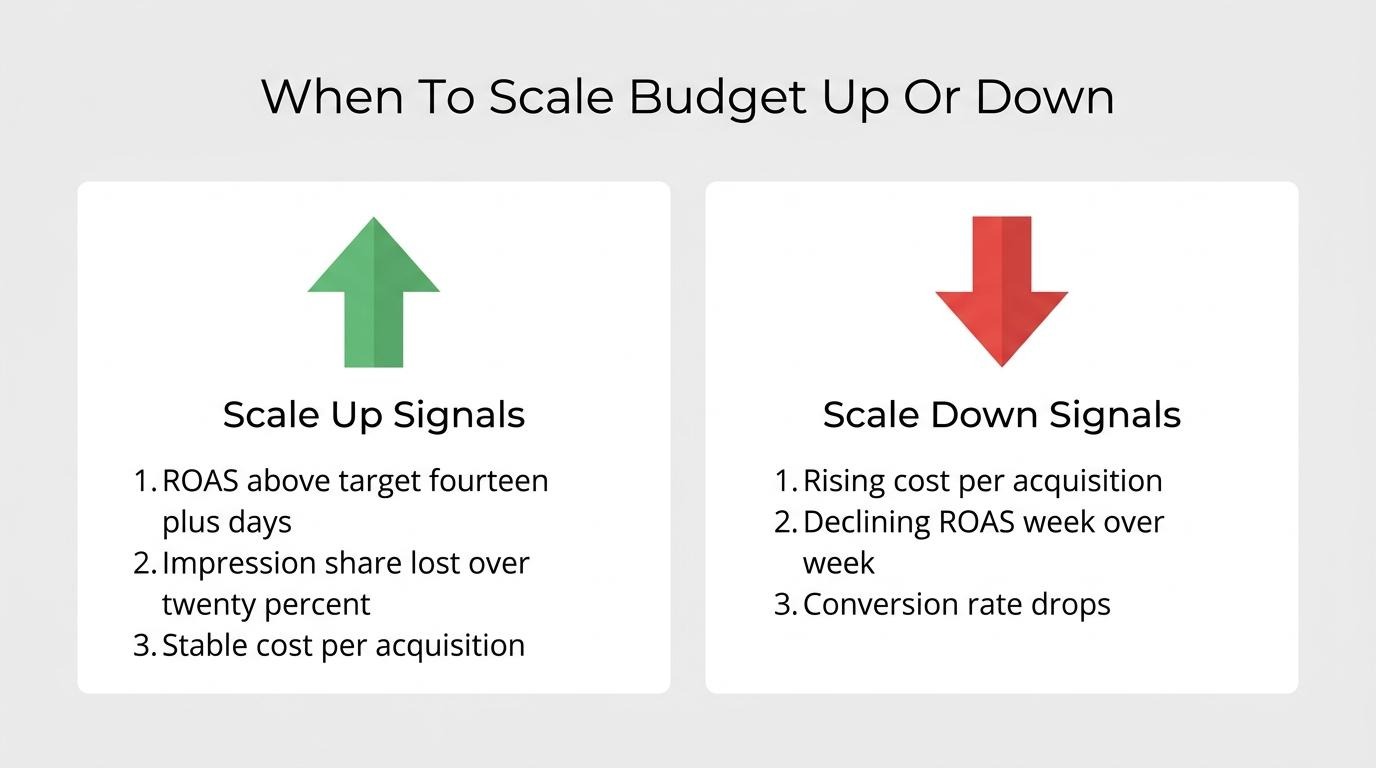
Before increasing spend, confirm five conditions.
The Campaign Has Stable Economics
Review at least several days of data. For lower-volume accounts, review a longer window.
The Funnel Converts After the Click
Do not scale an ad that generates clicks but fails at the landing page, form, checkout, or CRM stage.
Lead or Purchase Quality Is Verified
Platform results must be checked against sales outcomes.
Creative Fatigue Is Controlled
If frequency is rising and CTR is declining, scaling may accelerate fatigue.
The Next Budget Increase Has a Measurement Plan
Know what metric would make you continue, pause, or reverse the increase.
Scaling without decision rules becomes emotional campaign management.
Scale Spend Like a System, Not a Panic Button
Scaling paid ad budget requires discipline because growth changes delivery conditions.
Vertical scaling increases budget inside a proven structure. Horizontal scaling expands winning creative into new audiences and campaign paths. Lifetime budgets help manage fixed promotional periods. Budget scheduling prepares the account for predictable demand spikes. Bid strategy determines whether the system prioritizes volume, cost control, or value.
The safest scaling model is not always the fastest. It is the one that increases spend while protecting the economics that made the campaign worth scaling in the first place.
Do not double the budget because the dashboard looked good yesterday. Increase spend in measured steps, observe the stress signals, duplicate winners intelligently, and let each new budget level prove itself before moving higher.


