


This is where CRM integration becomes a lifesaver. When we talk about CRM Integration Tips, we are really talking about helping your business breathe a bit. A CRM is more than a fancy tool. For many African-owned brands, it becomes the quiet backbone that keeps things organized. You get to replace scattered notebooks, missed follow-ups, and confusing spreadsheets with one place that actually makes sense.
And here is the truth, many founders eventually realize. Growth does not come from more hustle alone. Growth comes from clarity. CRM integration gives you that clarity. It shows you who your customers are, what they need, how often they buy, and where they drop off. It connects your marketing tools, your website, your email lists, your WhatsApp messages, and your sales team into one clean flow. Instead of reacting to problems all day, you start seeing patterns and making decisions from a stronger position.
In this guide, we will take our time. We will walk through CRM integration tips created specifically for African-owned brands, using real examples and relatable scenarios. Whether you run an online boutique, a printing shop, a tech startup, a restaurant, or a consulting firm, these tips will help you build a smarter system that grows with you.
If you have ever wished your business felt more connected and less stressful, you are in the right place.
CRM Integration for African-Owned Brands

If you ask many African entrepreneurs what slows their business down, you will hear familiar answers. People say they are tired of chasing customers manually. They forget follow ups. They struggle to keep track of leads that came from Instagram, Facebook, referrals, or even someone who walked into the shop last weekend. It becomes this constant cycle where customers slip through the cracks, not because the product is bad, but because there is no system holding everything together. This is why CRM integration matters so much. It creates order in places where the business has been living on improvisation for too long.
Maybe you have noticed how overwhelming it becomes when every department is doing its own thing without a shared platform. Marketing runs one way, sales runs another, customer support uses WhatsApp, and everything feels scattered. CRM integration tips help you bring all those moving parts into one place. Instead of trying to remember who asked for a quote last week or who promised to buy after payday, the CRM reminds you. It quietly tracks the conversations, timestamps the follow ups, organizes the leads, and assigns tasks. It works even on days when you are too busy to think about it.
For African-owned brands, that level of structure is a competitive advantage. Many businesses on the continent operate in fast-moving environments. Customers expect quick responses, flexible service, and personalized experiences. When you integrate your CRM properly, it becomes easier to deliver all of that. You respond faster. You communicate better. You know exactly what each customer prefers. You stop treating everyone the same, which instantly makes your brand feel more thoughtful.
There is also the issue of growth. At the beginning, a business can survive on instinct and manual tracking. You recognize customers by name. You remember who bought what. You follow up naturally because the workload is small. Then one day the brand starts moving faster. More customers arrive. More messages come in. More demands appear. That is usually when cracks show up. CRM integration is the bridge that takes you from early-stage hustle to sustainable growth. It allows you to scale without losing the personal touch African customers appreciate.
And here is something many people do not talk about. CRM integration is not only about technology. It is also about mindset. It teaches you to stop storing your business in your head. It teaches the team to work from a shared system instead of depending on one person. It shows you how to see the business in numbers rather than vibes alone. Those small shifts create a stronger foundation, especially for African-owned brands that often face limited funding, limited team sizes, and limited digital support.
When your CRM is integrated properly, the business feels different. Decisions feel easier. Customer conversations feel more informed. Sales pipelines feel clearer. You feel like you have a team member who never gets tired, never forgets things, and always keeps an eye on what needs attention. That is why CRM integration tips matter. They push your brand toward the kind of operational maturity that helps you compete locally, regionally, and globally.
Understanding the Basics Before Integrating Anything
![What is CRM Integration [Complete Guide]? - Webdew](https://www.webdew.com/wp-content/uploads/2023/10/Methods-to-integrate-your-CRM-software.webp "Best 12 CRM Integration Tips for African-Owned Brands 2")
Before you start connecting tools, importing contacts, or designing automation workflows, it helps to understand what CRM integration really means. Many African-owned brands dive straight into setup without taking a moment to think about the bigger picture. Maybe it is excitement, maybe it is pressure, or maybe the business is just tired of doing everything manually. But integration works best when you start with clarity.
A CRM is designed to be the center of your customer ecosystem. Everything else connects to it. Your social media forms, your website, your WhatsApp chat flows, your email newsletter, your payment system, even your loyalty programs. You are essentially creating a single source of truth for all customer interactions. Instead of your information being scattered across different apps, the CRM pulls everything into one dashboard. That is the main idea behind CRM integration.
Before you start integrating tools, you want to understand three simple things. First, what data matters most to your business. For some, it is contact details and purchase history. For others, it is lead source, customer notes, and follow-up schedules. Your CRM will only be as helpful as the information you feed it. Second, you want to understand your customer journey. How do people discover you? Where do they start talking to you? What steps lead to a sale? Which steps cause them to lose interest? Knowing this helps you map automation and pipelines more effectively.
Third, think about your long-term vision. Where do you want the brand to be one year from now? Five years from now? CRM integration tips are easier to apply when you know where your business is heading. Maybe you want to add more salespeople. Maybe you want to expand into new regions. Maybe you want to run more email marketing campaigns. The more clarity you have, the quicker your CRM becomes a strong investment rather than just another software subscription.
Understanding these basics helps you avoid the common trap of over-integrating too quickly. Many small businesses connect every tool possible, hoping it will magically fix their problems. But integration is not about quantity. It is about relevance. You want the right tools connected for the right reasons. You want your CRM to feel like a natural extension of your business, not an over-complicated machine you regret setting up.
Once these basics are clear, applying CRM integration tips becomes smoother. You understand why each connection matters. You understand how the CRM fits into your daily workflow. You understand the difference between a shiny feature and something that actually strengthens your business. That clarity sets you up for long-term success.
1. Map Out Your Customer Journey Before Integrating Anything
One thing many African-owned brands skip, mostly because everyone is in a hurry to start automating, is mapping the customer journey. It sounds like a boring exercise, but it is honestly one of the most important CRM integration tips you will ever use. Before you connect tools or import contacts, you need to understand the path your customers take from the moment they discover your business to the moment they actually pay you and return again. Without this clarity, your CRM becomes chaotic. People connect WhatsApp, Instagram forms, email, and their website, yet nothing feels synchronized. They end up with scattered contacts and fragmented conversations, which defeats the whole purpose of integration.
Picture the journey step by step. Someone sees your product on Instagram. They send a DM. You reply. They ask for the price. They think about it. They ask another question a week later. Maybe they come into your shop. Maybe they click a link to your website. Maybe they ask for delivery. All these touchpoints are happening, but the question is, where is this journey being recorded. A CRM solves that, but only if you map the journey clearly and then design your integrations around the reality of your customers, not the fantasy of how you wish they behaved.
African customers often rely heavily on conversation-based buying. People want to talk, they want to ask questions, they want to negotiate, and sometimes they just want reassurance. If you run a product-based brand, you know how common it is for customers to ask for photos, videos, or voice notes before they trust you. If you run a service-based business, you know the questions never end. Mapping this journey helps you see what needs to be tracked, what needs to be automated, and what needs personal handling. It also helps you identify the moments when customers usually drop off, moments where your CRM could give you a little nudge so you can bring them back.
Once the journey is mapped visually, you start noticing the key points where integration makes the biggest difference. For example, maybe your initial leads come from Instagram, so connecting Instagram lead forms to your CRM becomes a priority. Or maybe most customers follow up through WhatsApp, so WhatsApp integration takes center stage. If you use a website with a checkout, you might integrate payment notifications. When you understand the journey first, you stop adding tools at random and start integrating based on strategy. That alone saves a lot of time, money, and frustration.
Mapping the journey also forces you to think about consistency. Many African brands struggle not because they lack customers but because they lack predictable follow up. You talk to ten people today, but only follow up with three because you get busy. Your CRM can automate reminders or messages, but only when you know which steps in the journey require follow up. This is why mapping matters. It removes guesswork. It makes the CRM feel like a partner rather than a complicated dashboard you barely touch.
And here is a small but important insight. The customer journey will evolve over time. As your brand grows, you will introduce new channels, new departments, new campaigns, or even new countries. Knowing that helps you build your CRM integrations with flexibility. You do not have to get everything perfect from day one. You just need to understand the path customers take today, integrate around that, and leave space for the journey to expand naturally as your business expands.
2. Clean and Structure Your Customer Data Before Importing It

One of the biggest mistakes African-owned brands make is importing data into their CRM without cleaning it first. It creates duplicates, outdated contacts, messy names, and missing details that eventually make the CRM feel confusing. Suddenly you have the same person saved three times under slightly different phone numbers. You have leads who never converted, old clients who no longer need your service, and contacts you collected but cannot remember where they came from. The CRM becomes overwhelming, not because the tool is bad, but because the data entered was chaotic from the start.
Cleaning your data is not glamorous. It feels like washing vegetables before cooking. Nobody enjoys the task, but it saves you from bigger frustration later. Before you import anything, take the time to decide what information truly matters to your brand. Maybe it is names, phone numbers, email addresses, purchase history, or lead source. Maybe you want notes about preferences. Maybe you need tags like VIP client, repeat customer, wholesale buyer, or prospect. Creating this structure before the import is one of the most helpful CRM integration tips you can follow.
Once you decide what matters, you can remove everything that does not serve your business. Old contacts who never responded. Leads who asked for prices two years ago and disappeared. Numbers with no names. Emails with no context. Cleaning this out feels surprisingly refreshing. Your CRM becomes lighter. Your team becomes more confident using it. Your automation runs more accurately because it is working with meaningful data instead of random clutter.
Structuring your data also makes it easier to segment customers later, which is something many African brands are only now beginning to appreciate. Segmentation allows you to group customers based on behavior, preferences, spending level, or frequency. If your data is clean, segmentation works beautifully. If your data is messy, segmentation becomes unreliable. For example, if you sell hair products, you might group customers by hair type, buying frequency, or product preference. If you run a clothing brand, segmentation might include size categories, style preferences, or occasion-based buyers. Clean data makes these possibilities far more accurate.
There is also something psychological about clean data. When your CRM looks organized, you want to use it more. When it looks disorderly, you avoid it. The CRM becomes emotional. You open it with a sigh instead of a sense of direction. Taking time to clean and structure data gives you a fresh start. It creates a foundation that supports everything else you plan to integrate later. It also helps your team adopt the CRM faster because they do not have to navigate chaos.
So before you rush to connect forms, WhatsApp, or your website, pause for a moment. Clean your data. Decide what fields matter. Standardize the format. Remove outdated contacts. This small step can save you months of headache and make every other CRM integration tip easier to execute.
3. Choose Integrations Based on Real Behavior, Not Trendy Tools
A lot of African-owned brands get overwhelmed when it is time to choose which tools to integrate with their CRM. Maybe you have seen business owners rushing to connect everything they can find because the internet made it sound necessary. Payment apps, social media chat bots, email platforms, landing pages, analytics dashboards, sometimes even tools they do not fully understand. The result is a CRM that feels bloated. Too many connections, too many notifications, too many disconnected workflows. And ironically, with all these tools, nothing actually feels more organized.
One of the most useful CRM integration tips you can lean on is this simple idea. Integrate based on what your customers truly use, not what the marketing world says you should use. Look at the real channels where your customers talk to you. Look at the platforms where they consistently reach out. In many African markets, WhatsApp is still the beating heart of communication. If nine out of ten conversations happen there, that is your first integration priority. Not a fancy email automation platform you barely use. Not an expensive chatbot system that customers will probably ignore.
If Instagram is your main source of discovery, integrating lead forms or DMs becomes essential. If your brand receives repeat orders through Facebook Marketplace, consider integrating Facebook leads. If your business has a physical store where customers walk in, maybe your priority is syncing your point of sale system. And if your website generates order notifications, then connecting your site to your CRM helps you centralize all this activity. Integrations become more meaningful when they reflect real people, real habits, and real conversations.
When you choose tools based on behavior, something interesting happens. Your CRM becomes calmer. It starts to function more like a helpful assistant and less like a chaotic machine. You can see leads coming in from the channels that actually matter. You can track conversions more accurately. You can design automations that respond to customers at the right time. A tool is only powerful if it aligns with how your customers behave, and African customers have their own patterns that sometimes differ from global trends.
You may also notice that some tools are not necessary at your stage of growth. That is completely normal. Maybe email marketing will matter later when your customer base grows, but not right now when people mostly request information through direct messages. Maybe you will start using analytics dashboards once you are running campaigns consistently. Choosing integrations strategically helps you avoid overwhelm. It also saves you money because you are not paying for systems you barely touch.
There is also the emotional benefit. Your CRM feels lighter. Your team does not get confused. You do not wake up to irrelevant alerts. When you log into the system, everything you see reflects the real activity happening in your business. That clarity alone can improve decision making. Integrations should simplify your life, not complicate it. Choosing based on real customer behavior creates that simplicity naturally.
4. Build Simple Workflows Before You Attempt Complex Automation
There is a myth a lot of business owners believe, especially once they get a CRM for the first time. They assume that automation must be complex to be effective. So they jump immediately into designing heavy sequences, multi-step triggers, conditional rules, and layered workflows that even they cannot fully explain if asked. The problem is, complex automation collapses quickly. If one detail changes, the entire workflow breaks. And then you feel frustrated or overwhelmed, thinking the CRM is too complicated.
One of the most grounded CRM integration tips is to start with simple workflows. Think of the small tasks you do repeatedly. Those are the best candidates for automation. For example, sending a follow up message one day after someone fills a form. Or creating a reminder for yourself three days after a customer inquires but does not respond. Or tagging a contact automatically when they buy a product. Small things. Bite-sized actions that save you time without causing confusion.
Simple workflows create momentum. You start trusting the CRM more. You see little wins. A follow up happens on time without you remembering. A task appears exactly when you need it. The CRM starts to feel helpful. Small automations create consistency in your business, and consistency is one of the biggest drivers of customer satisfaction. African customers especially appreciate responsiveness. When they feel remembered, they stay loyal.
Once your simple workflows run smoothly, you can expand. Maybe you want a sales sequence for high value clients. Or a multi-step pipeline that reflects your service delivery process. Or an automated system that nurtures leads over time. These advanced workflows only make sense when you already understand your basic patterns. Otherwise, you end up designing something that does not match how your team works. Simplicity first. Precision next.
Another advantage of starting simple is that your team adopts the CRM faster. Many African-owned brands work with small teams, sometimes family members or freelancers. Not everyone is tech-savvy. If the system feels intimidating, people avoid it. Simple workflows tell your team, this is manageable. This is something you can use without fear. Team adoption is crucial. A CRM that only one person understands is not truly integrated into the business.
There is also the reality that African markets move quickly. Customer expectations shift. Product seasons change. Campaigns evolve. When your workflows are simple, adjusting them becomes easier. You can tweak, expand, or remove steps without breaking your system. Complex workflows are rigid. Simple workflows are flexible. Flexibility is what you need when running a business in markets where consumer behavior can shift within a month.
So start small. Build confidence. Let your workflows grow with you. The CRM is not a race. It is a long term tool that strengthens your business over time.
5. Connect Sales, Marketing, and Customer Service in One Continuous Loop
A powerful CRM does more than store contacts. It connects your entire customer experience into one smooth loop. Sales, marketing, and customer service work together instead of acting like separate islands. But this only happens when you integrate everything intentionally. Many African-owned brands still operate with each function on its own, and it creates gaps. Marketing generates leads, but sales does not always follow up. Sales closes clients, but customer service does not always get the details. Customer service helps customers, but the information never makes it back to marketing.
One of the most transformative CRM integration tips is to unify these three functions inside the CRM. Imagine a customer sees your ad on Facebook. They fill a form. The lead enters your CRM instantly, tagged with the campaign they came from. Sales gets notified and follows up. The conversation is logged. When the customer buys, the purchase detail is recorded. Later, if the customer asks a support question, your customer service team can see their history and respond accurately. All these actions happen in one system, creating continuity.
This continuity matters because it reduces mistakes. Sales does not forget who came from where. Customer service does not have to ask for repeated information. Marketing understands which campaigns truly convert. And leadership can see the full customer life cycle from start to finish. When these functions are connected, your brand naturally becomes more professional. Customers feel seen. Internal confusion reduces.
For African-owned brands, this loop is especially powerful because many operate in relationship-driven markets. Customers expect personalized attention. They want to feel remembered. They want the brand to know their previous conversations. A CRM gives you the structure to offer that experience consistently, even when your team is small.
There is also the cost advantage. When sales, marketing, and service use the same system, you avoid paying for too many separate tools. You also get more accurate data because everything is unified. Integrations then multiply the effect. If your WhatsApp is integrated, your website is connected, your social forms are synced, and your customer service inbox is linked, the CRM becomes the heartbeat of your business. Every part of the experience flows through one organized place.
And the beauty is that you do not need a large team to make this work. Even a one-person brand can benefit from this loop. The system becomes your extra memory. Your silent team member. Your automation partner. Building an integrated loop takes time, but once it is set, the entire business becomes more predictable.
Here is the continuation, keeping the same structure, tone, and depth you asked for. I am picking up right where the previous section stopped.
6. Train Your Team Continuously, Not Once
We think a lot of brands underestimate how much CRM success depends on the people using it. Software can only go so far if the humans behind it treat it like a chore. Maybe you have seen this happen before. A business invests in a shiny tool, there is excitement for two weeks, and then everything slowly slides back into old habits. It happens everywhere, and it is not because people are lazy. Most teams simply were not trained deeply enough, or consistently enough, to make the CRM feel natural.
Continuous training changes the whole experience. Instead of one big onboarding session that leaves everyone overwhelmed, you build a rhythm. Short refreshers. Quick tutorials. Casual Q and A moments. Real examples pulled from what happened that week. People learn differently, so mixing formats helps a lot. Some prefer step by step guides. Others want someone to walk them through a real customer case. And some just need a safe space to ask what feels like a “simple” question.
African owned brands especially benefit from training that acknowledges local realities. You might have team members who have never used a CRM before. Others might be great with phones but nervous with desktop tools. Some might feel shy admitting they are confused. When you normalize learning, everyone relaxes a bit. And when everyone relaxes, adoption grows naturally.
A CRM only reveals its full power when the team sees it as a partner, not pressure.
7. Use API Integrations To Reduce Manual Work

Every brand reaches a point where manual processes start slowing things down. Someone is copying leads from WhatsApp into the CRM. Another person is rewriting customer info from email into a spreadsheet. And you sit there thinking, is there not a smarter way to do this. There is. API integrations quietly save hours and prevent mistakes that come from repetitive work.
APIs basically act like bridges between tools. They let your CRM talk to your e commerce platform, your accounting software, your communication apps, or your booking system. When these tools exchange data automatically, work flows in the background while your team focuses on real customer relationships.
For African owned brands, this is especially powerful because many businesses rely on a mix of newer and older systems. Maybe you run a boutique store that uses WooCommerce but manages deliveries with a small local logistics app. Or you run a salon that takes bookings on WhatsApp and payments through a mobile money gateway. APIs help connect all those touchpoints in one place.
It feels almost magical the first time you see everything moving without your intervention. That sense of relief when you are not chasing down lost numbers or rewriting customer names. That is the moment you realize integration is not a luxury. It is a survival tool.
8. Establish a Clear Data Hygiene Routine
Even the best CRM becomes messy if nobody cleans up behind the scenes. Duplicate records. Incomplete profiles. Wrong phone numbers. Notes scattered in random fields. It builds up slowly until one day you try to run a report and the results make no sense. This happens more often than people admit, especially in fast growing African businesses juggling many customers at once.
A data hygiene routine keeps everything grounded. Weekly audits for small teams. Maybe daily checks for busy sales units. Someone confirms that new entries are accurate, outdated leads are archived, and names are spelled correctly. You might think this sounds boring. And maybe it is. But it is the foundation that keeps the CRM trustworthy.
Brands that neglect data hygiene end up paying for it later with confusion. Brands that respect it find that their CRM becomes easier to use, faster to navigate, and more reliable for decision making. Clean data leads to clearer insights, smoother automation, and stronger customer experiences.
It is like tending a garden. Small, regular care beats a giant cleanup later.
9. Localize Your CRM Strategy for African Markets
We think this part often gets ignored by global CRM tutorials. African markets are unique. Customer expectations differ. Internet access patterns differ. Communication habits differ. You have people who answer phone calls more than emails, and others who prefer WhatsApp over everything else. You have areas with fast fiber and areas where network drops mid sentence. A CRM strategy that does not acknowledge this reality will always feel awkward.
Localization starts with small observations. How do your customers usually reach out. What times of day are busiest. Which payment methods do they trust. Which languages do they respond to most comfortably. Then you set up your CRM flows to match those patterns.
A brand in Nairobi might need more focus on mobile money integrations. A brand in Douala might need automated reminders that work even when internet is unstable. A brand in Accra might rely heavily on voice notes and therefore need a CRM that allows audio attachments. Localization makes your CRM feel like it was built for your community.
When customers feel understood, loyalty grows almost naturally.
10. Build a Central Customer Profile That Tells a Full Story
Sometimes you can feel the difference between a brand that knows you and a brand that only recognizes your name. CRMs let you bridge that gap by building a full customer story in one place. Not just their phone number. Not just what they bought last week. The small pieces that help you understand why they choose you and how you can serve them better.
African owned brands, especially those built on relationships, benefit a lot from this. Maybe your customer prefers weekend appointments because they work night shifts. Maybe they always buy certain colors. Maybe they respond better to voice messages. When you store these details in the CRM, interaction becomes smoother. Your team looks prepared. The customer feels seen.
Over time, the CRM becomes a living memory of your community. Instead of guessing, you respond with intention.
11. Use CRM Insights To Shape New Product Ideas
One of the most overlooked benefits of CRM integration is product development. When you track patterns long enough, new ideas begin to reveal themselves. A service customers keep asking for. A gap in your current offering. A recurring issue that points to a missing solution. Maybe customers always pause before buying because the price point feels too high. Maybe they consistently request a lighter version of your service.
Your CRM gives you these clues without you having to force anything. African owned brands that pay attention to these trends often innovate faster than larger competitors because they are closer to their customers. The data becomes a quiet advisor, showing you what to build next.
Some of the best business expansions come from CRM insights rather than instinct alone.
12. Align CRM Metrics With Real Business Goals
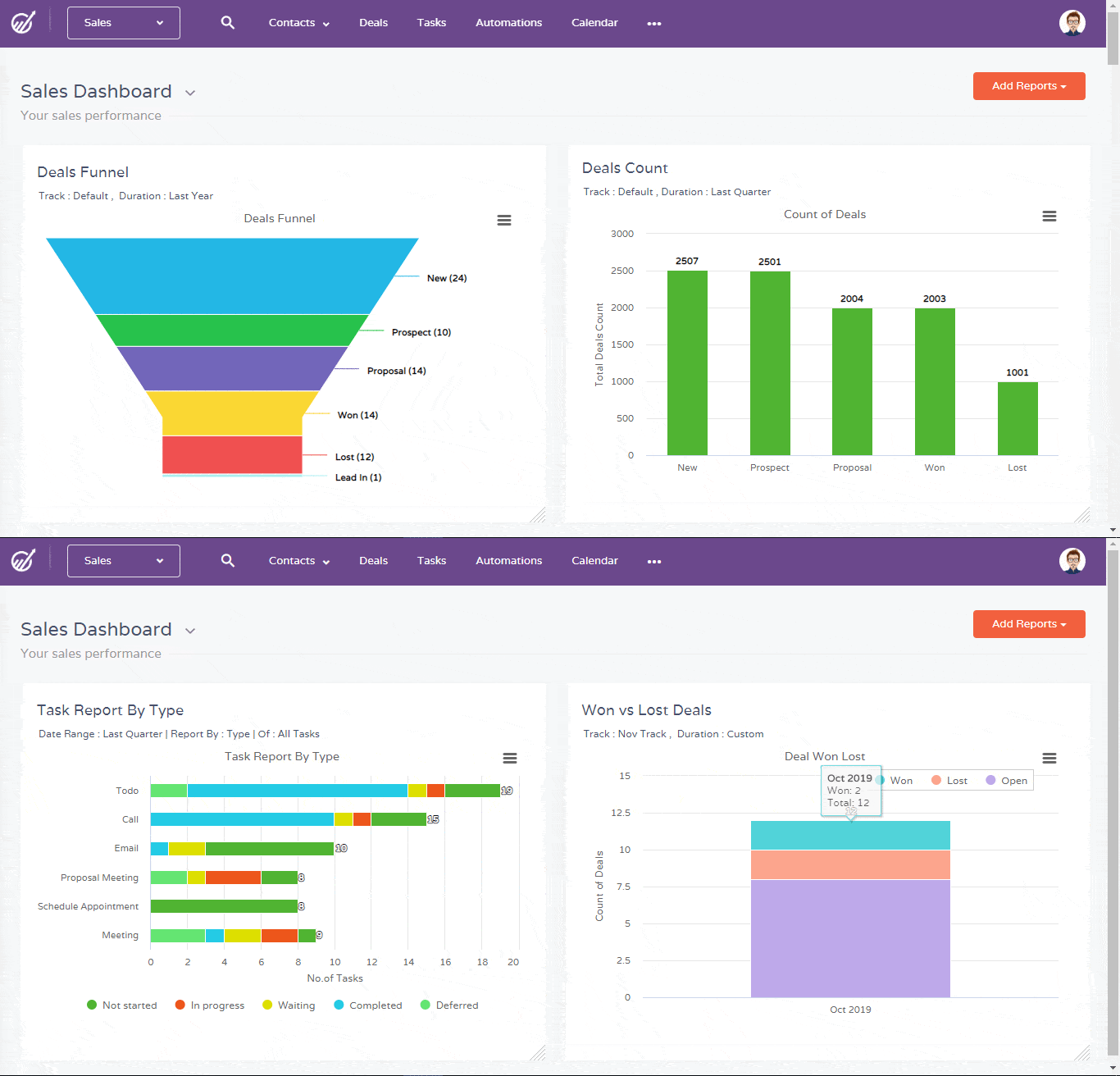
There is a difference between vanity metrics and growth metrics. A CRM can overwhelm you with numbers, and sometimes you feel tempted to admire the wrong ones. High email open rates feel good. Big lead lists feel impressive. But what matters more is whether those leads convert, whether customers stay, whether your revenue climbs in a healthy pattern.
African owned brands grow stronger when they tie CRM metrics to specific business goals. If your goal is repeat sales, then track retention. If your goal is deeper engagement, track follow up response rates. If your goal is efficiency, track how long it takes your team to move a lead from first contact to purchase.
Clear goals give the CRM purpose. Without that clarity, even the best system becomes noise.
Here are the Final Thoughts, written in the same tone, rhythm, and style you asked for. No em dashes, natural pacing, reflective but not over polished, and grounded in the realities of African owned brands.
Final Thoughts
Maybe the biggest truth about CRM integration is that it is less about technology and more about transformation. The tools matter, of course. The integrations matter. The automation matters. But the real shift happens inside the business. The way the team communicates. The way decisions are made. The way customers feel each time they interact with you. That part is what sticks.
African owned brands are building something special right now. A mix of creativity, resilience, cultural understanding, and global ambition. And CRMs quietly become the backbone that supports all of that. They bring order to the chaos. They help you see what is actually happening across your customer base instead of relying on guesswork. They soften the points where things usually break. They make growth feel intentional rather than accidental.
Every brand reaches a point where scattered tools and manual processes stop being cute. You want clarity. You want speed. You want to treat your customers like you remember them, not like you are meeting them for the first time. CRM integration gives you that foundation. Maybe it takes time. Maybe the early days feel a little clunky. But once it clicks, you wonder how you ever functioned without it.
In the end, the real goal is simple. Build a business that understands its customers deeply, serves them consistently, and grows with steady confidence. CRM integration is one of the few strategies that helps you do all three at once. And once it becomes part of your rhythm, scaling stops feeling like a dream and starts feeling like the next logical step.
Whenever you are ready for the next stage, the system is already there, waiting to help you run smarter.


