


Chaos to Consistency: Build a Predictable Marketing System for Entrepreneurs in 30 Days
Most small business owners do not fail at marketing because they are lazy. They fail because their marketing depends on a system that cannot survive real life.
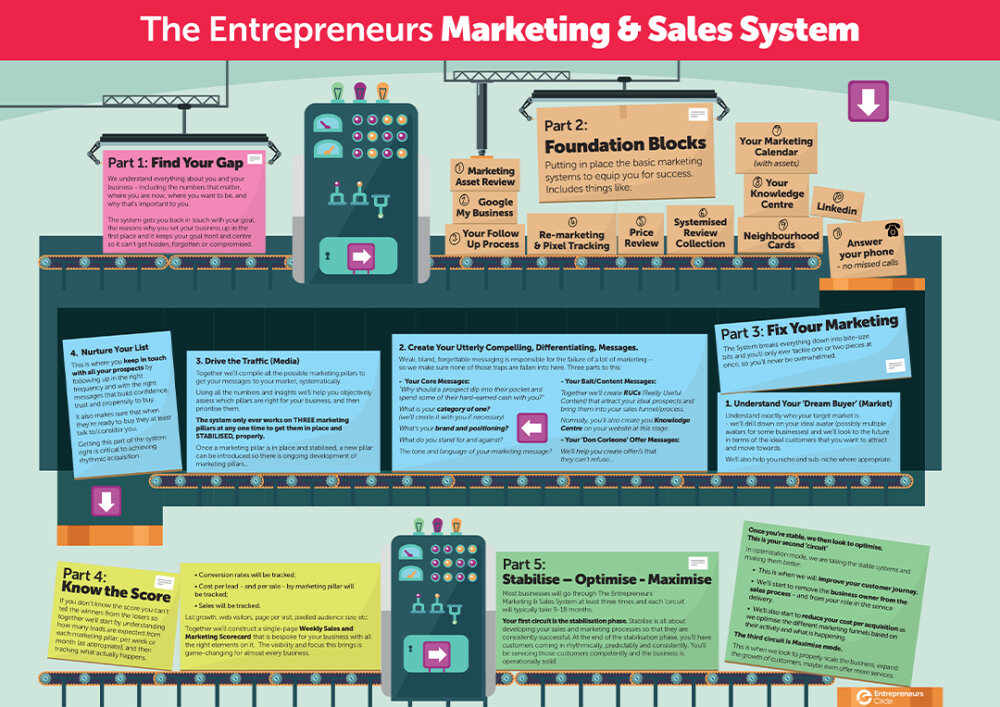
When business is slow, you suddenly start posting, messaging old leads, offering discounts, and looking for customers. When business improves, delivery takes over. You become busy serving clients, fulfilling orders, managing operations, handling complaints, chasing payments, and solving daily problems. Marketing disappears again. Then the pipeline dries up, and the panic cycle repeats.
This is the feast-or-famine cycle.
It is exhausting because it makes your business feel unpredictable. One month you are overwhelmed. The next month you are anxious. One week you are turning people away. The next week you are wondering where the next sale will come from. The problem is not always demand. Often, the problem is that your marketing is too dependent on bursts of effort instead of a repeatable operating system.
A predictable marketing system for entrepreneurs solves this by turning marketing from a random activity into a structured rhythm. It does not require you to post every day, chase every trend, run complicated funnels, or spend hours trying to “stay visible.” It requires you to build a simple machine that consistently does four things:
- Attracts the right people.
- Captures their interest.
- Follows up with them.
- Converts trust into action.
The goal is not to automate your entire business overnight. The goal is to create enough structure that your marketing continues even when you are busy, tired, serving customers, or managing operations.
Consistency is not a personality trait. It is an engineered system.
Why Entrepreneurs Struggle With Consistent Marketing

Most entrepreneurs begin marketing through effort, not design. You post when you remember. You follow up when you feel pressure. You create content when inspiration comes. You send offers when sales slow down. You ask for referrals when cash flow becomes uncomfortable. This approach can work temporarily, but it cannot create stable growth because it has no rhythm.
The deeper issue is that small business owners are often carrying too many roles at once. You are the strategist, salesperson, customer service person, finance manager, content creator, operations lead, and delivery team. Marketing becomes one more task competing for attention. When urgent work appears, marketing loses.
This is why willpower-based marketing fails.
Willpower says, “I need to be more disciplined.”
Systems thinking says, “I need a structure that makes the right action easier to repeat.”
That difference matters. A predictable marketing system does not depend on you feeling creative every morning. It gives you pre-decided topics, reusable templates, automated follow-up, scheduled publishing, a simple content rhythm, and a clear weekly review. Instead of asking, “What should I post today?” you follow a process that already tells you what to create, where to publish it, and what action it should drive.
For small business owners, this is not just about organization. It is about revenue stability.
If marketing only happens when sales are low, your business will keep experiencing gaps. If marketing happens consistently while sales are healthy, you create a future pipeline before you urgently need it.
What a Predictable Marketing System Actually Means
A predictable marketing system is a repeatable process that helps your business stay visible, generate leads, nurture prospects, and convert customers without depending on daily improvisation.
It does not mean results are guaranteed every day. Marketing always involves market conditions, offer strength, timing, trust, pricing, and customer readiness. But predictability improves when your actions become consistent and measurable.
A chaotic marketing approach looks like this:
- Random posting
- No clear audience
- No content plan
- No follow-up process
- No lead capture
- No reusable sales assets
- No tracking
- No automation
- No weekly review
- No connection between content and sales
A predictable marketing system looks like this:
- Clear target customer
- Clear core offer
- Weekly content rhythm
- Lead capture asset
- Simple follow-up sequence
- Reusable proof assets
- Scheduled promotional moments
- Basic automation
- Weekly measurement
- Continuous improvement
The difference is not complexity. The difference is design.
Many entrepreneurs assume a marketing system must be advanced. They imagine expensive software, complicated funnels, paid ads, dashboards, and long email sequences. Those tools can help later, but they are not the starting point. The starting point is a simple rhythm that you can actually maintain.
If your system is too complex for your current capacity, you will abandon it. If it is simple enough to repeat, it can become powerful over time.
The 30-Day Goal: Build a System, Not a Campaign
A campaign is temporary. A system is repeatable.

A campaign says, “Let us push this offer for two weeks.”
A system says, “Every week, we create visibility, capture leads, follow up, and improve based on what happened.”
Campaigns are useful, but they should sit inside a system. Without a system, every campaign starts from zero. You have to recreate the message, rebuild the audience, remember who was interested, design new content, and manually follow up. That wastes time and weakens momentum.
In 30 days, your goal is not to build a perfect marketing machine. Your goal is to create the foundation of consistency:
- A weekly marketing rhythm
- A simple content structure
- A lead capture process
- A follow-up process
- A small automation stack
- Four reusable marketing assets
- A measurement habit
Once these pieces exist, your marketing becomes easier to repeat and improve.
The Weekly Marketing Rhythm: A 3-Hour-Per-Week Framework
Most small business owners do not need a marketing plan that requires 15 hours per week. They need a system that works within real constraints. If you can commit three focused hours per week, you can build a rhythm strong enough to reduce chaos.
The 3-hour weekly marketing framework has five parts:
- Review
- Plan
- Create
- Distribute
- Follow up
Each part has a specific purpose. Together, they prevent marketing from becoming random.
Hour 1: Review and Plan
The first hour is for thinking before creating. Many entrepreneurs skip this and jump straight into posting. That is why their content often feels scattered.
Start by reviewing the previous week:
- Which post, message, email, or conversation created the most response?
- Which questions did customers ask repeatedly?
- Which objections appeared?
- Which offer received attention?
- Which leads need follow-up?
- Which content did not connect?
- Which sales conversations revealed confusion?
- Which customer story can become proof?
This review turns real customer behavior into marketing direction.
Then choose one weekly marketing theme. Your theme should connect to your audience’s pain point and your offer. For example:
- “Why your website gets traffic but no inquiries”
- “How to choose the right package before booking”
- “What to check before hiring a service provider”
- “Why inconsistent marketing creates cash-flow stress”
- “How to prepare for a seasonal sales period”
- “What customers need to know before buying this product”
A weekly theme prevents you from creating disconnected content. It also allows you to repurpose one idea across multiple channels.
After choosing the theme, define one primary action you want people to take. This may be:
- Book a consultation
- Send a WhatsApp message
- Download a checklist
- Join an email list
- Request a quote
- View a product catalog
- Register for a workshop
- Reply with a keyword
- Visit a landing page
Every week should have a clear business action. Visibility without direction creates attention but not momentum.
Hour 2: Create the Core Content
The second hour is for creating one strong piece of core content.
This does not have to be a long article every week. Your core content can be:
- A short educational post
- A carousel
- A 2-minute video
- A customer story
- A newsletter
- A case study
- A voice-note script
- A WhatsApp broadcast
- A short blog post
- A practical checklist
The purpose of core content is to explain one useful idea clearly enough that your audience understands the problem, trusts your perspective, and sees the next step.
A simple structure works well:
- Name the problem.
- Explain why it happens.
- Show the cost of ignoring it.
- Give a practical solution.
- Connect the solution to your offer.
- Invite the next action.
For example, if you run a service business, your content might explain why customers struggle to choose the right package. You could then show a simple comparison framework and invite people to message you for a recommendation.
This is stronger than simply posting, “Book now.”
Educational content builds trust before the sales conversation begins. It also gives you material to reuse across multiple channels.
Hour 3: Distribute, Follow Up, and Schedule
The third hour is where many entrepreneurs lose consistency. They create content but do not distribute it properly. Or they post once and move on. A predictable system requires distribution and follow-up.
Use the third hour to:
- Post your core content on your main channel
- Repurpose it into 2–3 smaller posts
- Add it to WhatsApp status or broadcast
- Send it to warm leads where relevant
- Schedule one follow-up message
- Save the content in your asset library
- Track responses
For example, one core post can become:
- A Facebook post
- A LinkedIn post
- An Instagram caption
- A WhatsApp status sequence
- A short email
- A sales conversation script
- A FAQ answer
- A future carousel
This is how you create consistency without constantly creating from scratch.
The final part of the hour should be follow-up. Follow-up is where revenue often hides. Many entrepreneurs focus on attracting new leads while ignoring people who already showed interest.
Your weekly follow-up list should include:
- People who asked for prices
- People who requested details
- Past customers who may need the service again
- Prospects who downloaded a resource
- Referrals who have not responded
- Leads who delayed because of timing
- Customers who may be ready for an upgrade
A predictable marketing system treats follow-up as part of marketing, not an occasional sales task.
The 30-Day Implementation Plan
A 30-day system works best when each week builds one layer. Do not try to automate everything at once. Do not redesign your entire brand, launch five channels, build a funnel, and create a content calendar in the same week. That creates another form of chaos.
Build in sequence.
Week 1: Clarify the Offer and Customer Journey
Before automation, content, or scheduling, clarify what your marketing is supposed to move people toward.
Many small business owners are inconsistent because their offer is unclear. If you are not clear on who you serve, what problem you solve, and what action customers should take, your marketing will feel scattered no matter how often you post.
In week one, answer these questions:
- Who is the specific customer you want more of?
- What urgent or meaningful problem do they have?
- What offer solves that problem?
- What result should they expect?
- What objections usually stop them?
- What proof do they need?
- What is the first step to work with you?
- What happens after they show interest?
Then map the customer journey:
- They discover you.
- They understand the problem.
- They trust your expertise.
- They show interest.
- They receive follow-up.
- They make a decision.
- They buy.
- They receive delivery.
- They return or refer.
Your marketing system should support each stage. If one stage is missing, prospects leak out.
For example, if people discover you but do not understand your offer, you need clearer educational content. If people understand but do not trust you, you need proof assets. If people trust you but do not act, you need a stronger offer and clearer next step. If people inquire but disappear, you need follow-up.
Week one is about finding the leaks before building the machine.
Week 2: Build the Weekly Content Rhythm
In week two, create your repeatable content structure.
You do not need to post randomly every day. You need a predictable rhythm that covers the major questions customers ask before buying.
A simple weekly rhythm can look like this:
Monday: Problem Awareness
Explain a problem your customer is experiencing.
Example:
“Why your marketing disappears every time business gets busy.”
This content helps the audience recognize the cost of their current situation.
Wednesday: Practical Education
Teach a framework, checklist, mistake, or process.
Example:
“The 3-hour weekly marketing rhythm for busy entrepreneurs.”
This content builds trust and positions your business as useful.
Friday: Proof or Offer
Share a customer story, testimonial, case study, behind-the-scenes process, or direct offer.
Example:
“How one service provider turned one weekly post into five follow-up conversations.”
This content connects education to action.
If three posts per week are too much, start with two. If two is too much, start with one strong weekly post and repurpose it. The goal is not volume. The goal is rhythm.
A consistent marketing system should answer four recurring content questions:
- What problem do you solve?
- Why does that problem matter?
- How can the customer think about it better?
- Why should they trust you to help?
If your content answers those questions repeatedly, your marketing becomes more coherent.
Week 3: Build Follow-Up and Lead Capture
Week three is where your system becomes more than content.
Content creates visibility. Lead capture creates continuity.
If people see your content but you have no way to capture interest, you are relying on them to remember you later. That is risky. Customers are busy. They may like your post, plan to message you, get distracted, and forget.
A lead capture system gives interested people a simple next step.
Examples include:
- A free checklist
- A consultation request form
- A WhatsApp keyword
- A quote request form
- A downloadable guide
- A booking link
- A mini-audit
- A product recommendation quiz
- A catalog request
- A webinar registration
- A waitlist
The lead capture asset should be directly related to your offer. If you sell marketing services, a “30-day marketing consistency checklist” makes sense. If you sell event services, an “event planning budget checklist” makes sense. If you sell beauty services, a “pre-booking preparation guide” makes sense. If you sell consulting, a “business diagnostic worksheet” makes sense.
The goal is to capture people who are not ready to buy today but may become ready soon.
Then build a simple follow-up sequence.
It can be as simple as:
- Day 1: Send the resource and ask one diagnostic question.
- Day 3: Share a useful tip related to the resource.
- Day 5: Share proof or a customer example.
- Day 7: Invite them to take the next step.
This does not need to be complicated. The key is that follow-up happens by design, not memory.
Week 4: Automate and Measure
Week four is where you reduce manual effort.
Automation should not replace strategy. It should remove repetitive tasks so you can focus on conversations, delivery, and decisions.
Start with simple automation:
- Schedule posts in advance
- Use saved replies for common questions
- Set up an email welcome sequence
- Use WhatsApp Business quick replies
- Create a booking form
- Create a quote request form
- Connect a lead form to a spreadsheet
- Set reminders for follow-up
- Use a simple CRM or pipeline board
- Automate delivery of lead magnets
Then measure what happened.
Track:
- Content published
- Inquiries received
- Leads captured
- Follow-ups sent
- Sales conversations started
- Bookings or purchases made
- Common objections
- Best-performing topics
- Conversion from inquiry to action
Measurement does not need to be advanced. A simple spreadsheet can work. The goal is to stop guessing.
After 30 days, you should know which topics attract attention, which messages create inquiries, which offers produce action, and where prospects drop off.
That information makes the next 30 days stronger.
What to Automate First, Second, and Third
Many entrepreneurs automate the wrong things first. They buy tools before clarifying the process. They set up complicated email funnels before they know what customers actually need to hear. They automate posting before their message is clear. This creates efficient confusion.
Automation should follow customer behavior.
Automate First: Repetitive Responses
Start by automating the questions you answer all the time.
Common examples include:
- “How much is it?”
- “What is included?”
- “How do I book?”
- “Where are you located?”
- “How long does it take?”
- “Do you deliver?”
- “What do I need before we start?”
- “Can I see examples?”
- “What package is best for me?”
If you answer these manually every day, you are wasting mental energy. Create saved replies, FAQ pages, WhatsApp quick replies, or short explainer messages.
This does not make your business less personal. It makes your communication more consistent. You can still personalize after the basic information is clear.
A strong saved reply should include:
- A direct answer
- A short explanation
- A next step
- A friendly invitation to ask a specific question
For example:
“Our starter package includes X, Y, and Z. It is best for business owners who need a simple setup before scaling. If you want, send me your current situation and I will tell you whether the starter or full package fits better.”
That response saves time while still feeling helpful.
Automate Second: Lead Capture and Delivery
Once repetitive responses are handled, automate lead capture.
This means interested people should be able to take the next step without waiting for you to be online.
Set up:
- A form
- A booking link
- A downloadable resource
- A WhatsApp keyword process
- A catalog request
- A quote request page
- A consultation application
- A simple landing page
If someone discovers your business at 11 p.m., they should still be able to express interest. If someone is not ready to buy but wants the checklist, they should receive it without manual delay. If someone wants a quote, they should know what information to submit.
This protects opportunities that would otherwise disappear.
Lead capture also helps you separate serious prospects from casual browsers. A person who fills out a form, downloads a guide, requests a quote, or books a call has shown more intent than someone who only liked a post.
Automate Third: Follow-Up
Follow-up automation should come after you understand your customer journey. If you automate too early, you may send messages that do not match what prospects need.
Once you know the common objections, questions, and decision delays, create a follow-up sequence.
A basic follow-up system can include:
- A welcome message
- A helpful educational message
- A proof message
- An objection-handling message
- A reminder message
- A direct invitation
For example, if someone downloads your marketing consistency checklist, the follow-up could be:
- “Here is the checklist and how to use it.”
- “Most entrepreneurs struggle because they rely on willpower, not systems.”
- “Here is a simple example of a weekly rhythm.”
- “Here are the four assets that make marketing easier.”
- “If you want help building this for your business, here is the next step.”
This sequence warms the lead without constant manual chasing.
What Not to Automate Too Early
Do not automate strategy too early. If your offer is unclear, automation will not fix it. If your audience is wrong, automation will not correct it. If your pricing is confusing, automation may spread confusion faster. If your content is generic, automation will only publish generic content consistently.
Avoid automating:
- Unvalidated offers
- Weak messaging
- Poor customer service
- Confusing pricing
- Aggressive sales pressure
- Generic content
- Follow-up that ignores context
- Promises you cannot deliver
Automation should make a good process easier. It should not hide a broken one.
The 4 Assets That Run Your Marketing on Autopilot
A predictable marketing system needs assets. Assets are reusable pieces of marketing that continue working after you create them. They reduce the need to start from scratch every week.
The four most important assets are:
- A clear offer page
- A lead magnet
- A proof library
- A follow-up sequence
Together, these assets help your marketing attract, educate, reassure, and convert prospects with less daily effort.
Asset 1: A Clear Offer Page
Your offer page is the home base of your marketing. It can be a website page, landing page, Google Doc, PDF, catalog page, or structured WhatsApp message. The format matters less than the clarity.
A strong offer page answers:
- Who is this for?
- What problem does it solve?
- What result does the customer get?
- What is included?
- How does the process work?
- What proof supports it?
- What objections are addressed?
- What does it cost or how is pricing handled?
- What should the customer do next?
Many entrepreneurs lose leads because interested people have to ask too many basic questions. A clear offer page reduces friction. It also helps your content convert because every post can point to one clear destination.
Your offer page should not sound like a brochure full of vague claims. It should act like a decision guide.
For example, instead of saying:
“We provide quality marketing services for all businesses.”
Say:
“We help service-based small business owners build a simple weekly marketing system so they can generate leads consistently without posting randomly every day.”
Specificity creates trust.
Asset 2: A Lead Magnet
A lead magnet is a useful resource that prospects receive in exchange for showing interest. It should solve a small but meaningful problem related to your paid offer.
Examples include:
- Checklist
- Template
- Buyer’s guide
- Audit worksheet
- Planning calendar
- Mini-course
- Calculator
- Script
- Comparison guide
- Diagnostic quiz
For a predictable marketing system, your lead magnet should attract people who are likely to need your service.
If your business helps entrepreneurs systematize marketing, a strong lead magnet could be:
- “The 3-Hour Weekly Marketing Planner”
- “The Small Business Follow-Up Script Pack”
- “The 30-Day Marketing Consistency Checklist”
- “The Content Repurposing Map for Busy Entrepreneurs”
A weak lead magnet attracts broad attention but not buying intent. A strong lead magnet attracts the right problem.
The purpose is not to give away everything. The purpose is to create a helpful first step that builds trust and starts a relationship.
Asset 3: A Proof Library
A proof library is a collection of evidence that your business can deliver.
It can include:
- Testimonials
- Case studies
- Screenshots
- Before-and-after examples
- Customer stories
- Results summaries
- Process photos
- Reviews
- Frequently asked questions
- Objection responses
- Media mentions
- Certifications
- Delivery examples
Many entrepreneurs have proof but do not organize it. They leave testimonials buried in WhatsApp chats, screenshots, old posts, notebooks, or memory. Then when a prospect asks, “Can I see examples?” they scramble.
A proof library makes trust easier to build.
Organize proof by objection. For example:
- If prospects worry about price, show value-based proof.
- If they worry about reliability, show delivery proof.
- If they worry about results, show outcome proof.
- If they worry about process, show behind-the-scenes proof.
- If they worry about whether the offer fits them, show customer-specific examples.
Proof should not only say, “People like us.” It should answer the buyer’s hidden doubts.
Asset 4: A Follow-Up Sequence
Your follow-up sequence is the asset that prevents leads from going cold.
Many sales are lost not because the customer said no, but because the business stopped following up. Entrepreneurs often avoid follow-up because they do not want to seem pushy. But good follow-up is not pressure. It is guidance.
A strong follow-up sequence helps prospects make a decision by giving them useful information over time.
It can include:
- A reminder of the problem
- A practical tip
- A customer example
- An objection answer
- A comparison
- A deadline
- A direct invitation
- A check-in message
The sequence can be automated through email, partially automated through WhatsApp Business, or manually managed with reminders. The important thing is that it exists.
A simple 7-day sequence can work:
Day 1: Deliver the Resource
Send the lead magnet, guide, or requested information.
Day 2: Clarify the Problem
Explain the common mistake or challenge related to the resource.
Day 4: Share Proof
Show a customer example, testimonial, or result.
Day 6: Handle an Objection
Address a common concern such as time, price, trust, complexity, or readiness.
Day 7: Invite Action
Ask whether they want help applying the solution.
This sequence keeps your business present without constant improvisation.
How the 4 Assets Work Together
The four assets create a simple marketing engine.
Your content attracts attention.
Your lead magnet captures interest.
Your offer page explains the solution.
Your proof library builds trust.
Your follow-up sequence moves prospects toward action.
This is how marketing begins to run with less daily pressure.
For example, a small business owner sees your post about inconsistent marketing. They download your 3-hour weekly planner. They receive a follow-up message explaining how to use it. They click your offer page to see how your service works. They review testimonials from other entrepreneurs. A few days later, they receive a message inviting them to book a consultation.
That is a system.
It is not aggressive. It is structured.
How to Repurpose Content Without Sounding Repetitive
Repurposing is essential for consistency because entrepreneurs rarely have time to create everything from zero. But repurposing should not mean copying the same caption everywhere. It means turning one idea into different formats for different contexts.
Start with one core idea.
Example:
“Marketing consistency comes from systems, not motivation.”
Repurpose it into:
- A short educational post
- A checklist
- A carousel
- A WhatsApp status series
- A newsletter
- A short video script
- A sales email
- A FAQ answer
- A workshop topic
- A lead magnet section
Each version should serve a different purpose.
The post creates awareness.
The checklist creates action.
The carousel simplifies the idea.
The WhatsApp status keeps you visible.
The newsletter deepens trust.
The video adds personality.
The sales email connects to your offer.
The FAQ answer handles objections.
This approach lets you market consistently without exhausting your creativity.
The Simple Content Bank Every Entrepreneur Needs
A content bank is a stored collection of ideas, examples, stories, and messages. It prevents the weekly question: “What should I post?”
Create categories such as:
- Customer questions
- Common mistakes
- Myths
- Objections
- Case studies
- Testimonials
- Behind-the-scenes processes
- Before-and-after examples
- Personal lessons
- Industry insights
- Offer explanations
- Comparison posts
- Checklists
- Quick tips
- Decision guides
Every time a customer asks a question, add it to the content bank. Every time a prospect objects, add it. Every time you explain something in a sales conversation, add it. Every time a client gets a result, add it.
Your customers are already telling you what content to create. A system helps you capture it.
How to Build Consistency Without Posting Every Day
Daily posting is not required for every small business. Consistency means showing up with a reliable rhythm, not overwhelming yourself with unrealistic volume.
A realistic rhythm might be:
- One strong educational post per week
- One proof post per week
- One offer reminder per week
- Two WhatsApp status updates per week
- One email or broadcast per week
- One follow-up session per week
That is enough to create visibility if the message is clear and the follow-up is strong.
The mistake is thinking consistency means constant noise. It does not. Consistency means your audience repeatedly sees useful, relevant, trust-building messages that connect to a clear offer.
Quality of rhythm matters more than volume of activity.
The Role of Marketing Automation for Small Businesses
Marketing automation for small business should make the customer journey smoother, not colder.
Good automation helps people get the right information faster. It reduces missed opportunities. It ensures follow-up happens. It keeps your business organized. It allows you to serve prospects even when you are busy.
But automation should still feel human. Use clear language. Avoid robotic messages. Give people a way to ask questions. Personalize where needed. Do not use automation to pressure people aggressively.
The best automation supports trust.
For example:
- A booking reminder reduces missed appointments.
- A saved reply gives faster answers.
- A welcome email helps a new lead understand the next step.
- A lead magnet delivery message gives immediate value.
- A follow-up reminder helps you reconnect at the right time.
- A quote form collects the details needed to respond properly.
These are practical automations that improve the customer experience.
What to Measure Every Week
A predictable marketing system must be measured. Otherwise, you are only creating activity.
Track simple numbers:
- How many pieces of content did you publish?
- How many people engaged meaningfully?
- How many inquiries came in?
- How many leads were captured?
- How many follow-ups were sent?
- How many sales conversations started?
- How many proposals or quotes were sent?
- How many customers bought?
- Which content created the strongest response?
- Which objection appeared most often?
The goal is not to become obsessed with metrics. The goal is to see patterns.
If content gets attention but no inquiries, your next step may be unclear.
If inquiries come in but do not convert, your offer, proof, pricing, or follow-up may need work.
If leads download your resource but never respond, your follow-up may be weak.
If people ask the same question repeatedly, your offer page may be unclear.
If one topic consistently creates serious conversations, create more around that topic.
Measurement turns marketing into a learning system.
The 30-Day Predictable Marketing System Checklist
By the end of 30 days, you should have:
- One clearly defined target customer
- One core offer
- One clear next step
- One weekly marketing theme process
- One 3-hour weekly marketing rhythm
- One lead magnet
- One offer page
- One proof library
- One follow-up sequence
- Saved replies for common questions
- A simple content bank
- A basic tracking sheet
- A weekly review habit
- A repurposing process
- A simple automation setup
This is not a full enterprise marketing department. It is a practical operating system for a small business owner.
Common Mistakes That Break Marketing Consistency
Mistake 1: Building Too Many Channels at Once
If you try to be active on every platform, you may become inconsistent everywhere. Start with the channel where your best customers already pay attention. Build rhythm there first. Expand later.
Mistake 2: Creating Content Without a Sales Path
Content should not exist in isolation. Every piece should connect to a next step, even if the next step is soft. If people like your content but do not know what to do next, your system leaks.
Mistake 3: Automating Before Clarifying the Message
Automation cannot fix unclear positioning. Before you automate, make sure your offer, audience, and customer journey are clear.
Mistake 4: Ignoring Follow-Up
Many entrepreneurs focus on visibility but neglect follow-up. This creates wasted attention. If someone shows interest, your system should help them move forward.
Mistake 5: Treating Marketing as an Emergency Task
Marketing should not only happen when sales are low. It should happen especially when sales are healthy, because that is how you prevent future gaps.
Mistake 6: Measuring Vanity Metrics Only
Likes and views matter less than inquiries, leads, conversations, bookings, purchases, and repeat customers. Measure what connects to revenue.
Mistake 7: Recreating Everything From Scratch
Templates, content banks, proof libraries, saved replies, and repurposing systems exist to reduce mental load. Use them.
How to Know Your System Is Working
Your predictable marketing system is working when marketing becomes easier to repeat and your pipeline becomes easier to understand.
You will notice signs such as:
- You no longer wonder what to post every week.
- Your content connects to your offer more clearly.
- Prospects ask better questions.
- Follow-up happens on schedule.
- Common objections are easier to answer.
- Leads are captured instead of forgotten.
- Proof is easier to share.
- You can see where prospects drop off.
- You feel less pressure to create from scratch.
- Sales conversations become more consistent.
The biggest sign is not that every week produces the same revenue. Business will still have variation. The sign is that your actions are no longer random, and your marketing is no longer disappearing whenever operations become busy.
Predictability begins with behavior before it shows up in revenue.
Why This System Works Better Than Willpower
Willpower depends on your mood, energy, and available time. Systems depend on structure.
A weekly rhythm tells you when marketing happens.
A content bank tells you what to say.
An offer page tells prospects what you do.
A lead magnet captures interest.
A proof library builds trust.
A follow-up sequence keeps conversations alive.
Automation reduces repetitive work.
Measurement tells you what to improve.
Together, these pieces make consistency easier than chaos.
That is the real advantage. You stop treating marketing like a creative emergency and start treating it like a business function.
From Chaos to Consistency
The feast-or-famine cycle is not solved by posting harder when sales are low. It is solved by building a marketing system that continues working before the panic starts.
In 30 days, you can create that foundation. You can clarify your offer, establish a weekly rhythm, build reusable assets, automate simple tasks, and start measuring what actually moves people toward buying. You do not need a massive budget or a complicated funnel. You need a practical system that fits your capacity and supports your revenue goals.
A predictable marketing system gives your business a steadier pulse. It helps you stay visible when you are busy, follow up when you would normally forget, and build trust before prospects are ready to buy.
Consistency is not about doing more every day.
It is about designing a system that keeps doing the right things every week.


