


Meta Ads Copywriting Strategy for Converting Cold Social Traffic
Your Facebook or Instagram followers may stop to read a caption because they already recognize your salon, know your work or trust the person behind the account.
Cold prospects have none of those advantages.
They encounter your advertisement between personal messages, entertainment clips, news updates and competing offers. They do not owe your business their attention. Before they consider booking, your copy must quickly establish relevance, communicate a desirable outcome and make the next step feel simple.
That is why a promotional social media post and a direct-response advertisement cannot be written the same way.
A social post can entertain, update or build familiarity. A sales ad must create movement. It should move the reader from unfamiliarity to interest, from interest to belief and from belief to one specific action.
For salon owners running click-to-WhatsApp campaigns, that action is usually not “engage with our brand.” It is something concrete: check availability, request a price, choose an appointment or begin a booking conversation.
Why Organic-Style Captions Fail With Cold Traffic
Many weak salon ads begin like this:
Welcome to Bella Beauty Studio, where beauty meets elegance. We offer braids, wigs, nails, facials and many other professional services. Contact us today for more information.
Nothing is technically wrong with the message. The problem is that it makes the prospect do too much interpretive work.
The opening does not identify a specific customer problem. The service list describes what the salon provides without explaining why those services matter. The call to action does not clarify what will happen after the prospect makes contact.
The copy asks for attention before earning it.
Meta advises advertisers to keep primary text brief, communicate the desired action quickly and account for the fact that people scan feeds rapidly, especially on mobile devices. It also warns that longer text may be truncated across placements and devices. (Facebook)
Your ad does not need to be aggressively short in every situation. It does need to reveal its commercial value early.
Use the Hook–Outcome–Proof–Action Framework
A practical Meta ads copywriting strategy can be organized into four components:
- Hook: Stop the right prospect by naming a recognizable problem or desired result.
- Outcome: Explain what improves for the customer.
- Proof: Reduce doubt with credible evidence or risk reversal.
- Action: Give the prospect one clear next step.
This framework prevents your copy from becoming an unstructured wall of claims.
1. Open With a Hook That Creates Self-Recognition
A strong opening sentence makes the intended customer think, “This is about my situation.”
It does not need to be sensational. It needs to be specific.
Compare these two openings:
Weak:
“Looking for professional braiding services?”
Stronger:
“Tired of spending hours in a salon only to leave with braids that feel painfully tight?”
The second opening introduces a recognizable frustration. A prospect who has experienced painful braiding immediately understands why the advertisement may be relevant.
Use the “So What?” Hook Test
Read your first sentence and ask, “So what?”
If the answer is unclear, the hook is probably too vague.
Consider:
“We now offer knotless braids.”
So what?
A stronger version explains the customer-level consequence:
“Get the knotless-braid look you want without the heavy tension that makes your scalp uncomfortable for days.”
The rewrite does not merely announce the service. It connects the service to comfort, appearance and the customer’s previous negative experience.
Four Hook Angles to Test
You can build opening lines around four reliable sources of relevance.
Problem recognition
“Still avoiding protective styles because previous braids damaged your edges?”
Desired outcome
“Want neat, lightweight braids that still look fresh weeks after your appointment?”
Objection removal
“No surprise add-on charges: know your full braiding price before your appointment begins.”
Specific situation
“Need a polished protective style before your wedding, trip or graduation weekend?”
The hook should attract the customer most likely to value your offer—not every person scrolling through Facebook.
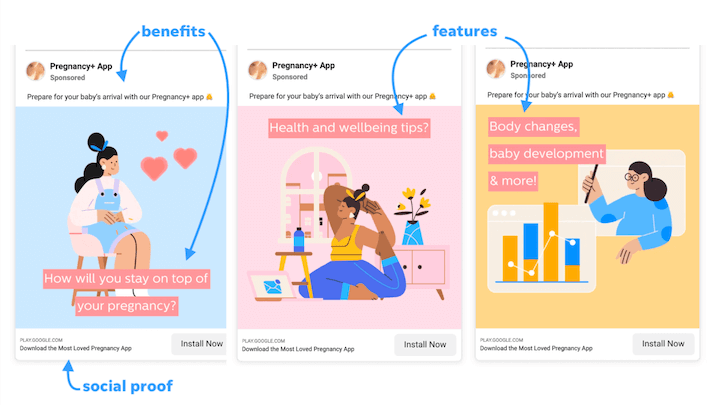
2. Replace Feature Walls With Benefit-Led Copy
A feature tells the reader what the service includes.
A benefit explains what that feature changes for the customer.
Salon owners frequently list features because those details feel concrete:
- Professional stylists
- Premium extensions
- Air-conditioned salon
- Online appointments
- Multiple braid styles
These points are not useless. They are incomplete.
Use a three-step benefit ladder:
Feature → Functional advantage → Customer outcome
For example:
Feature: Online appointment scheduling
Functional advantage: The customer can reserve a time before travelling to the salon
Customer outcome: She avoids arriving without a confirmed slot or waiting for hours
The customer-facing version becomes:
“Reserve your appointment on WhatsApp before you leave home, so you know exactly when your stylist is ready.”
Another example:
Feature: Premium extensions
Functional advantage: The material is lighter and easier to manage
Customer outcome: The client can wear the style more comfortably
The ad copy becomes:
“Choose lightweight extensions that give you a full finish without making your hairstyle feel unnecessarily heavy.”
Format Benefits for Scanners
Cold prospects often scan digital content instead of reading every line. Nielsen Norman Group’s usability research found that concise, objective and scannable formatting substantially improved how effectively people used web content. (Nielsen Norman Group)
Do not bury your strongest reasons to book inside one dense paragraph.
Use short, parallel points:
- Confirm your total price before the appointment
- Choose a style suited to your hair and schedule
- Reserve your time through WhatsApp
- Leave with clear maintenance instructions
Each line should answer a practical customer question.
What will be easier? What risk disappears? What result becomes more likely?
3. Add Proof Where Doubt Naturally Appears
Cold traffic is cautious because your claim comes from a business the prospect has not used before.
Your proof should address the specific doubt created by your promise.
When you promise a comfortable experience, use customer feedback about comfort. When you promise reliable appointments, use evidence about punctuality or booking procedures. When you promote a particular result, show relevant before-and-after work with appropriate permission.
Useful proof elements include:
- A specific customer testimonial
- A visible portfolio of comparable styles
- A transparent price range
- A clear consultation process
- The stylist’s relevant experience
- A service guarantee you can genuinely honour
- The number of available appointments, when accurate
Avoid unsupported superiority claims such as “the best salon in the city.” They are easy to write and difficult for a cold prospect to believe.
Proof does not need to make the advertisement long. One strong sentence can be enough:
“See recent knotless-braid results from clients with different hair lengths in the carousel.”
4. Give the Prospect One Clear Call to Action
Do not end your advertisement with five competing instructions.
“Send us a message, visit our page, follow us, comment below or call for more details” sounds flexible. In practice, it forces the prospect to decide what to do next.
Research on choice overload shows that additional options are not automatically harmful, but decision complexity, uncertainty and task difficulty can increase the likelihood that people postpone or avoid a choice. (DOI)
Your advertisement should remove unnecessary decisions.
For a click-to-WhatsApp campaign, choose one instruction:
“Tap Send Message and reply with ‘BRAIDS’ to see this week’s available appointments.”
That CTA works because it identifies:
- The button to press
- The message to send
- The information the prospect will receive
Meta provides campaign-appropriate CTA buttons because clear prompts help draw attention and encourage the intended action. (Facebook)
Make sure the button, copy and WhatsApp response flow all support the same next step.
A Complete Before-and-After Rewrite
Weak Social-Post Copy
We are your home of beauty and elegance. We offer knotless braids, cornrows, wigs, nails and makeup at affordable prices. Our professional team is ready to serve you. Book now, follow our page or call us for enquiries.
Direct-Response Version
Love knotless braids but hate the heavy tension and all-day salon wait?
Book a confirmed appointment for neat, lightweight braids designed around your preferred length and finish.
- Know your price before your appointment
- Reserve your time through WhatsApp
- Choose from recent client styles
- Receive simple care instructions before you leave
Tap Send Message and reply with “BRAIDS” to check this week’s openings.
The second version does not rely on more adjectives. It creates relevance, translates the service into practical benefits and presents one low-friction action.
Test Copy Components Separately
Do not rewrite the hook, offer, benefit list and CTA simultaneously, then assume the winning element is obvious.
Test one meaningful component at a time.
For example, keep the creative, offer and CTA consistent while comparing three hooks:
- Pain-based hook
- Desired-outcome hook
- Price-transparency hook
Then evaluate whether the new hook improves qualified response—not merely reactions or cheap clicks.
Useful diagnostic metrics include:
- Outbound click-through rate
- Cost per WhatsApp conversation
- Percentage of conversations that request the advertised service
- Booking rate from qualified conversations
- Cost per completed booking
Meta encourages advertisers to test copy and creative variations rather than assume one message will resonate equally with every prospect. Its current tools can also accommodate multiple primary-text and headline options for delivery testing. (Facebook)

Your Cold-Traffic Copy Checklist
Before publishing, confirm that your advertisement answers these questions:
- Does the first sentence identify a specific problem, desire or objection?
- Can the prospect understand the offer without knowing the salon?
- Does each feature connect to a customer benefit?
- Is the copy easy to scan on a phone?
- Is there credible evidence supporting the promise?
- Does the ad ask for one primary action?
- Does the CTA explain what happens after the click?
- Can your WhatsApp team continue the same message without confusing the lead?
If the copy fails one of these tests, adding more promotional language will not fix it. Clarify the message instead.
Write for Movement, Not Applause
The purpose of direct-response copy is not to sound more impressive than every other salon advertisement.
It is to make the right prospect recognize a relevant problem, understand the offered outcome, believe the promise and take the next step.
Start with a hook that earns attention. Replace broad service descriptions with customer-level benefits. Add proof where doubt is strongest. Then close with one specific instruction that moves the prospect into a structured booking conversation.
When every sentence performs one of those jobs, your Meta ad stops behaving like an ordinary social media caption and starts functioning like a sales asset.


