


Paid search used to be a very human sport: exact match keywords, manual bids, and a spreadsheet that looked like it survived a small fire. Today, it’s largely algorithmic. Google (and other platforms) use machine learning to decide which auctions to enter, how much to bid, and who is most likely to convert.
That shift is good news, if your data is solid.
If it isn’t, “AI optimization” turns into a very expensive guessing game. Smart Bidding can’t magically infer lead quality from a broken thank-you page event. And it can’t optimize toward profit if you only track “form submitted” and call it a day.
Scaling ad spend usually triggers the law of diminishing returns. To counter this, businesses must adopt Algorithmic Growth: the practice of feeding highly refined, AI-processed, first-party data back into ad platform algorithms (like Google Ads’ Smart Bidding). This alignment ensures that the platform’s machine learning optimizes not just for volume, but for deep, long-term business value.
![AI-powered search: What you need to know [2026]](https://unable-actionable-car.media.strapiapp.com/AI_powered_search_What_you_need_to_know_6cceb73e97.png "How to Align Paid Search with AI-Driven Data for Sustainable Scaling 1")
This article breaks down a practical framework for algorithmic growth: how to align paid search strategy with AI-driven data so scaling becomes sustainable (repeatable, measurable, and resilient), not a monthly rollercoaster.
The Paradigm Shift: From Manual Bidding to Algorithmic Orchestration

Historically, a paid search strategy relied on granular control: Single Keyword Ad Groups (SKAGs), manual bid adjustments by device or time of day, and rigid match types. Success was determined by a media buyer’s ability to manipulate the platform interface.
Today, ad platforms utilize deep neural networks to evaluate millions of contextual signals (user location, device, historical behavior, browser syntax) in milliseconds during a real-time auction. Humans cannot compete with this processing speed. Consequently, the role of the marketer has shifted from bid manipulator to data orchestrator.
If you feed an ad platform’s algorithm basic data, such as a pixel firing upon a form submission, the algorithm will aggressively hunt for users most likely to submit that form, regardless of lead quality. If you feed the algorithm AI-driven data, such as a predicted lifetime value (pLTV) score attached to that specific user, the algorithm hunts for highly profitable customers.
Feeding the Algorithm: The Role of AI-Driven First-Party Data

To achieve sustainable scaling, you must upgrade the data payload you send to Google, Microsoft, or any other search platform. This requires moving beyond binary conversions (Did they buy? Yes/No) to value-centric data models.
1. Predictive Lifetime Value (pLTV)
Instead of optimizing for the initial transaction value, businesses should utilize machine learning models (such as RFM—Recency, Frequency, Monetary, analysis paired with regression algorithms) to predict what a customer will be worth over the next 12 to 24 months.
By passing this predicted value back to the ad platform via offline conversion tracking (OCT) or server-to-server APIs, the paid search algorithm learns to bid more aggressively on search queries that yield long-term loyalists, and bid down on queries that attract one-time, low-value buyers.
2. Predictive Lead Scoring for B2B
For B2B companies, a lead is just the beginning of a long sales cycle. An AI model analyzing CRM data can instantly score an incoming lead based on firmographics, email domains, and behavioral signals.
- Low-quality lead: Assign a value of $10.
- High-quality lead (matches Ideal Customer Profile): Assign a value of $500.
When these dynamic values are fed back into the Paid search strategy, the algorithm shifts budget toward the search terms, audiences, and times of day that generate the $500 leads, effectively ignoring the junk volume.
3. Dynamic Margin Optimization
Revenue is a vanity metric; profit is the reality. E-commerce businesses should dynamically inject profit margins into their conversion tracking. If Product A sells for $100 with a 10% margin, and Product B sells for $100 with a 60% margin, the algorithm must know that Product B is worth six times more to the business.
Implementing Value-Based Bidding (VBB)
Once your AI-driven data pipeline is established, the next step in algorithmic growth is deploying Value-Based Bidding (VBB), specifically Target ROAS (tROAS).
VBB instructs the algorithm to maximize conversion value rather than conversion volume. The mathematical objective of the ad platform shifts fundamentally:
Where:
- is the predicted probability of conversion for user .
- is the dynamic, AI-calculated value of that conversion.
To scale sustainably with VBB:
- Set realistic targets: Setting a tROAS too high chokes the algorithm, preventing it from entering auctions and learning. Start with a tROAS 15% lower than your historical 30-day average to give the algorithm “liquidity,” then incrementally raise it as volume stabilizes.
- Ensure data density: Algorithms require volume to establish statistical significance. Consolidate campaigns to ensure the algorithm processes at least 30 to 50 value-based conversions per month per campaign.
Structuring Paid Search Campaigns for Machine Learning
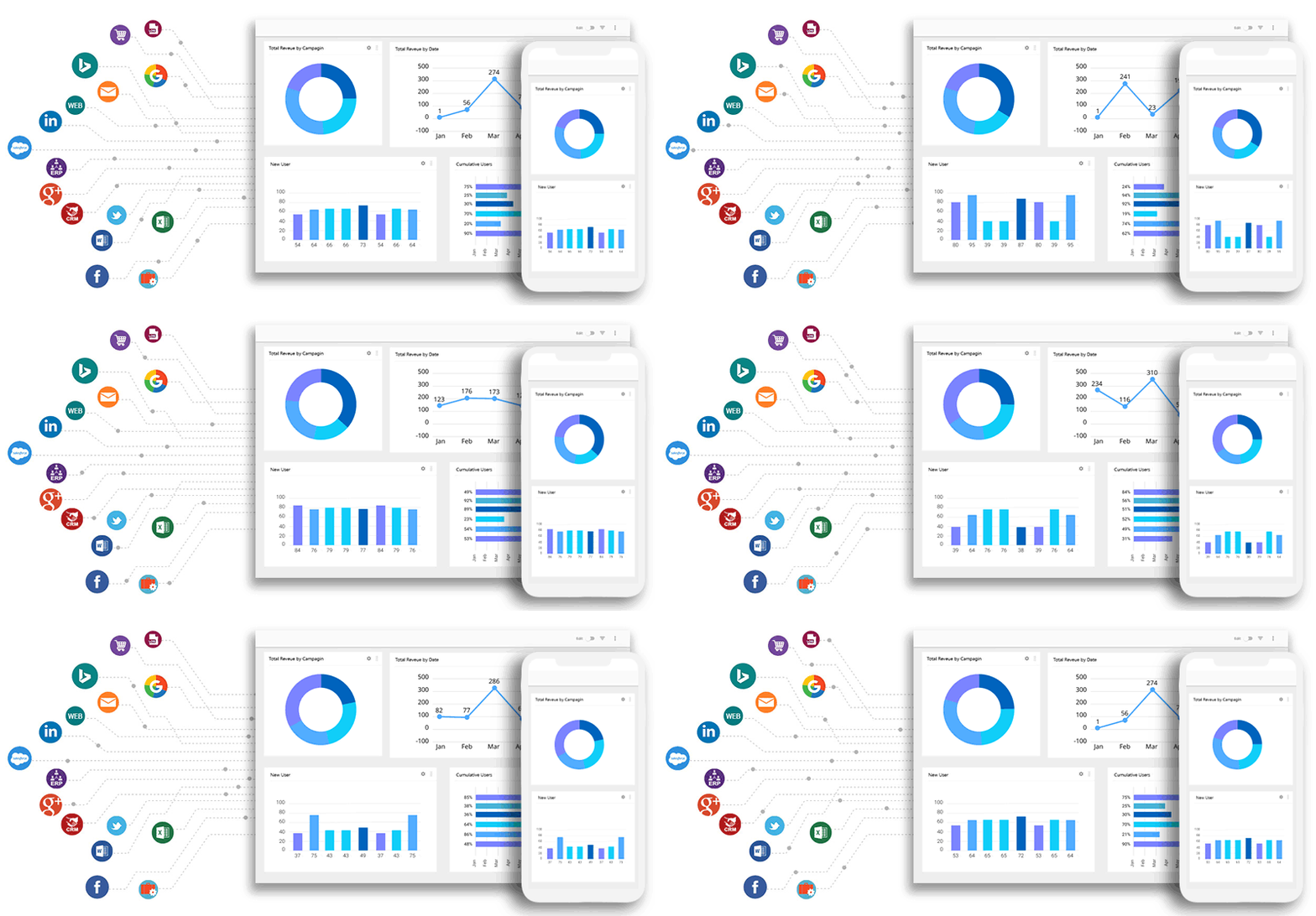
Algorithmic growth requires a campaign structure that favors data liquidity over hyper-segmentation. The fragmentation of the past (thousands of ad groups with a few clicks each) prevents machine learning models from identifying patterns.
The Modern Consolidation Strategy
- Broad Match + Smart Bidding: Broad match is no longer the budget-wasting setting it was a decade ago. When paired with high-quality AI conversion data and VBB, broad match allows the algorithm to find profitable long-tail queries that manual keyword research misses. The algorithm uses the strict conversion value data as a guardrail to prevent irrelevant spend.
- Themed Ad Groups: Group keywords by semantic theme and user intent rather than strict match types. This gives the algorithm a larger pool of data to draw from when testing ad copy against user queries.
- Dynamic Search Ads (DSA) for Gap Coverage: Use DSAs to crawl your site and automatically generate ads for queries you haven’t explicitly targeted, catching the 15% of daily Google searches that are entirely new.
Predictive Modeling for Budget Allocation
A critical aspect of sustainable scaling is knowing when to stop. All advertising channels follow the mathematical law of diminishing returns. As you scale spend, your incremental CPA will inevitably rise.
The relationship between Ad Spend () and Conversions () can generally be modeled using a logarithmic or exponential decay function:
Where:
- represents the maximum potential market capture (the asymptote).
- represents the steepness of the growth curve (efficiency).
To avoid wasting budget, data science teams can use historical data to plot this curve and find the exact point where the marginal cost of an additional conversion exceeds its marginal AI-predicted value.
Below is a Python code block demonstrating how a business might use historical paid search data to calculate the point of diminishing returns using the scipy.optimize library.
Python
import numpy as np
import pandas as pd
from scipy.optimize import curve_fit

# Sample historical data: Ad Spend vs Conversions
data = {
    'ad_spend': [1000, 2000, 3000, 4000, 5000, 6000, 7000, 8000],
    'conversions': [50, 95, 130, 155, 175, 188, 195, 198]
}
df = pd.DataFrame(data)

# Define the diminishing returns function
def diminishing_returns(x, A, k):
    return A * (1 - np.exp(-k * x))

# Fit the curve to the historical data
# p0 is the initial guess for the parameters A and k
popt, pcov = curve_fit(diminishing_returns, df['ad_spend'], df['conversions'], p0=[250, 0.0005])

A_opt, k_opt = popt
print(f"Optimized Maximum Conversions (A): {A_opt:.2f}")
print(f"Optimized Growth Rate (k): {k_opt:.6f}")

# Calculate marginal ROI to find optimal spend
# We want to find where the cost of the next conversion exceeds its value
target_cpa = 50.00 # Maximum acceptable CPA based on AI LTV predictions
optimal_spend = None

for spend in range(1000, 15000, 100):
    marginal_conversions = diminishing_returns(spend + 100, A_opt, k_opt) - diminishing_returns(spend, A_opt, k_opt)
    marginal_cpa = 100 / marginal_conversions if marginal_conversions > 0 else float('inf')

    if marginal_cpa > target_cpa:
        optimal_spend = spend
        break

print(f"To maintain a marginal CPA under \${target_cpa}, optimal scaled spend is \${optimal_spend}")
By utilizing predictive models like this, marketing teams can definitively prove to stakeholders when budget should be shifted away from paid search and into other channels, preventing the erosion of overall profitability.
A Strategic Roadmap for Implementation
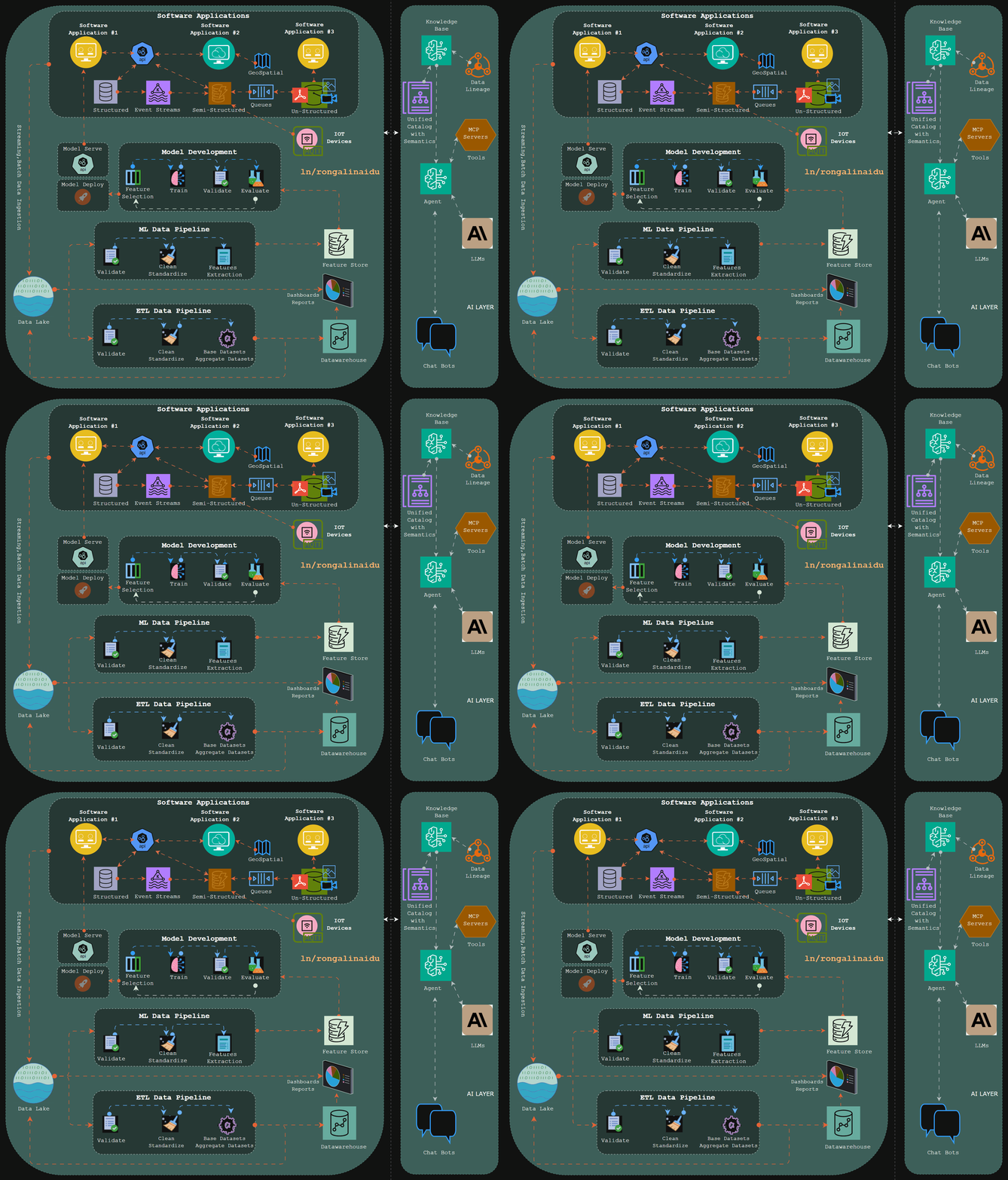
Transitioning your Paid search strategy from manual operations to algorithmic growth is a phased process.
- Phase 1: Data Infrastructure Audit (Weeks 1-2)
Evaluate what conversion signals are currently being sent to the ad platforms. Move from front-end pixel tracking to robust Server-Side Tracking (SST) to ensure data accuracy amid cookie deprecation and ad blockers. - Phase 2: CRM and AI Integration (Weeks 3-6)
Build the bridge between your CRM/database and the ad platform. Implement offline conversion tracking. If full pLTV modeling is not immediately feasible, start with rule-based static values (e.g., assigning different static dollar values to “Demo Booked” vs “Whitepaper Download”). - Phase 3: Campaign Consolidation (Weeks 7-8)
Restructure campaigns to feed the algorithm efficiently. Pause micro-segmented SKAGs and merge them into intent-based, broader ad groups. - Phase 4: Transition to Value-Based Bidding (Weeks 9-12)
Switch bidding strategies from “Maximize Conversions” or “Target CPA” to “Maximize Conversion Value” or “Target ROAS”. Monitor the algorithm’s learning phase closely, resisting the urge to make manual bid adjustments.
Conclusion
The future of Paid search strategy belongs to businesses that view ad platforms not as a place to manually buy traffic, but as machine learning engines waiting to be fed high-quality data. By shifting focus away from keyword bids and towards AI-driven internal data modeling—predictive LTV, dynamic margins, and advanced lead scoring, advertisers can guide these algorithms toward sustainable, highly profitable growth. Algorithmic growth is the definitive mechanism for scaling revenue without scaling waste.


