


Google Warns Against Markdown Website Versions for AI SEO
As businesses look for ways to appear in AI-generated answers, a growing number of website owners are considering machine-focused content formats such as Markdown pages, AI text files, and separate versions of articles designed specifically for large language models.
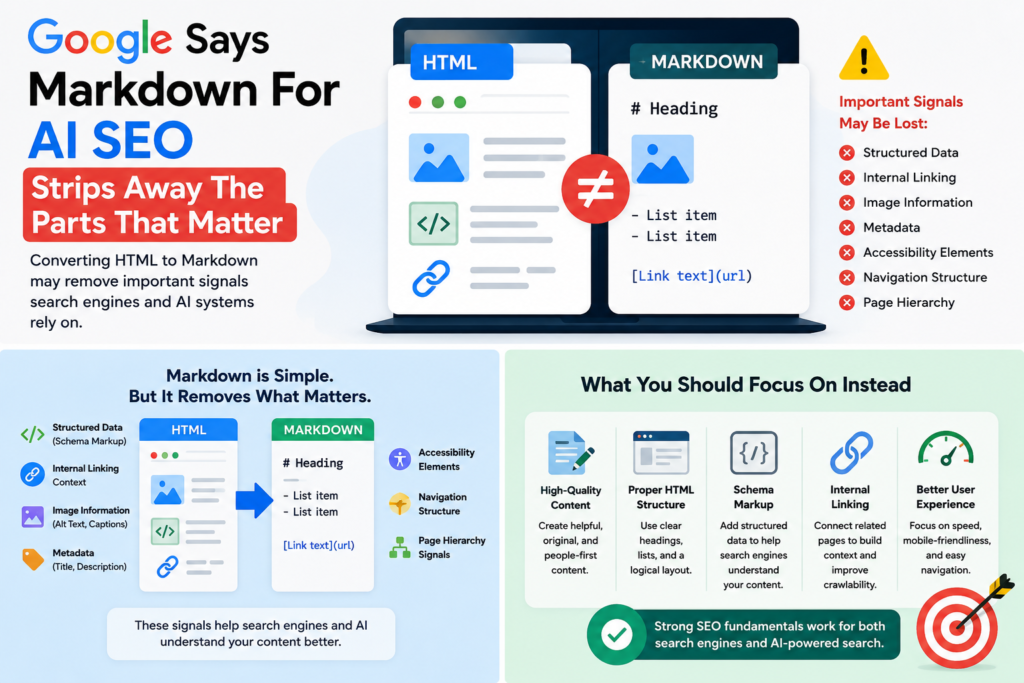
Google’s message is increasingly clear: creating an additional Markdown version of every webpage is not necessary for visibility in Google Search, and may introduce more problems than benefits.
Google Search representatives John Mueller and Martin Splitt recently discussed the drawbacks of maintaining separate HTML pages for users and Markdown pages for AI systems. Their central concern was not that Markdown itself is harmful, but that parallel publishing systems make websites more complicated to operate, test, and maintain. (Search Engine Journal)
Google’s official generative AI optimization guidance reinforces that position. The documentation, updated on June 15, 2026, says publishers do not need special machine-readable files, AI-specific text formats, or Markdown pages to appear in Google’s generative AI experiences. (Google for Developers)
Why Publishers Are Creating Markdown Versions
Markdown is a lightweight text format that uses simple symbols to define headings, links, lists, and other content elements. It is often easier for developers and content systems to process than a complex webpage filled with navigation, advertising, scripts, design components, and interactive features.
That simplicity has led to a theory within the SEO industry: if a clean Markdown version of a page is easier for an AI system to read, providing one might improve the page’s chances of being extracted, understood, or cited.
The strategy usually involves maintaining two versions of the same content:
- A fully designed HTML page for human visitors.
- A simplified Markdown page intended for AI crawlers or language models.
Although the idea appears technically logical, Google’s representatives argue that it solves a problem that well-structured HTML already addresses.
Google Says Parallel Content Creates Twice the Work
The most immediate problem is operational.

A publisher maintaining HTML and Markdown versions must ensure that both contain the same information, remain accessible, and update at the same time. Every content correction, product change, legal notice, statistic, internal link, or editorial update may need to be reflected across both versions.
Splitt noted that producing one version for users and another for automated systems effectively increases the amount of publishing work. Instead of simplifying content delivery, the strategy creates another layer that must be generated, monitored, and repaired. (Search Engine Journal)
For a large publisher, this could mean maintaining thousands of additional URLs or files. For a small business, it could consume development resources that would produce greater returns if invested in improving the primary website.
The issue becomes particularly serious when the two versions fall out of sync. An AI system could access outdated prices, obsolete product details, incorrect business information, or an older version of an article while human visitors see the current information.
Machine-Facing Pages Can Break Without Anyone Noticing
A broken customer-facing webpage is often discovered quickly. Visitors may report it, conversion rates may decline, analytics may reveal a problem, or employees may notice the error while using the website.
A broken machine-facing version is easier to miss.
Mueller warned that users will not necessarily alert a company when an AI-specific page fails because they may never see that version. Automated systems might also encounter incomplete text and still process it without recognizing that important sections are missing. (Search Engine Journal)
This creates a monitoring gap. The business may believe it is providing a clean, optimized version of its content while AI crawlers are receiving outdated, incomplete, or malformed information.
Maintaining an invisible second website therefore requires additional testing, logging, quality assurance, and technical oversight.
Google Compares the Risk to Dynamic Rendering
Google’s representatives connected the Markdown discussion to earlier experiences with dynamic rendering.
Dynamic rendering was used as a temporary solution for JavaScript-heavy websites. Under that model, users received one version of a page while search engine crawlers received a separately rendered version.
Although the approach could solve certain crawling problems, maintaining two representations of the same page often made technical issues harder to diagnose. Splitt said the separation between versions regularly created complications in practice. (Search Engine Journal)
Google’s current documentation describes dynamic rendering as a workaround rather than the preferred long-term solution. The broader lesson is applicable to Markdown publishing: whenever people and machines receive different versions, the risk of inconsistencies increases. (Google for Developers)
Markdown Is Not Banned or Penalized
Google’s comments should not be interpreted as a blanket warning against using Markdown.
Many content management systems allow writers to create content in Markdown before converting it into HTML. Documentation websites, developer portals, repositories, and knowledge bases also use Markdown effectively as part of their publishing workflows.
The concern is specifically about creating a duplicate Markdown version solely because a publisher believes Google’s AI systems require it.
Google states that it can discover and index several types of files, but being indexable does not mean a particular format receives special treatment. Its guidance says AI text files, special markup, Markdown, and files such as llms.txt are not required for visibility in Google Search. (Google for Developers)
Google also says maintaining these files for another service is acceptable. However, for Google Search, they neither improve nor damage rankings because Google does not use them as a special optimization signal. (Google for Developers)
HTML Still Provides Important User Benefits
A raw Markdown document cannot provide the same experience as a properly designed website without an additional system converting or presenting it.
HTML pages can combine text with navigation, branding, responsive layouts, accessibility features, images, video, interactive tools, forms, product information, and conversion elements. Splitt emphasized that visual presentation matters to users and that recreating those capabilities around Markdown ultimately begins to resemble building another browser or HTML-rendering layer. (Search Engine Journal)
Google’s official guidance similarly recommends organizing information with clear paragraphs, sections, and headings while supporting text with relevant images and videos where they improve the user experience. (Google for Developers)
For marketers and business owners, this is an important distinction. The objective is not simply to make content easy for a machine to extract. A successful page must also help a visitor understand the information, trust the business, and take the next step.
What Google Recommends for AI Search Visibility
Google’s position is that the foundations of SEO continue to apply to generative search experiences such as AI Overviews and AI Mode.
According to its official guidance, these experiences rely on Google’s existing Search index, ranking systems, and retrieval processes. A page generally needs to be crawlable, indexed, and eligible to appear with a search snippet before it can be considered for Google’s generative AI features. (Google for Developers)
Rather than creating duplicate AI pages, website owners should concentrate on several established priorities.
Create Content That Adds Original Value
Google recommends publishing useful, non-commodity content with unique expertise, first-hand experience, or an original point of view.
A generic article that restates widely available information may provide little reason for either users or AI-powered search systems to select it over competing sources. Content based on proprietary research, real customer questions, specialist knowledge, practical testing, or direct business experience is more likely to offer distinctive value. (Google for Developers)
Improve the Existing HTML Page
Publishers should make their primary pages easier for both humans and automated systems to process.
That includes:
- Using descriptive headings.
- Dividing long text into logical sections.
- Keeping essential information in crawlable page content.
- Providing clear internal links.
- Using descriptive page titles and metadata.
- Making navigation understandable.
- Ensuring the main content is distinguishable from surrounding elements.
Google says perfectly valid semantic HTML is not mandatory, but using meaningful HTML where practical can improve navigation for assistive technologies and other users. (Google for Developers)
Keep Important Content Crawlable and Indexable
A strong article cannot appear in search experiences if Google cannot reliably access it.
Businesses should check that important pages are not accidentally blocked by robots.txt, noindex directives, login requirements, faulty JavaScript, or incorrect canonical tags. Website owners can use Google Search Console to identify indexing and crawling problems. (Google for Developers)
Reduce Unnecessary Duplicate Content
Creating separate AI-facing URLs can add duplication and consume crawling resources.
Where multiple versions are genuinely necessary—for example, print pages, regional content, or syndicated materials—publishers should use appropriate canonicalization and URL management. However, creating extra pages without a clear user or business purpose may add technical debt without improving AI visibility.
Google specifically advises reducing duplicate content where possible because it can create a poor user experience and cause search engines to spend resources on URLs the publisher does not consider important. (Google for Developers)
Use Structured Data for Its Intended Purpose
Structured data remains useful because it can help pages qualify for supported rich results. However, Google says there is no special schema markup required for generative AI search.
Businesses should continue implementing accurate, relevant structured data rather than adding unsupported markup based on speculative AI SEO claims. (Google for Developers)
What This Means for Small Businesses
The warning is especially relevant for SMEs with limited technical and content resources.
Maintaining a second machine-oriented version of a website could require additional development, hosting, monitoring, editorial controls, and troubleshooting. Unless another platform explicitly requires that format and the business has a clear use case, those resources may be better directed toward the main website.
A local service provider, retailer, or professional firm is likely to gain more from:
- Publishing detailed answers to real customer questions.
- Keeping service and product information accurate.
- Improving mobile usability and page speed.
- Adding original photos and videos.
- Maintaining its Google Business Profile.
- Strengthening internal links and site navigation.
- Monitoring important pages in Search Console.
Google’s guidance indicates that local and ecommerce businesses can also support visibility by maintaining accurate information through tools such as Google Business Profile and Merchant Center. (Google for Developers)
The Bigger AI SEO Lesson
The discussion reflects a broader challenge in AI SEO: businesses are being encouraged to adopt new files, formats, acronyms, and optimization techniques before clear evidence shows that those additions provide value.
Google does not argue that AI search requires no optimization. Instead, it describes AI visibility as an extension of established search optimization.
Its guidance emphasizes content quality, technical accessibility, user satisfaction, crawlability, and a strong page experience. It specifically advises publishers not to overinvest in tactics such as AI-only files, excessive content chunking, manufactured mentions, or rewriting every page in a style intended solely for machines. (Google for Developers)
Conclusion
Google’s warning does not mean Markdown is inherently bad for websites. It means publishers should be cautious about creating and maintaining a duplicate Markdown website purely for AI SEO.
Parallel versions can double publishing work, introduce inconsistencies, and allow machine-facing errors to remain undetected. More importantly, Google says special Markdown pages are not required to appear in its generative AI search features.
For most businesses, the stronger strategy is to improve the website they already have: publish distinctive and trustworthy information, use clear HTML structure, maintain crawlability, support content with useful visuals, and deliver an experience that works well for real visitors.
In the race for AI visibility, a better primary website is likely to be a more sustainable investment than an invisible second one.


