


Google Rebrands NotebookLM to Gemini Notebook With New AI Research Upgrades
Google is giving one of its most useful AI research tools a new name.
NotebookLM is now Gemini Notebook, a rebrand that brings the product more clearly into Google’s Gemini ecosystem while keeping it available as a standalone research assistant. Google says the new name reflects how the product will do more across the Google ecosystem, including inside the Gemini app and Google Search.
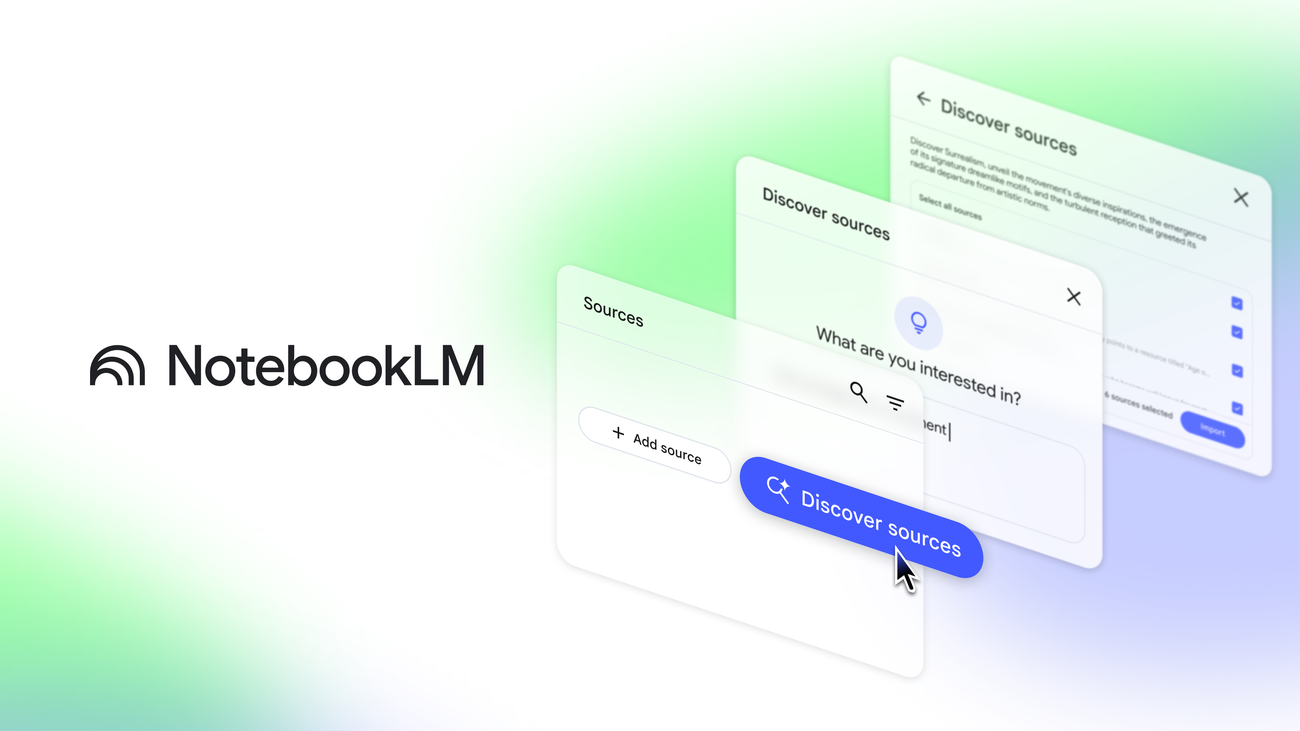
For users, this is not just a cosmetic change. Gemini Notebook is being positioned as a more connected research workspace: a place where people can upload sources, organize knowledge, generate summaries and, with new upgrades, perform deeper analysis using a secure cloud computer.
For students, researchers, marketers and small businesses, the change signals Google’s broader strategy: Gemini is no longer just a chatbot. It is becoming a connected productivity layer across research, writing, analysis and search.
What Is Gemini Notebook?
Gemini Notebook is the new name for NotebookLM, Google’s AI-powered research and note-taking tool.
NotebookLM was originally introduced at Google I/O 2023 as Project Tailwind, with a focus on helping users learn from their own sources. Google says more than 30 million people and over 600,000 organizations are now using the tool.
The core idea remains the same: users add documents, notes, links or other sources, and Gemini Notebook helps them understand, summarize and work with that material.
Unlike a general chatbot, Gemini Notebook is built around source-grounded research. That makes it especially useful for tasks where accuracy, context and document-specific answers matter.
Why Google Changed the Name From NotebookLM
Google says NotebookLM is being renamed to Gemini Notebook to reflect its deeper role inside the Gemini ecosystem. The product remains standalone, but the branding now makes it clearer that it is part of Google’s wider AI family.
The rebrand also helps solve a product-positioning issue.
NotebookLM became popular as a research assistant, but the name did not clearly connect it to Gemini, Google’s flagship AI brand. By renaming it Gemini Notebook, Google makes the relationship more obvious for users who already use Gemini in Search, Workspace or the Gemini app.
This matters because Google is increasingly connecting AI tools across products rather than leaving them as separate experiments.
What Changes for Existing NotebookLM Users?
For current users, the transition should be straightforward.
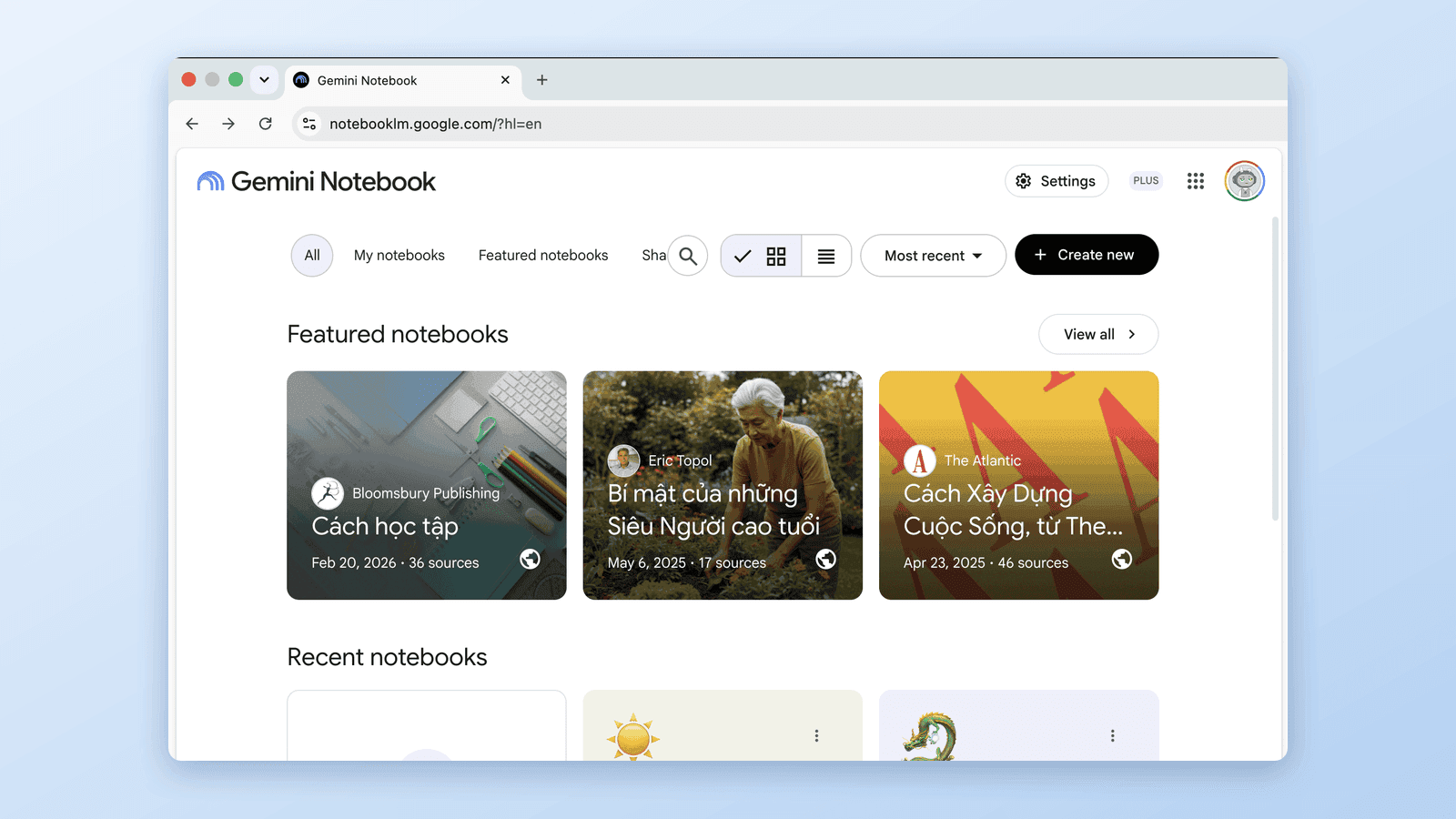
Google says users will see the new Gemini Notebook name and logo roll out across different interfaces over the next several weeks. Admins do not need to take action, and automatic redirects will keep existing shared notebooks and user links working.
That means existing notebooks, links and workflows should continue to function.
End users may need to update the mobile app, depending on their device and rollout timing. The change affects Google Workspace customers, Workspace Individual subscribers and personal Google account users with access to NotebookLM.
The Biggest Upgrade: A Secure Cloud Computer
The most important functional upgrade is not the new name. It is the addition of a secure cloud computer for deeper research and analysis.
Google says Gemini Notebook is rolling out an update that gives every notebook access to a secure cloud computer. This allows the tool to write and execute code natively, helping users perform complex data analysis grounded in their sources.
This is a major shift.
Previously, NotebookLM was strongest as a source-based summarization and research tool. With secure code execution, Gemini Notebook becomes more useful for analytical workflows, especially when users need to work with data, tables, reports or structured information.
For example, users may be able to ask Gemini Notebook to analyze data from uploaded sources, identify trends, create comparisons or support more technical research tasks.
Who Gets the Secure Cloud Computer Feature First?
Google says the secure cloud computer upgrade is available now for Google AI Ultra users and Workspace business customers with AI Ultra Access and AI Expanded Access. The feature will roll out to Pro users on the web over the coming weeks.
This staged rollout shows that Google is treating advanced notebook analysis as a premium productivity feature.
For businesses, that may make Gemini Notebook more attractive as part of an AI-enabled Workspace setup. For individual users, access may depend on their Google AI plan and the timing of the rollout.
Gemini Notebook Will Sync Across Google Products
Google also says Gemini Notebook will become more connected across its products.
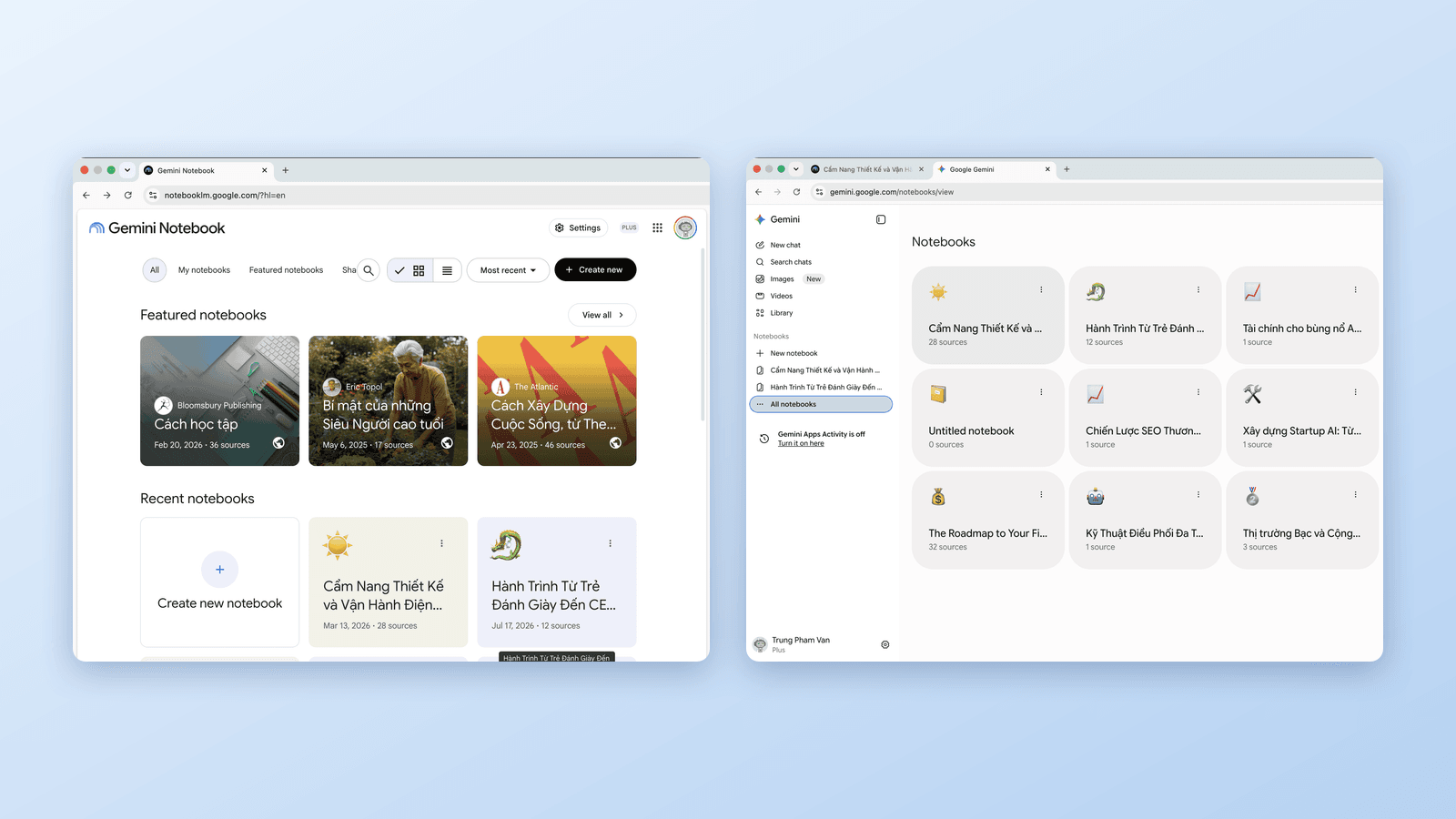
Users can already access and create notebooks directly within the Gemini app, with full cross-app syncing between the Gemini app and the standalone Gemini Notebook experience. Google also plans to bring notebooks directly into AI Mode in Search.
This is an important strategic move.
Instead of treating notebooks as isolated research spaces, Google is making them portable across the places where users already ask questions, search for information and work with AI.
A user could begin a project in Gemini, continue organizing sources in Gemini Notebook, and later access notebook context through Search’s AI Mode.
Why This Matters for Marketers and Content Teams
For marketers, Gemini Notebook could become a practical research and content planning tool.
Marketing teams often work with scattered materials: customer interviews, campaign briefs, website analytics, competitor research, transcripts, sales notes, product documents and industry reports.
Gemini Notebook can help organize those materials into one source-grounded workspace.
Useful marketing workflows may include:
- Summarizing customer research
- Turning sales notes into buyer personas
- Comparing competitor messaging
- Creating campaign briefs from internal documents
- Analyzing survey responses
- Building content outlines from source material
- Reviewing product positioning
- Preparing podcast or webinar research
- Creating internal training guides
The value is not only faster writing. It is better source management.
Instead of asking a general AI tool to guess, teams can give Gemini Notebook specific source material and ask it to work from that context.
Why This Matters for SMEs
Small and medium-sized businesses may benefit from Gemini Notebook because it can reduce the friction of research-heavy work.
Many SMEs do not have dedicated research, strategy or operations teams. A business owner may need to review supplier documents, customer feedback, sales data, contracts, training materials and marketing plans while also running the company.
Gemini Notebook could help turn that information into usable summaries, checklists, training notes or decision support.
For example, an SME could use Gemini Notebook to:
- Create onboarding materials from internal documents
- Summarize customer complaints and feedback
- Compare vendor proposals
- Organize product manuals
- Build staff training guides
- Prepare meeting briefs
- Analyze simple business data
- Turn market research into action plans
The new secure cloud computer upgrade may make the tool especially useful when business documents include numbers, tables or structured datasets.
Why This Matters for Students and Researchers
Gemini Notebook has already become popular among students and researchers because it is designed around learning from uploaded sources.
The rebrand does not remove that core use case. In fact, the deeper Gemini integration could make the product more useful for academic and professional research.
Students can use Gemini Notebook to summarize lecture notes, explain difficult readings, create study guides or compare themes across multiple sources.
Researchers can use it to organize papers, extract key arguments, identify contradictions and prepare literature review notes.
The secure code execution upgrade could also help users perform data analysis directly within a notebook, depending on their access tier.
Gemini Notebook Is Not Just a New Logo
At first glance, the change from NotebookLM to Gemini Notebook may look like a simple branding update.
But the move is bigger than that.
Google is aligning its research assistant with the broader Gemini ecosystem, adding secure code execution and preparing notebook access across Gemini and Search.
That means Gemini Notebook is becoming part of a larger AI workflow:
- Gemini for conversation and assistance
- Gemini Notebook for source-grounded research
- Search AI Mode for discovery and follow-up exploration
- Workspace integrations for business productivity
For users, this could reduce the need to move information manually between tools.
For Google, it strengthens Gemini as the central brand for AI-powered work.
What Businesses Should Do Now
Businesses already using NotebookLM should review how the rebrand affects their workflows.
The immediate priority is not to change tools, but to understand the new capabilities and access levels.
Teams should:
- Check whether their accounts have access to Gemini Notebook.
- Confirm whether existing notebook links still work.
- Update internal documentation that refers to NotebookLM.
- Review whether mobile app updates are needed.
- Test Gemini app syncing.
- Identify research workflows that could benefit from source-grounded AI.
- Evaluate whether premium access is needed for secure code execution.
For Workspace admins, Google says no action is required, but organizations should still communicate the name change to employees to avoid confusion.
Practical Use Cases for Gemini Notebook
1. Campaign Research
Marketing teams can upload market reports, customer interviews and competitor pages, then ask Gemini Notebook to identify trends, audience pain points and content opportunities.
2. Sales Enablement
Sales teams can use Gemini Notebook to summarize product documentation, objection-handling notes and customer case studies into quick reference guides.
3. Training and Onboarding
HR and operations teams can turn policy documents, handbooks and role guides into onboarding notebooks for new employees.
4. Data-Backed Content Planning
With secure code execution, users may be able to analyze structured data and turn findings into reports, charts or content briefs.
5. Academic Study
Students can upload notes, readings and lecture materials, then generate study guides, summaries and explanations based on their actual course content.
6. Executive Briefings
Business leaders can use Gemini Notebook to summarize multiple documents before meetings, helping them understand key issues faster.
The SEO and Content Strategy Angle
Gemini Notebook may also influence how content teams research and produce SEO content.
Instead of asking AI to create generic articles from memory, teams can build notebooks around verified sources, brand documents, search data and customer research.
This can improve content quality because the AI is grounded in specific material.
For SEO teams, Gemini Notebook can support:
- Source-based article briefs
- Competitor content analysis
- Topic cluster planning
- Search intent research
- Internal knowledge-base creation
- Product documentation summaries
- Expert interview analysis
This does not remove the need for human editors. It makes the research stage more efficient and organized.
Key Risks and Limitations
Gemini Notebook can be powerful, but users should still apply human judgment.
AI summaries can miss nuance, misinterpret sources or overstate conclusions. Code execution can support analysis, but users should still verify formulas, assumptions and outputs.
Businesses should also be careful with sensitive or confidential material. Before uploading documents, teams should review company policies, Workspace controls and privacy requirements.
A practical rule is simple: use Gemini Notebook to accelerate research, but do not outsource final judgment.
Conclusion: Gemini Notebook Shows Where Google AI Is Heading
Google’s rebrand of NotebookLM to Gemini Notebook is more than a naming update.
It shows Google’s plan to make Gemini a connected layer across research, productivity and search. Gemini Notebook remains a standalone research tool, but it is now more clearly tied to the Gemini app, Google Search and advanced source-grounded analysis.
The secure cloud computer upgrade is especially important because it moves the product beyond summaries and into deeper analytical work.
For marketers, SMEs, students and researchers, Gemini Notebook could become a valuable workspace for turning scattered information into structured insight.
The biggest takeaway is simple: Google is turning notebooks into AI-powered research environments. The teams that benefit most will be those that use Gemini Notebook not just to summarize information, but to organize knowledge, analyze sources and make better decisions.


