


This week’s updates feel especially connected, though. They point toward a future where the tools we use talk to each other more directly, where automation does the heavy lifting, and where discovery becomes more conversational and less mechanical. If you look closely, there is a quiet pattern forming. Browsers are becoming assistants. Feeds are becoming the backbone of e-commerce. Search platforms are leaning into structure. And ad ecosystems keep lowering the walls between organic and paid data.
Let’s walk through what changed and why it matters.
ChatGPT Atlas: A Browser Built Around Context and Agentic Workflows
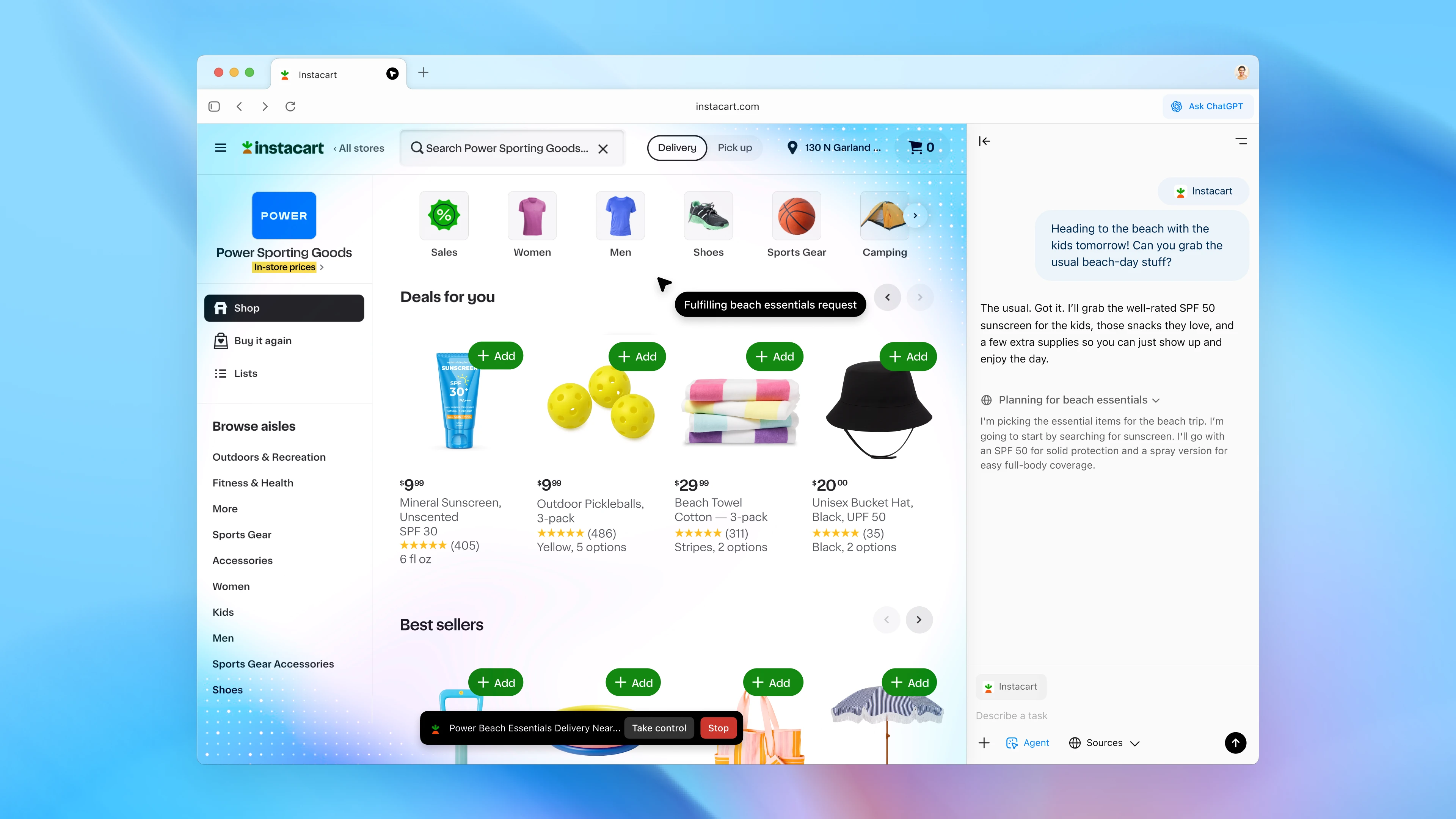
The new ChatGPT Atlas browser is one of those releases that makes you pause for a second. We have lived with browsers that act like empty windows for years. Atlas flips that idea. It brings ChatGPT into the core experience so that every page you open can be understood, summarized, compared, or turned into an action.
What makes this interesting is how it handles memory. Atlas can retain context in ways that feel natural. If you are researching a project, switching tabs, copying notes, or reviewing references, the browser quietly keeps track of what matters. It means you do not lose your flow every time you jump between tasks. The agent mode takes it further by letting ChatGPT perform multi-step actions inside the browser. Think data extraction, workflow automation, or step-by-step research without juggling windows. It creates a more fluid space for people who work across many tabs or who often rely on AI to complete tasks.
For now, Atlas is available on Mac, and OpenAI says more platforms are on the way. It supports users across all tiers, which signals that this is not just a pro-level tool. It is shaping up to be a new computing baseline.
Source:
OpenAI Atlas Announcement
Google Business Profiles: Scheduling, Streamlined Publishing, and Better Local Management

Google has quietly upgraded Business Profiles with features that solve long standing frustrations. Scheduling Google Posts is now built in. You can set announcements, event reminders, offers, photos, or updates to publish at specific times without needing a third party scheduler. That alone simplifies weekly planning for marketers and agencies.
The bigger shift is multi location publishing. Instead of repeating the same upload across branches or franchises, Google now lets you publish one update to several locations at once. Businesses with multiple outlets benefit immediately. Agencies with many clients feel the relief too because the platform finally acknowledges how real world businesses operate.
These updates matter more than they seem. Google Posts influence local visibility, engagement, and overall profile activity. When the publishing process becomes easier, consistency improves. And consistency is one of the indicators Google uses when evaluating the relevance and reliability of a business.
Source:
Search Engine Land
ChatGPT Shopping Feeds for Generative Engine Optimization: A New Layer of Ecommerce Discovery

This is the update many marketers underestimated. ChatGPT Shopping is shifting fully into structured merchant feeds through the Agentic Commerce Protocol. Instead of relying mainly on crawling, the platform treats the feed as the primary source of truth. That changes the way products appear in generative engine optimization.
Think about what this means. The clarity and richness of your data directly influence how your products are understood in conversational queries. If the feed contains high quality images, videos, 3D visuals, ratings, return rates, and variant level details, ChatGPT can generate responses that feel genuinely helpful. It can recommend products with context, nuance, and personalization. If the data is incomplete, the product simply fades into the background.
OpenAI recommends refreshing feeds every fifteen minutes if possible. It is a hint that recency and accuracy matter more than ever. Optional fields inside the feed also offer new levers for marketers who want control over how products rank and appear. This is where generative engine optimization becomes more data driven. The brands that invest in their feed quality stand out in natural language discovery.
Source:
OpenAI Shopping Research
Google’s Auto Linking Update: Seamless Integration Between YouTube Channels and Google Ads
Google is rolling out automatic linking between YouTube channels and Google Ads accounts whenever it detects a strong connection between the two. For many advertisers, this reduces one of the most tedious setup steps. Once linked, the advertiser gets access to audience data, remarketing pools, watch behavior, and view based conversion insights. It becomes easier to select videos for campaigns and track combined performance.
The auto linking process still respects privacy and permissions. Channel owners and Ads admins receive notifications thirty days before the link happens. Anyone can opt out. Both sides can unlink at any time. The difference now is that Google handles the friction points, which helps small teams and new advertisers get up and running quickly.
For marketers who work with creators or manage hybrid organic paid funnels, this update speeds up execution and improves the visibility of cross channel impact. It also tightens the circle between video consumption and advertising intent.
Source:
Search Engine Land
Action Steps for Marketers
- Download or test ChatGPT Atlas to explore automation and smoother research workflows.
- Use Google Business Profile scheduling and multi location publishing to improve your local content strategy.
- Audit your shopping feed and fill in rich media, ratings, variants, and optional structured fields for stronger generative engine optimization.
- Monitor YouTube auto linking notifications and confirm permissions so your Ads account accesses audience signals correctly.


